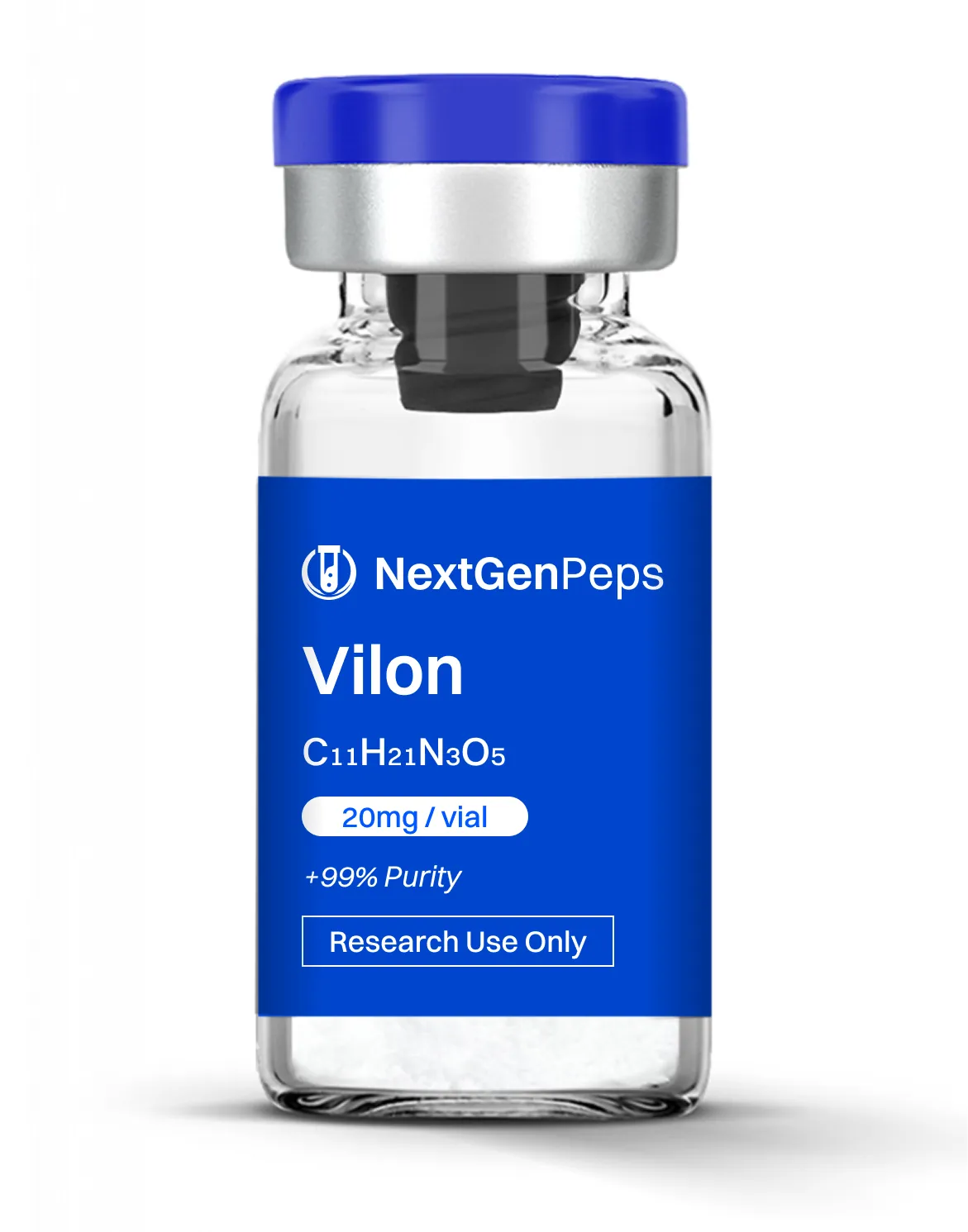
How is Vilon packaged?
Vilon is supplied in the product format and quantity shown for the selected variant. Please inspect the sealed package when it arrives and contact support promptly if the package or labeling appears damaged.
Out of stock
Vilon research vials, a short synthetic peptide supplied for laboratory use. Purity and endotoxin tested, with the certificate of analysis published.
Vilon is a high-purity, research-grade synthetic dipeptide developed for laboratory studies of immune regulation, thymic cell function, and gene-level control in target cells.
Molecular Composition and Mechanistic Profile
Vilon (Lys-Glu, or KE): A two-amino-acid peptide with the sequence lysine-glutamic acid. Molecular weight is approximately 275 Da (formula C11H21N3O5). It was identified as a minimal active fragment from thymic extracts within the Khavinson bioregulator series and is one of the shortest peptides studied in this framework.
Structural characteristics: The small size supports cell and nuclear penetration along with proposed interactions with DNA and chromatin. Research models suggest it can influence chromatin structure (including decondensation of heterochromatin regions), gene expression related to immune cell differentiation, and pathways involving cytokines, proliferation markers, and DNA repair proteins such as sirtuins and PARPs.
Experimental data from the originating research program indicate associations with support for T-cell related markers, modulation of inflammatory cytokine profiles in certain models, chromatin remodeling in aged lymphocytes, and lifespan or tumor incidence effects in rodent studies when administered chronically.
Integrated Research Applications
Vilon is formulated to support focused investigation of short-peptide effects on immune and related pathways. Representative research domains include:
In vitro models examining lymphocyte or thymic cell differentiation markers, gene expression patterns, chromatin structure, and cellular responses under controlled or aging-related conditions.
Preclinical studies of immune modulation, recovery after stress or challenge, spontaneous tumor incidence, and lifespan parameters in rodent models.
Exploratory work on DNA repair signaling, cytokine balance, and interactions with other short bioregulators.
Using Vilon as a single, well-characterized entity allows researchers to evaluate tissue-oriented signaling without the variability of complex tissue extracts.
Analytical Validation and Quality Assurance
Commercial research preparations of Vilon are typically specified at high purity (often ≥98–99%) and characterized by HPLC and mass spectrometry. These methods confirm identity, sequence integrity, and batch consistency for laboratory use.
Storage and Stability Guidelines
Proper storage preserves structural integrity and experimental reproducibility. Typical guidance for lyophilized Vilon includes:
Room temperature (unopened, lyophilized): Suitable for limited periods when sealed, dry, and protected from light.
Refrigerated storage (2–8 °C): Appropriate for medium-term maintenance of unopened or reconstituted material used over days to weeks.
Frozen storage (≤ −20 °C, preferably lower for long-term): Recommended for extended timelines, with vials kept well sealed to limit moisture and degradation.
Reconstituted solutions are generally stored cold, protected from light, and used within a defined experimental window according to local lab practices to maintain activity and limit contamination risk.
Vilon is supplied in the product format and quantity shown for the selected variant. Please inspect the sealed package when it arrives and contact support promptly if the package or labeling appears damaged.
Orders are shipped within the United States via USPS. Transit times are typically 3–7 business days, depending on destination and carrier conditions. Tracking information is provided when available.
Storage requirements are product-specific. Keep Vilon in its original labeled container and follow the product documentation or manufacturer instructions supplied with the order. Contact support if the applicable storage guidance is not available.
Due to the nature of research materials, NextGenPeps orders are final and are not eligible for refunds, returns, or exchanges. Review the shipping and reship policies before ordering.
No. NextGenPeps materials are supplied strictly for laboratory research and development use and are not intended for human or animal consumption, clinical use, diagnostic use, cosmetic use, or dietary use.
Vilon is a synthetic dipeptide made of just two amino acids, lysine and glutamic acid, which makes it one of the shortest bioactive peptides known to science. Vilon was modeled on the active short peptides found in Thymalin, and is considered one purified, defined fragment of that older thymic preparation, studied for decades in Russia.
Research suggests Vilon acts on gene expression rather than functioning like a typical drug studies describe it reactivating genes that become silenced with age through a process called chromatin remodeling. In lab studies, it's been shown to stimulate thymocyte activity and promote transformation into proliferating cells, and separate research found it raised expression of CD5, a marker tied to T-cell differentiation, in animal derived thymic tissue. Some studies have also looked at its potential role in reducing the prevalence of certain tumor types in animal models.
The closest comparison is Thymogen, since a related immunomodulatory dipeptide was isolated from Thymalin around the same time Vilon was synthesized, giving the two a shared origin and similar short chain thymic structure. Vilon is also frequently grouped with Epitalon, a pineal gland derived tetrapeptide studied by the same research group the two work through different mechanisms, with Epitalon linked to telomerase activity and Vilon linked to chromatin/gene accessibility effects, but they're often discussed together in bioregulator research.
✓ 99.748% purity
✓ 99.62% purity
✓ 99.310% purity
✓ 99.73% purity
✓ 99.715% purity