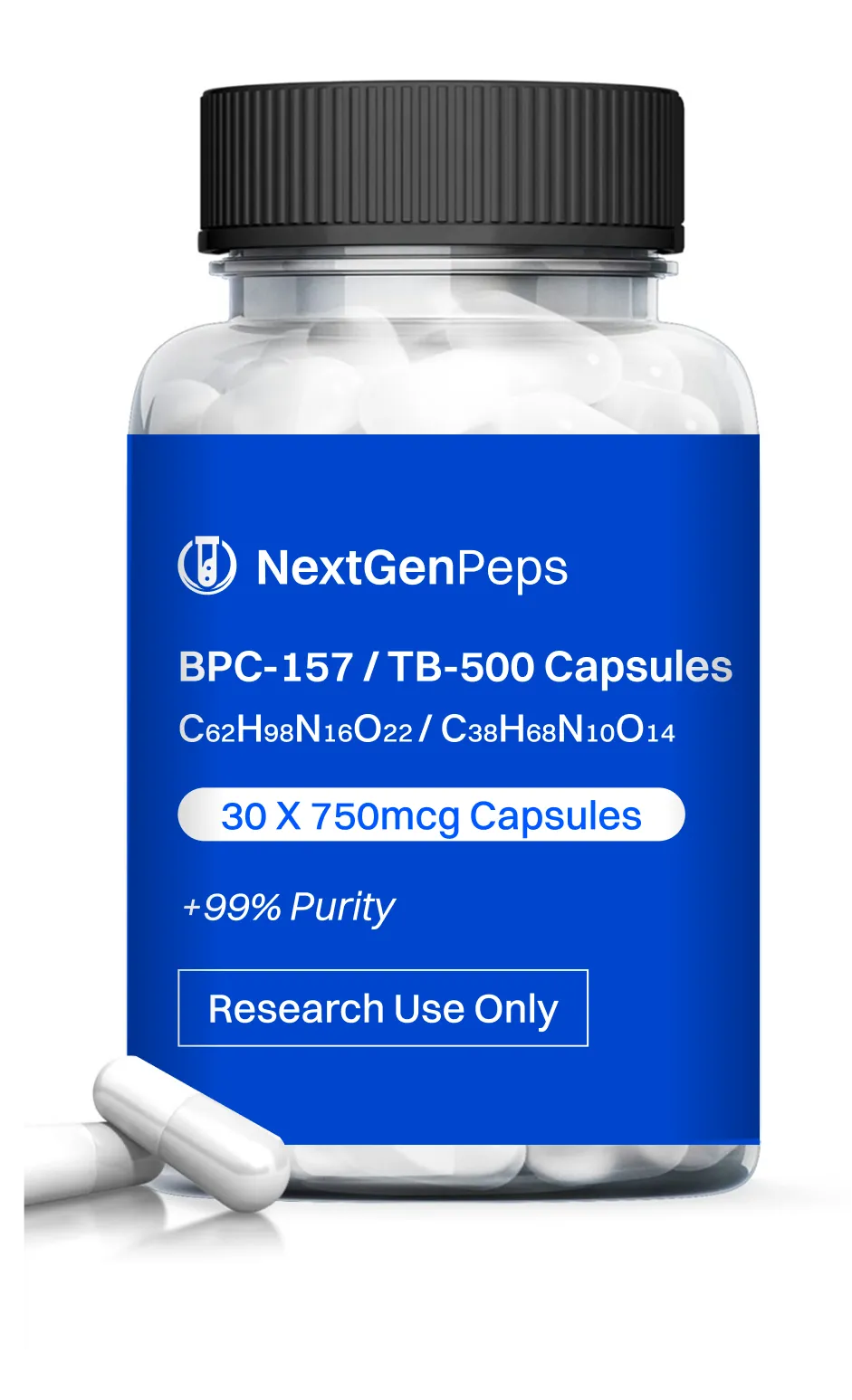
BPC-157 and TB-500 capsules, in brief. Repairing an injury takes several steps: blood vessels have to grow back into the damaged area, and repair cells have to move in and rebuild it. BPC-157 and TB-500 are two unrelated peptides that have each been studied for one of those steps. BPC-157 is linked mainly to new blood vessel growth, and TB-500, derived from the actin-binding protein thymosin beta-4, mainly to cell movement. In one rat study of repaired Achilles tendons, TB-500 given alone by injection made the tendon significantly stronger and BPC-157 alone added collagen, but the two together did no better than either one [1]. These capsules put both peptides in an oral format, and the oral evidence for the two is very different. BPC-157 stays intact in gastric juice for more than a day, and rats given it in drinking water healed several gut and bladder injuries [2,3]. For TB-500, no study was found that gave it by mouth, so whether it survives digestion and reaches tissue intact is unknown. NextGenPeps supplies BPC-157 and TB-500 capsules, listed at 250 mcg of each peptide per capsule, for laboratory use only.
What do BPC-157 and TB-500 do?
In animal and cell studies, each peptide speeds a different part of tissue repair. BPC-157 work centres on blood vessels growing back into an injury, and thymosin beta-4 work centres on repair cells moving in [4,5].
In animal studies that has meant three things:
Tendon. In rats with a surgically repaired Achilles tendon, the TB-500 group had the strongest tendons at four weeks, and the BPC-157 group laid down more type I collagen than controls [1].
Fistulas and gut injuries, by mouth. BPC-157 given in drinking water closed surgically made fistulas in rats, including fistulas between the bladder and vagina and between gut and skin [2,3].
Blood vessels and cell movement. BPC-157 raised the vessel growth receptor VEGFR2 in endothelial cells and sped blood-flow recovery in rat hind-limb ischemia [4]; thymosin beta-4 drives cell migration and new vessel growth [5].
What the pair adds over its parts is not established, and the only combination study found no added benefit [1].
NextGenPeps supplies BPC-157 and TB-500 capsules for in vitro research and approved animal studies only. They are not sold as a drug, supplement or diagnostic.
How do BPC-157 and TB-500 work?
They act on different parts of the repair process: BPC-157 on blood vessel growth signalling, TB-500 on the actin machinery that lets cells move.
BPC-157. In cultured endothelial cells BPC-157 raised levels of VEGFR2, the main receptor for the vessel growth factor VEGF, and switched on the VEGFR2, Akt and eNOS chain that produces nitric oxide [4]. In fibroblasts from rat Achilles tendon it did not speed cell division but increased outgrowth, survival under oxidative stress and migration through the FAK and paxillin adhesion pathway [6].
TB-500. Thymosin beta-4 is the main protein that binds and stores single actin units inside cells, the building blocks of the filaments a cell uses to change shape and crawl. Outside cells it has been linked to cell migration, new vessel growth and lower inflammation in injured tissue [5]. The actin-binding work is done by a seven-residue stretch, LKKTETQ, which matched the full protein in endothelial migration and vessel sprouting assays [7]. That stretch, N-acetylated, is the TB-500 listed for these capsules.
What did BPC-157 and TB-500 do in animal studies?
Rat tendons healed stronger, and rat fistulas closed. The tendon result comes from injected peptides; the fistula results come from BPC-157 given by mouth.
Both peptides, injected, in rat tendons. In a 2026 study, rats had the Achilles tendon cut and surgically repaired, then received daily intraperitoneal vehicle, BPC-157, TB-500 described as a synthetic peptide derived from thymosin beta-4, or both, for four weeks (8 rats per group). Median load to failure was 26.9 N in controls, 37.2 N with BPC-157, 37.4 N with TB-500 and 34.5 N with both (Figure 1). Only TB-500 differed significantly from control (P=0.04). Under the microscope, TB-500 gave the best tendon healing scores, BPC-157 increased type I collagen (P=0.009), and the combination improved one healing score (P=0.04) without beating either peptide alone. Mechanical testing used only four tendons per group [1].
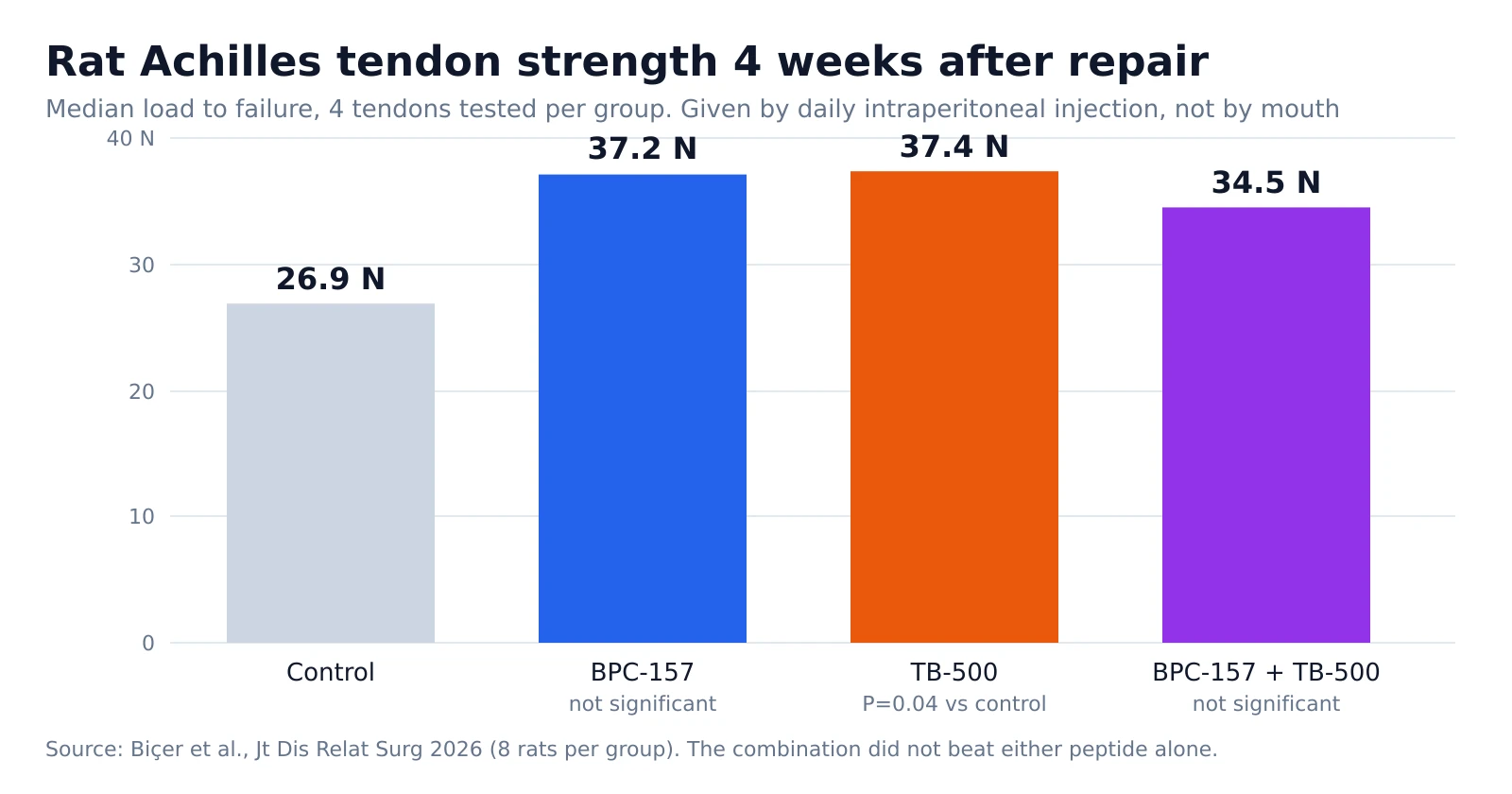
Figure 1. Rat Achilles tendon strength four weeks after repair. Median load to failure, four tendons tested per group; peptides were injected, not given by mouth. Source: Biçer et al., Jt Dis Relat Surg 2026.[1]
BPC-157 by mouth, in rat fistulas. In a 2021 study, female rats had a 4 mm fistula made between the bladder and vagina, and two weeks later received BPC-157 daily in drinking water or by intraperitoneal injection, with 6 rats per group at each time point up to six weeks. With both routes, urine stopped leaking through the vagina within the first week of therapy in every treated rat, while controls kept leaking. By the fourth week the treated bladders held five times more fluid before leaking than control bladders, matching healthy rats. Both the bladder and vaginal defects closed in treated rats, and none formed bladder stones, against stones in all controls at the later time points [3]. A review from the same research group reports similar closure of gut-to-skin, colon-to-bladder and rectum-to-vagina fistulas in rats given BPC-157 in drinking water [2]. Most of the oral BPC-157 work comes from that one group.
Does oral TB-500 work?
It has not been shown. No published study was found that gave TB-500, in either form, to animals by mouth, so oral activity is untested rather than disproven.
The two peptides in these capsules differ sharply in what is known about the oral route (Figure 2):
BPC-157. It is described as native and stable in gastric juice for more than 24 hours in vitro, which is unusual for a peptide, and it has healed injuries in rats when given in drinking water [2,3]. Its oral absorption has still not been measured: the pharmacokinetic work in rats and dogs used intravenous and intramuscular dosing only, and found a half-life under 30 minutes [8].
Full-length thymosin beta-4. A 43-residue protein of about 5 kDa. Proteins of this size generally face the digestive enzymes and the barrier of the gut wall that keep most peptides and proteins from being absorbed intact by mouth [9]. No oral stability, absorption or efficacy data for it were found.
The LKKTETQ fragment. At seven residues and 889 g/mol it is far smaller, but no oral stability, absorption or efficacy data for it were found either. Its activity has been shown in cell and tissue assays [7].
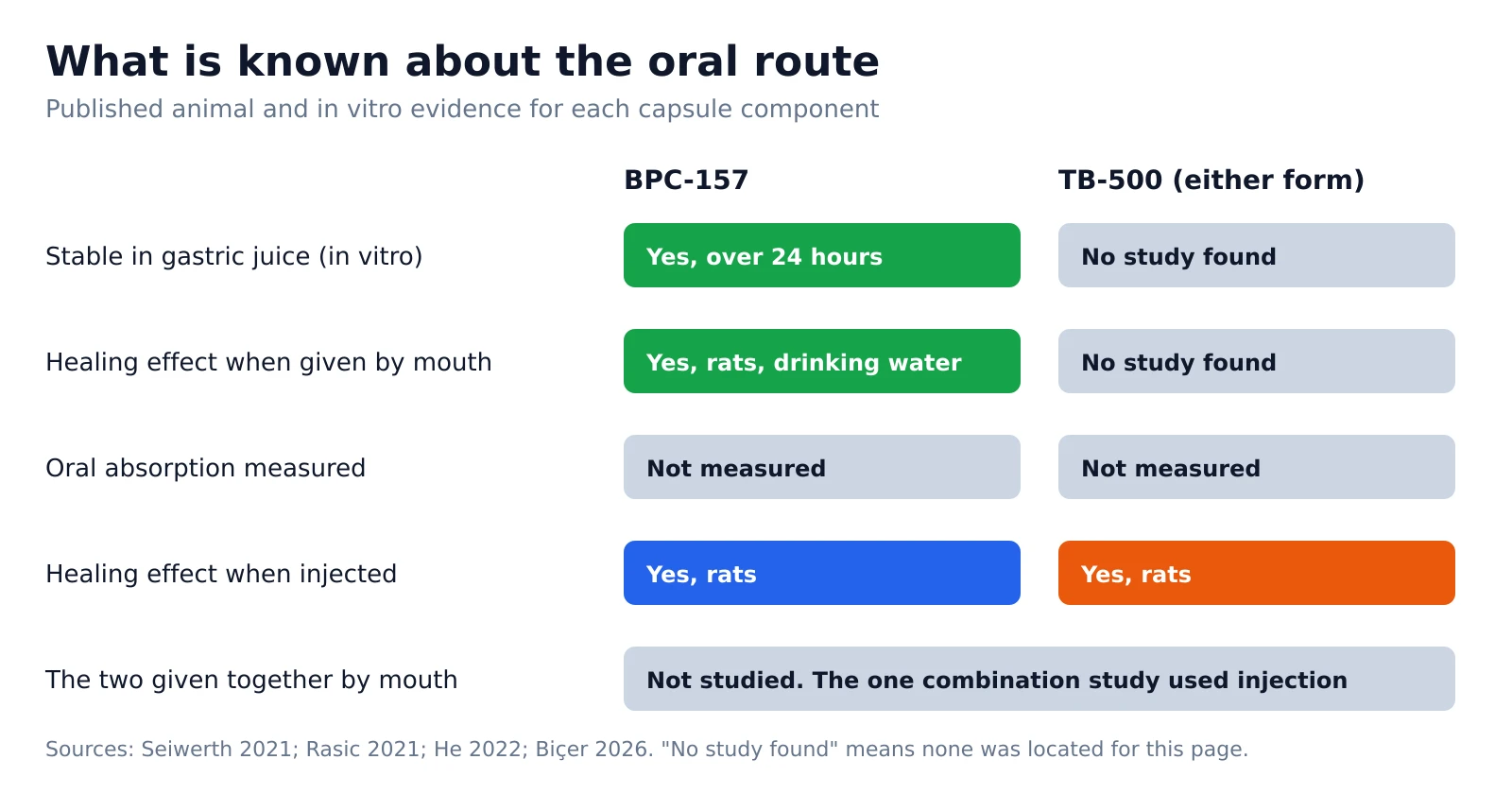
Figure 2. What is known about the oral route. Published evidence for each capsule component; "no study found" means none was located for this page. Sources: Seiwerth et al. 2021, Rasic et al. 2021, He et al. 2022, Biçer et al. 2026.[1,2,3,8]
The oral BPC-157 studies dissolved the peptide in drinking water. None used a capsule, and no study has given BPC-157 and TB-500 together by mouth.
BPC-157 and TB-500 capsules vs the vial blend
Same two peptide names, different format, different evidence base.
Route studied. The only combination study injected both peptides [1]. Oral data exist for BPC-157 alone [2,3].
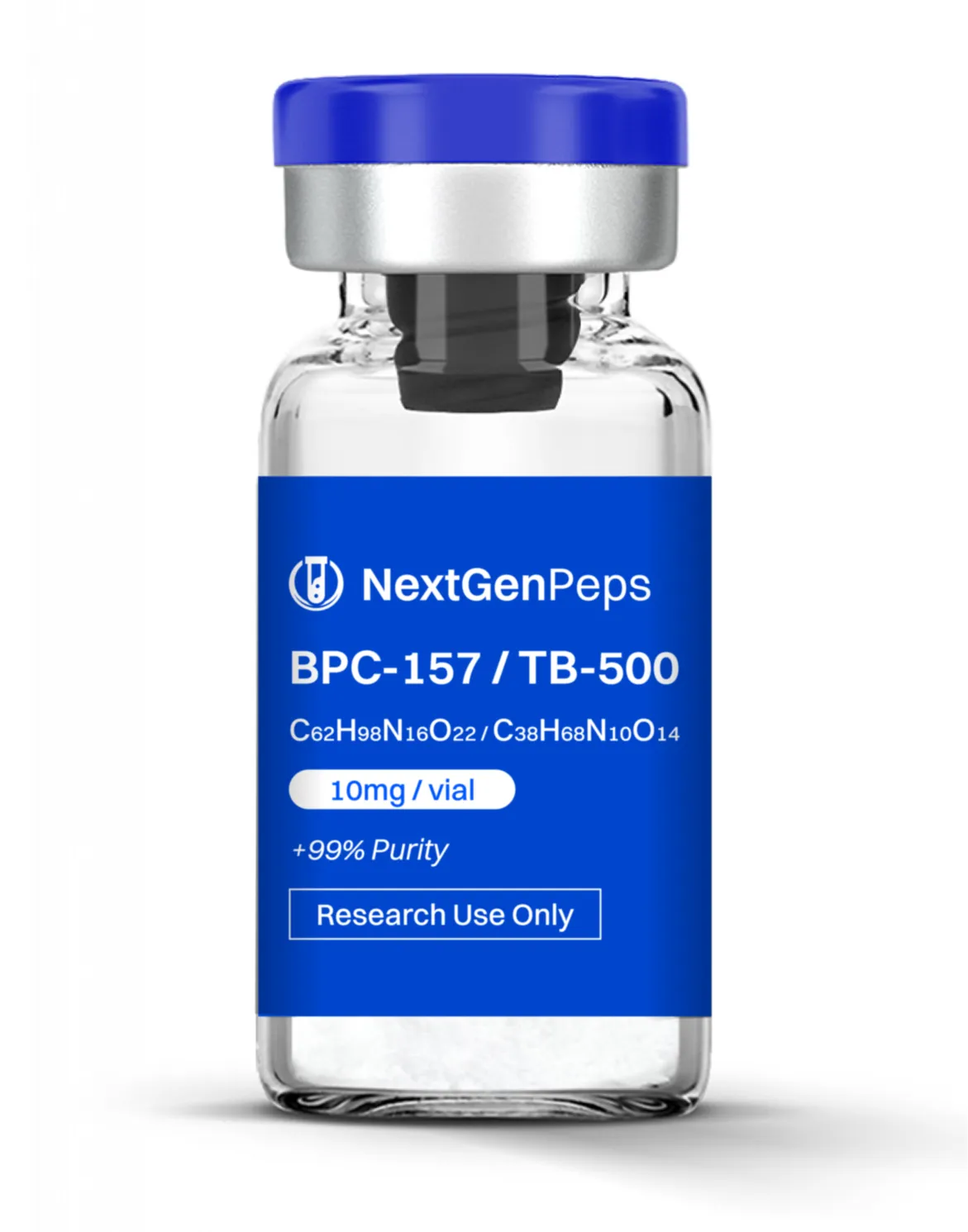
Format. The capsules hold a fixed 250 mcg of each peptide per capsule for oral-route work. The vial blend is lyophilized powder reconstituted for injected-route models.
TB-500 form. The capsules are listed with the Ac-LKKTETQ fragment, while the NextGenPeps TB-500 vial contains full-length thymosin beta-4. Results from one form should not be assumed for the other.
Related research formats: BPC-157 Capsules for oral-route work on BPC-157 alone, and the BPC-157 / TB-500 vial blend.
What are BPC-157 and TB-500 capsules made of?
Two synthetic peptides in each capsule, listed at equal mass. Because the two molecules differ in size, equal mass does not mean equal numbers of molecules.
BPC-157 is a linear peptide of 15 amino acids, GEPPPGKPADDAGLV, formula C62H98N16O22, 1419.5 g/mol (CAS 137525-51-0), a partial sequence of a protein described in gastric juice.
TB-500 in these capsules is listed as the N-acetylated seven-residue fragment Ac-LKKTETQ, residues 17 to 23 of thymosin beta-4, formula C38H68N10O14, 889.0 g/mol. Full-length thymosin beta-4 is 43 residues and 4963.5 g/mol.
At 250 mcg each, one capsule holds about 176 nmol of BPC-157 and about 281 nmol of the TB-500 fragment, roughly 1.6 fragment molecules per BPC-157 molecule (Figure 3). If a lot contained full-length thymosin beta-4 instead, the same mass would be only about 50 nmol.
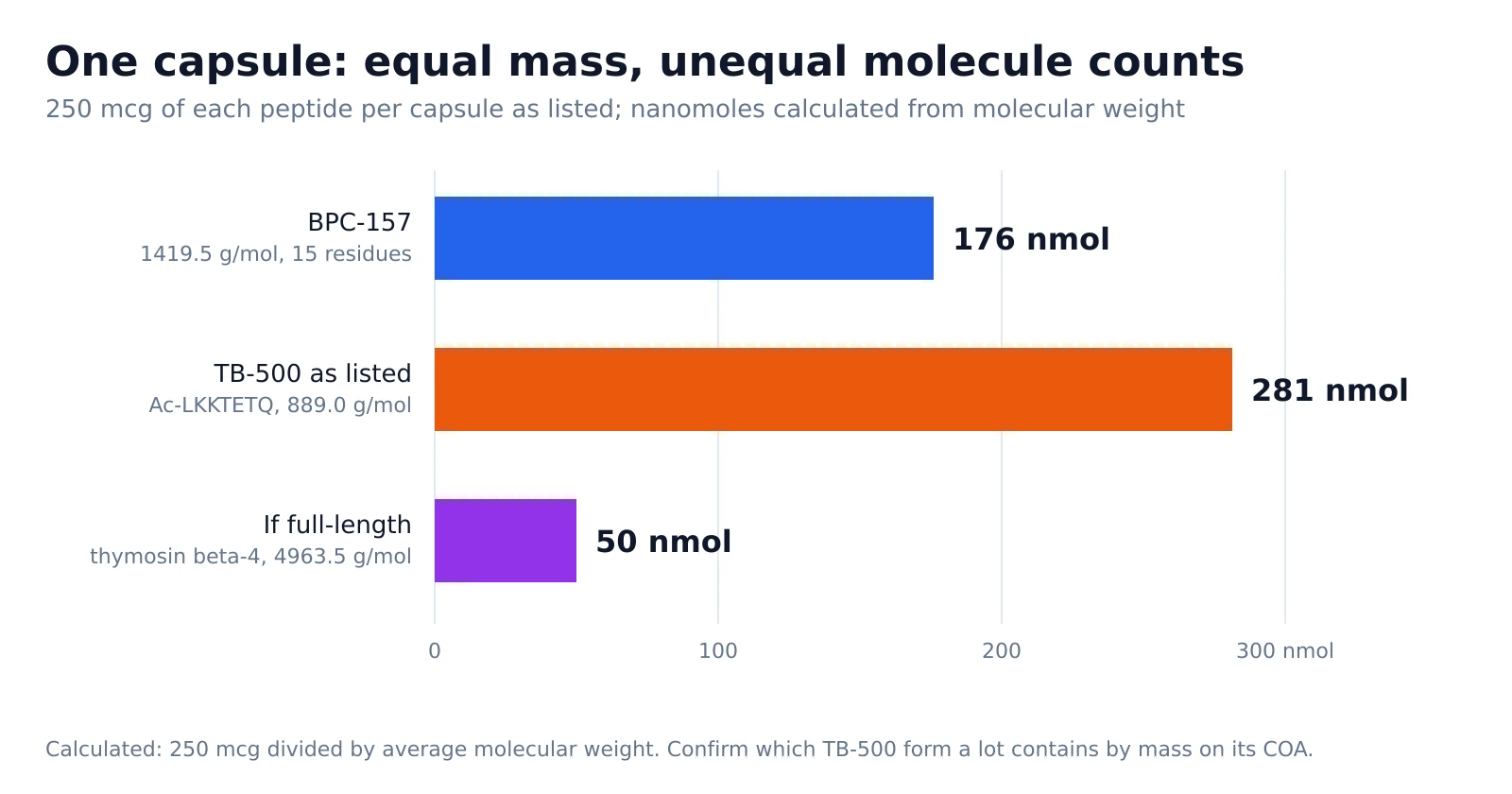
Figure 3. One capsule: equal mass, unequal molecule counts. Calculated from 250 mcg per peptide and average molecular weight. Which TB-500 form a lot contains should be confirmed by mass on its certificate of analysis.
BPC-157 and TB-500 capsules at a glance
Compound: BPC-157 plus TB-500 (Ac-LKKTETQ, thymosin beta-4 fragment 17 to 23), in one capsule
Class: Two-peptide research combination: synthetic pentadecapeptide plus synthetic actin-binding heptapeptide
BPC-157: GEPPPGKPADDAGLV; C62H98N16O22; 1419.5 g/mol; CAS 137525-51-0
TB-500: Ac-LKKTETQ; C38H68N10O14; 889.0 g/mol
Strength: 250 mcg BPC-157 and 250 mcg TB-500 per capsule, as listed
Identity and purity: Every lot is tested by independent labs and the certificate of analysis is published in the NextGenPeps COA library
Appearance: Capsules in a sealed container
Reconstitution: Not required
Half-life: BPC-157 under 30 minutes in rats and dogs after intravenous or intramuscular dosing [8]; no oral or fragment data found
Regulatory status: Neither peptide is an FDA-approved drug. Both prohibited in sport by the World Anti-Doping Agency [10]
Are BPC-157 and TB-500 legal or FDA approved?
Neither is an FDA-approved drug, and these capsules are sold only as research material.
On April 15, 2026, the FDA removed twelve peptides, including BPC-157 and the thymosin beta-4 fragment LKKTETQ ("TB-500"), from Category 2 of its interim list of bulk substances that raise significant safety concerns for pharmacy compounding. Removal did not by itself make them eligible for compounding [11]. At its July 23, 2026 meeting, the FDA's Pharmacy Compounding Advisory Committee voted 8 to 6, with one abstention, to recommend BPC-157, KPV and TB-500; the vote is not binding and the FDA must still complete rulemaking [12].
In sport, the World Anti-Doping Agency lists BPC-157 as a non-approved substance (S0) and thymosin beta-4 and its derivatives, such as TB-500, as prohibited growth factor modulators (S2) [10].
What are BPC-157 and TB-500 capsules used to study?
Mainly the oral route itself: whether these peptides act, and survive, when given by mouth in animal models.
Oral peptide stability. Gastric and intestinal stability of BPC-157 next to a short actin-binding peptide, in vitro [2,9].
Oral-route animal models. Gut, fistula and bladder injury models where oral BPC-157 has been tested, and whether adding TB-500 changes the result [2,3].
Tendon healing. Comparison with the injected combination results in repaired rat Achilles tendon [1].
Exposure measurement. Oral absorption has not been measured for BPC-157 [8] or TB-500, which is the open question for any oral protocol.
Buying BPC-157 and TB-500 capsules for research: what each container includes
For a two-peptide product, identity matters as much as purity, because two different molecules share the name TB-500. Every lot is tested by independent labs and the certificate of analysis is published in the NextGenPeps COA library.
Fixed composition. 250 mcg BPC-157 and 250 mcg TB-500 per capsule, as listed.
Independent testing. Identity and purity are tested by independent labs, with the certificate published in the COA library.
US-based fulfilment. Orders ship within 24 hours from the United States, with free US shipping on orders over $150.
Research use only. BPC-157 and TB-500 capsules are sold strictly for in vitro and approved animal research. They are not for human or veterinary use and are not sold as a drug, supplement or diagnostic.
BPC-157 and TB-500 capsules handling, storage and analytical notes
Format. Supplied as capsules in a sealed container; no reconstitution is needed. No dosing instructions are supplied, and none should be taken from the studies above.
Storage. The product record lists storage at 2 to 8 °C. Keep the container sealed, dry and protected from light, and limit time open to room air, since moisture degrades peptides.
Identity check. Mass spectrometry should show BPC-157 near 1419 Da and the TB-500 fragment near 889 Da. A mass near 4963 Da would indicate full-length thymosin beta-4 instead.
Oral-route design. Because oral absorption of BPC-157 is unmeasured [8] and no oral data exist for TB-500, oral studies need their own exposure measurements rather than assuming values from injected work.
Naming. TB-500 is used for both full-length thymosin beta-4 and the LKKTETQ fragment; Ac-LKKTETQ and thymosin beta-4 fragment 17-23 refer to the fragment. BPC-157 is also written BPC 157 or pentadecapeptide BPC 157.
What is not established about BPC-157 and TB-500 capsules
Oral TB-500. No study was found that gave either form of TB-500 by mouth, so its oral stability, absorption and activity are unknown.
Oral absorption of BPC-157. Oral BPC-157 healed rat injuries, but how much reaches the bloodstream has not been measured [8].
The combination by mouth. The only combination study injected both peptides, and even there the pair did not beat either peptide alone [1].
Capsule versus drinking water. The oral BPC-157 studies used drinking water. No study has tested a capsule format, and the oral data come mostly from a single research group [2,3].
Research Use Only. The statements made within this website have not been evaluated by the US Food and Drug Administration. These materials are not intended to diagnose, treat, cure or prevent any disease and are not intended for human or veterinary use. Studies described on this page are reported for scientific context and are not guidance of any kind.