





Human chorionic gonadotropin (hCG) is a placental glycoprotein hormone that bridges reproductive endocrinology, pregnancy biology, and tumor marker research. It belongs to the gonadotropin family and shares a common α‐subunit with luteinizing hormone (LH), follicle‐stimulating hormone (FSH), and thyroid‐stimulating hormone (TSH), but carries a distinct β‐subunit and glycosylation pattern that confer its unique, long‐acting biological profile.
Molecular Composition and Mechanistic Profile
Molecular identity and structure
Human chorionic gonadotropin (HCG) is a heterodimeric glycoprotein hormone composed of a common α‐subunit and a hormone‐specific β‐subunit linked non‐covalently.
HCG exists as multiple glycoforms, including regular HCG, hyperglycosylated HCG, free β‐subunit, β‐core fragments, and nicked variants, each differing in carbohydrate structures and biological roles.
Hyperglycosylated HCG (highly sialylated, with larger O‐glycans) is predominant in very early pregnancy and invasive trophoblastic disease and exhibits stronger autocrine/paracrine effects on trophoblast invasion and growth.
Mechanism of action
HCG is the natural ligand for the LH/hCG receptor (LHCGR), a class A G protein–coupled receptor expressed in gonadal and extra‐gonadal tissues.
Binding of HCG to LHCGR activates Gs protein, raising cAMP and driving steroidogenesis, gametogenesis, and luteal support functions in ovary and testis.
In early pregnancy, placental syncytiotrophoblast secretes HCG, which supports the corpus luteum, maintains progesterone production, and promotes angiogenesis and uterine receptivity.
Integrated Research Applications
Reproductive endocrinology and fertility
HCG is central to assisted reproduction research as an LH surrogate used to trigger final oocyte maturation and ovulation, model luteal function, and study endometrial receptivity.
In male models, exogenous HCG stimulates Leydig cell testosterone production and Sertoli cell‐mediated spermatogenesis, making it a key tool in hypogonadotropic hypogonadism and testicular function studies.
Pregnancy, placental biology, and implantation
Endogenous HCG and its hyperglycosylated variants regulate implantation, trophoblast invasion, angiogenesis, and placental development, so they are widely studied in preeclampsia, recurrent pregnancy loss, and gestational trophoblastic disease.
The review article highlights HCG’s roles beyond progesterone support, including modulation of uterine NK cells, macrophages, and regulatory T cells, which contribute to maternal‐fetal immune tolerance.
Experimental work examines how β‐hCG and hyperglycosylated HCG may actively promote malignant invasion, angiogenesis, and immune evasion in trophoblastic cancers.
HCG is a cornerstone analyte in clinical laboratory science for pregnancy testing, evaluation of ectopic and failing pregnancy, and detection of residual trophoblastic disease.
The review article details analytical challenges such as heterophilic antibodies, pituitary HCG in peri‐ and postmenopausal women, and variant forms that may cause false positive or negative results, guiding assay design and interpretation.
Analytical Validation, Formulation, and Storage
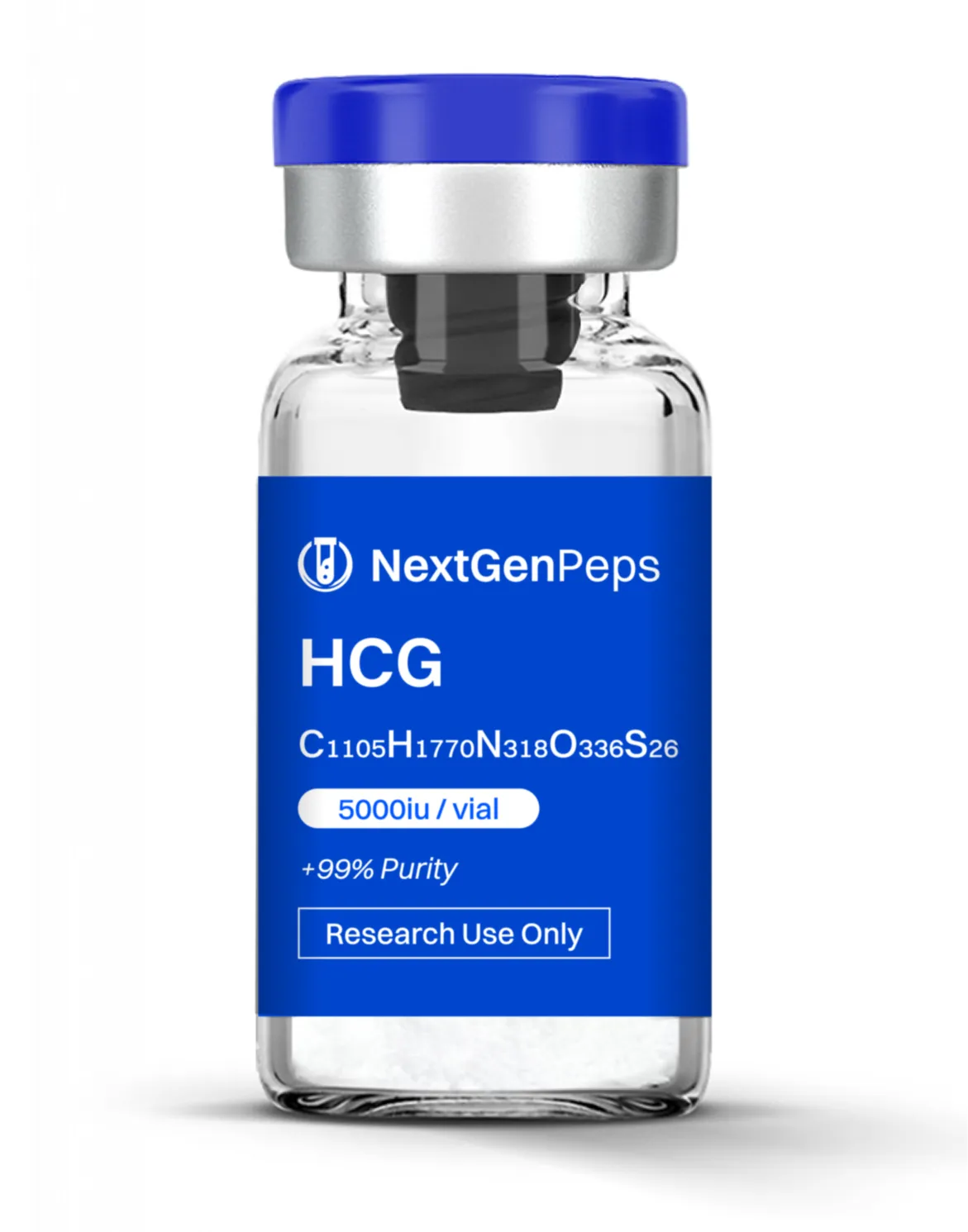
Research‐grade 5000 IU HCG (NextGenPeps/BioRegen COA)
Identity: Confirmed as HCG by UHPLC‐MS and MALDI‐MS, with spectral mass centered at ~36.7 kDa consistent with intact glycosylated hormone.
Purity: Specification >98%; batch result 99.20% purity.
Appearance: White lyophilized powder.
General handling and reconstitution
Lyophilized vials are typically reconstituted with sterile water or bacteriostatic diluent immediately prior to use, then handled under aseptic conditions.
Standard peptide/protein practice is: store lyophilized material refrigerated or frozen, minimize freeze–thaw cycles after reconstitution, and use refrigerated liquid stocks within defined lab‐specific timelines.
Clinical‐grade formulations
Medical HCG products are supplied as freeze‐dried powder plus diluent (often benzyl alcohol–containing solution) for intramuscular or subcutaneous injection; diluent volume and strength vary by brand.
They are manufactured under GMP conditions with rigorous potency (IU), sterility, pyrogen, and impurity testing distinct from research‐only products.
Because neither the COA nor the review article tabulates exact excipients, buffer compositions, or stability curves, we cannot fully match the formulation detail you have for some synthetic peptides (e.g., explicit solubility in DMSO vs water, precise storage times at −20 °C vs −80 °C).
NextGenPeps provides HCG exclusively as a research material for in vitro experimentation or ethically approved animal studies. This product is not approved for therapeutic, diagnostic, or nutritional use and is not intended for human administration, clinical treatment, or personal use of any kind.