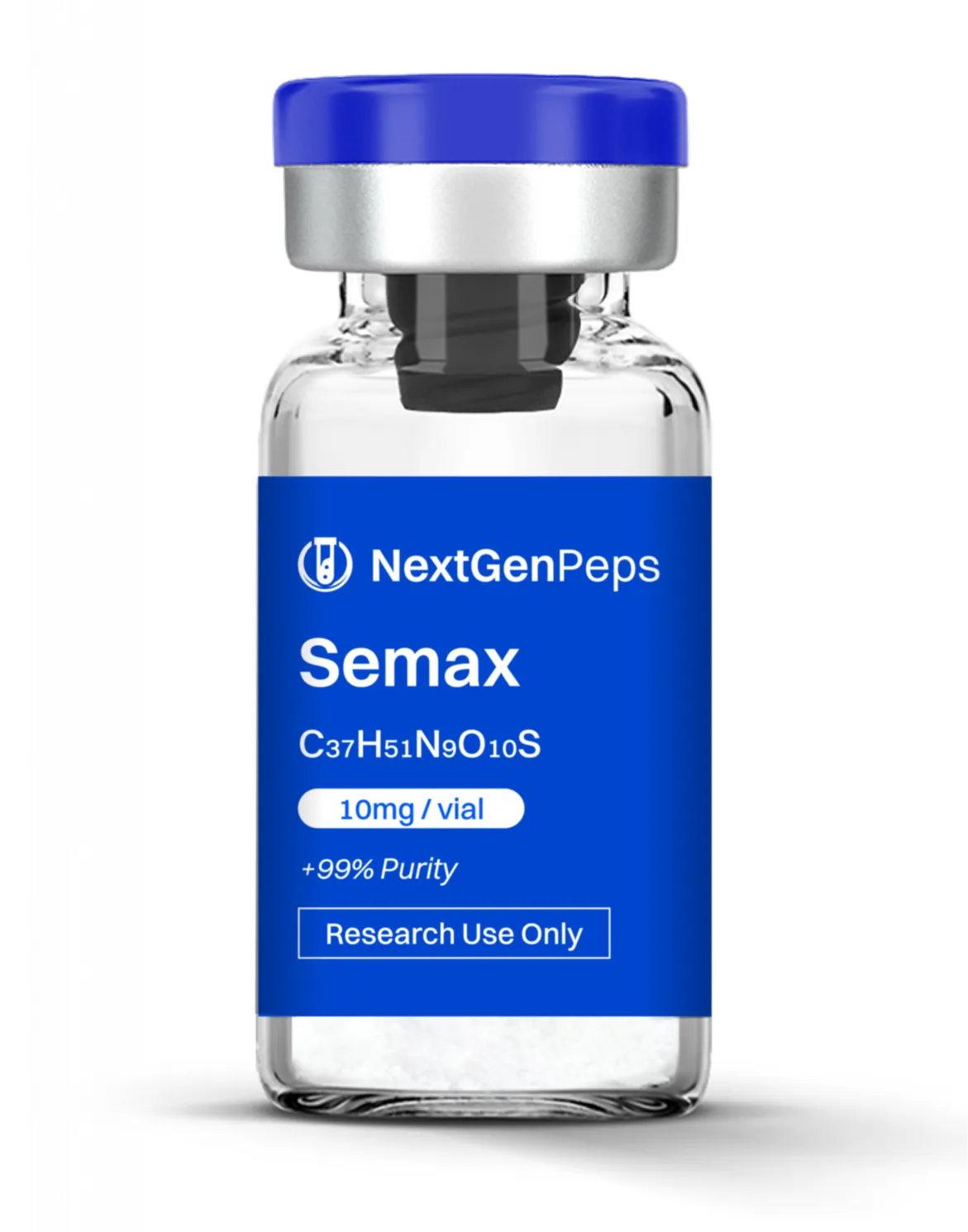






Semax Research Peptide Overview
Semax is a high-purity, research-grade synthetic heptapeptide derived from the adrenocorticotropic hormone fragment ACTH(4‐10), developed to investigate neuroprotective, neurotrophic, and nootropic mechanisms in controlled experimental systems. This peptide has been widely studied in models of ischemic brain injury, cognitive impairment, neuroinflammation, and stress physiology, making it a versatile tool for central nervous system (CNS) research.
Molecular Composition and Mechanistic Profile
Semax (Met‐Glu‐His‐Phe‐Pro‐Gly‐Pro): A linear heptapeptide ACTH(4‐10) analog designed to preserve neuroactive properties of endogenous ACTH fragments while minimizing classical endocrine effects. Semax modulates expression of genes linked to neurotrophins, cytokines, neurotransmission, and vascular remodeling, with robust upregulation of brain-derived neurotrophic factor (BDNF) and related neuroprotective transcripts in animal models.
N‐Acetyl Semax Amidate (NA‐Semax): A modified derivative in which the peptide is acetylated at the N‐terminus and amidated at the C‐terminus, enhancing stability, bioavailability, and resistance to enzymatic degradation relative to native Semax. Its sequence incorporates the core Semax motif with additional terminal modifications that may alter receptor interactions and pharmacokinetics.
Mechanistically, Semax and NA‐Semax have been associated with:
Increased BDNF, serotonin, and dopamine levels in the central nervous system, supporting neuroplasticity and mood regulation.
Modulation of nitric oxide synthesis, mitochondrial stability, and microcirculatory function, contributing to neuroprotection during ischemic or hypoxic stress.
Regulation of immune and inflammatory gene networks, influencing cytokine balance and neuroimmune cross‐talk.
Integrated Research Applications
Semax and N‐Acetyl Semax Amidate are explored across multiple research domains to dissect their impact on CNS function and recovery. Representative experimental arenas include:
Ischemic stroke and brain injury models: Evaluation of infarct volume, neuronal survival, angiogenesis, and functional recovery following focal ischemia or optic nerve inflammation.
Cognitive and behavioral studies: Assessment of learning, memory, attention, anxiety-like behavior, and stress response in rodent paradigms, including seizure-related cognitive dysfunction.
Neurodegeneration and oxidative stress: In vitro systems examining protection against oxidative and excitotoxic injury, with attention to mitochondrial function and free-radical scavenging pathways.
Immune and cardiovascular research: Investigation of gene programs regulating smooth muscle migration, erythropoiesis, and neovascularization, potentially explaining observed cerebrovascular protective effects.
These models allow researchers to interrogate Semax as an integrative modulator of neuroplasticity, vascular tone, and immune signaling.
Analytical Validation and Quality Assurance
Research-grade Semax and N‐Acetyl Semax Amidate are supplied as lyophilized powders at defined content per vial (commonly 30 mg), with:
Purity typically ≥99% verified by high-performance liquid chromatography (HPLC).
Identity confirmed by mass spectrometry and sequence analysis.
Specification sheets documenting peptide content, recommended solvents for
reconstitution, and storage conditions.
These quality controls support reproducibility, precise dosing, and consistent performance in both in vitro and in vivo protocols.
Storage and Stability Guidelines
Proper handling is essential to preserve Semax integrity and bioactivity for research. Typical guidance includes:
Lyophilized peptide: Store in sealed vials, protected from light, at refrigerated or frozen temperatures for medium- to long-term stability.
Reconstituted solutions: Prepare with sterile diluent, keep refrigerated, avoid repeated freeze–thaw cycles, and use within a limited time frame consistent with institutional SOPs.
Adherence to these conditions helps maintain peptide structure and minimizes degradation during ongoing experimental use.
NextGenPeps offers Semax for use in preclinical neuroscience and immunology research, including in vitro assays and controlled studies in rodent models. The compound is not approved as a human nootropic, cognitive enhancer, or therapeutic and must not be used in self-experimentation, clinical practice, or any application involving human subjects.