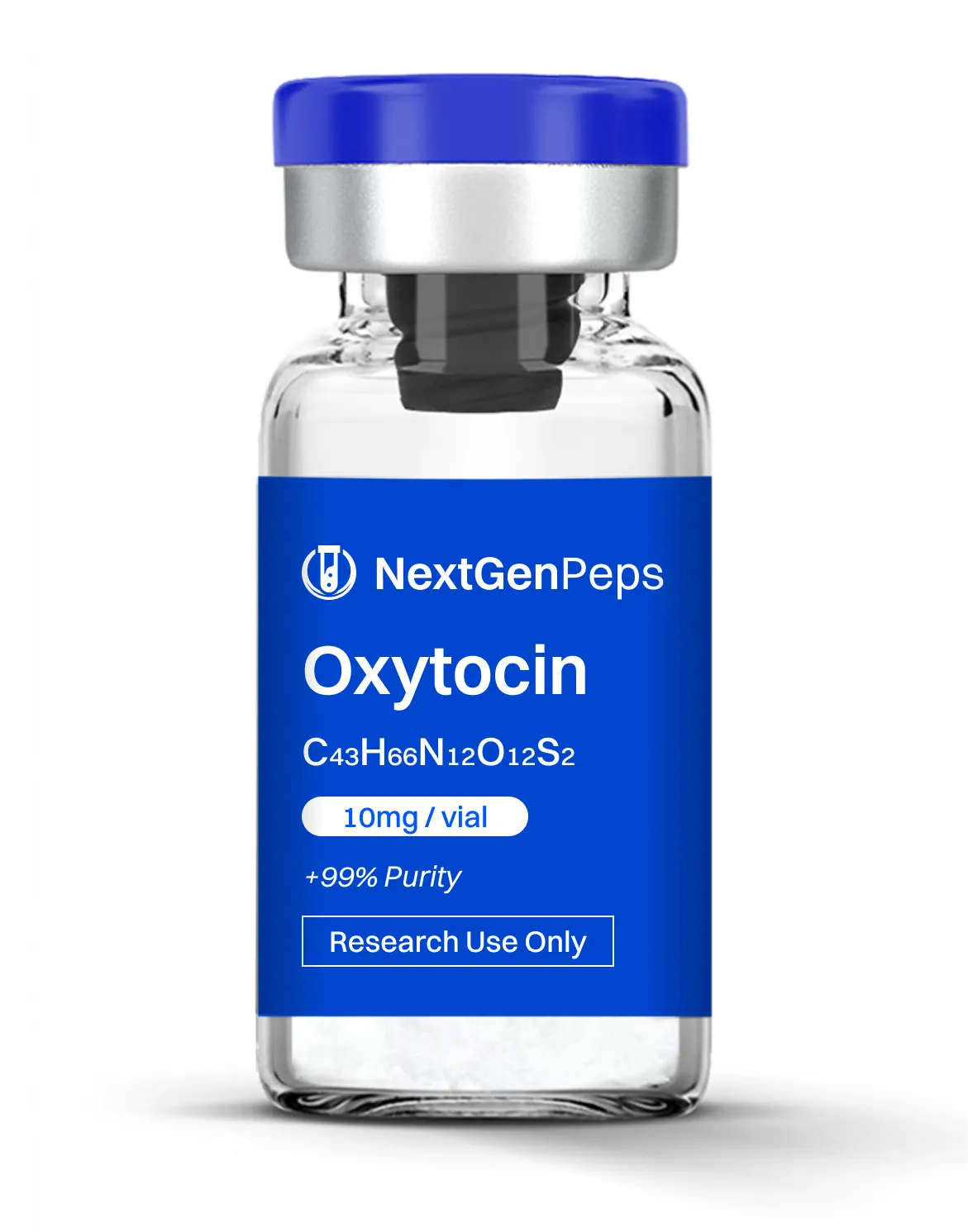






Oxytocin is a cyclic nonapeptide hormone investigated for its roles in social bonding, reproductive physiology, and neuromodulatory signaling pathways in preclinical models.
Molecular Composition and Mechanistic Profile
Peptide identity: Oxytocin is a nine amino acid peptide with the sequence Cys Tyr Ile Gln Asn Cys Pro Leu Gly NH2 featuring a disulfide bond between the cysteine residues at positions 1 and 6.
Origin: Endogenous neuropeptide synthesized in the hypothalamus and released from the posterior pituitary, produced synthetically for research applications.
Mechanistically, Oxytocin has been associated with:
Binding to G protein coupled oxytocin receptors that activate intracellular calcium and protein kinase pathways in experimental systems.
Modulation of neural circuits involved in social recognition pair bonding and stress responses in animal models.
Influences on reproductive behaviors and smooth muscle contractility observed in laboratory preparations.
These properties position Oxytocin as a tool for studying neuropeptide mediated social and reproductive signaling.
Integrated Research Applications
Oxytocin is examined across neural and endocrine systems. Representative domains include:
Social behavior models: Investigation of pair bonding parental care and social recognition in rodent and other animal preparations.
Reproductive physiology studies: Evaluation of effects on uterine and mammary tissue contractility in experimental systems.
Stress and anxiety related research: Assessment of neuromodulatory actions on hypothalamic pituitary adrenal axis markers in laboratory models.
Comparative neuropeptide research: Use alongside vasopressin to explore differential receptor mediated pathways in controlled settings.
Overall, Oxytocin serves as a research tool for exploring coordinated neuropeptide regulation of social reproductive and stress related networks.
Analytical Validation, Formulation, and Storage
NextGenPeps supplies Oxytocin as a high purity research peptide. Typical quality and handling features include:
Purity: ≥99% verified by HPLC.
Formulation: White lyophilized powder in sealed glass vials, intended for reconstitution with appropriate research grade solvent for experimental use only. No dosing guidance is provided for any organism.
Storage: Keep lyophilized material in a cool dark dry environment; long term storage at or below −20 °C. Store reconstituted solutions refrigerated, minimize freeze thaw cycles, and use within laboratory defined stability windows.
These conditions support structural integrity and reproducible experimental outcomes.
NextGenPeps supplies Oxytocin as a high purity research peptide intended strictly for controlled laboratory use in vitro or in established animal models, such as murine systems. This compound is not approved as a drug, diagnostic, or dietary ingredient, and is not manufactured, packaged, or marketed for human consumption, self experimentation, clinical application, or any use outside properly designed and ethically approved research protocols.