Research purposes only. Products are not for human consumption.Shop Now
5-Amino-1MQ - 10mg
99.48% HPLC purityLot-tested · COA below

5-Amino-1MQ

4.7· 3 reviewsout of 5In stock

Buy 5-Amino-1MQ for research: 10 mg vials of the NNMT inhibitor, 99.48% purity by UHPLC-MS, public COA on every lot. Ships within 24 hours.

Regular price $54.00Sale price $43.00You save $11.00 (20%)
1

Bundle & Save

Need more?

Select and SubscribeSave 20%
Order within 15h 25m to ship Mon, Nov 9Cutoff 5:00 PM PST · ships next business day
U.S. delivery availableFree shipping on orders over $150.00
Reship policyWrong item sent? We reship it free. Transit issues reviewed case by case.

Secure checkout · Visa · Mastercard · American Express · Discover · PayPal · Venmo · Apple Pay

Test results · tested sample

99.48%

Reported purity · Tested by Bioregen

Tested
Apr 20, 2026
Labeled
10mg
Lab
Bioregen
View certificate (PDF) →

Product details

5-Amino-1MQ, in brief. Cells run on NAD+, the molecule that carries the energy released from food, and they recycle it continuously from a precursor called nicotinamide. An enzyme called NNMT competes for that same precursor, tagging it for disposal instead of recycling. NNMT is unusually abundant in fat tissue and liver, and more abundant still in obesity. 5-Amino-1MQ blocks that enzyme, and the proposition is that blocking it leaves more precursor available for NAD+ and changes how a fat cell handles energy. The research interest comes from a 2017 mouse study in which NNMT inhibitors reversed diet-induced obesity. That work has not been followed by any published clinical trial. It is a small molecule and not a peptide, despite being sold alongside them and widely searched for as one. NextGenPeps supplies 5-Amino-1MQ for laboratory research only.

What does 5-Amino-1MQ do?

It blocks one enzyme, NNMT, and that is the whole of its described activity. What blocking it is meant to accomplish is to stop that enzyme consuming the precursor cells use to build NAD+, leaving more of it for energy metabolism. Everything else attributed to the compound is downstream of that single block, and almost all of it has only been seen in mice.

NNMT is expressed at high levels in fat tissue and liver, and its expression is elevated in obesity. That is why the enzyme became a metabolic target in the first place.

The one result that drives interest in the compound is in mice. Inhibitors of this class reversed high-fat-diet-induced obesity in animals on that diet. Nothing comparable has been published in a clinical trial.

How does 5-Amino-1MQ work?

NNMT transfers a methyl group from S-adenosylmethionine (SAM) onto nicotinamide, producing 1-methylnicotinamide and SAH. Nicotinamide is a precursor the cell can otherwise recycle into NAD+ through the salvage pathway. So each molecule of nicotinamide that NNMT methylates is one that cannot be salvaged, and each methylation also consumes a SAM methyl group (Figure 1).

The hypothesis behind inhibiting the enzyme is that blocking it preserves nicotinamide for NAD+ synthesis and preserves SAM for other methylation reactions, shifting cellular energy handling.

5-Amino-1MQ is a small, cell-permeable inhibitor built to test that hypothesis. Its permanent positive charge means it resembles the methylated product, which is the basis of its binding.
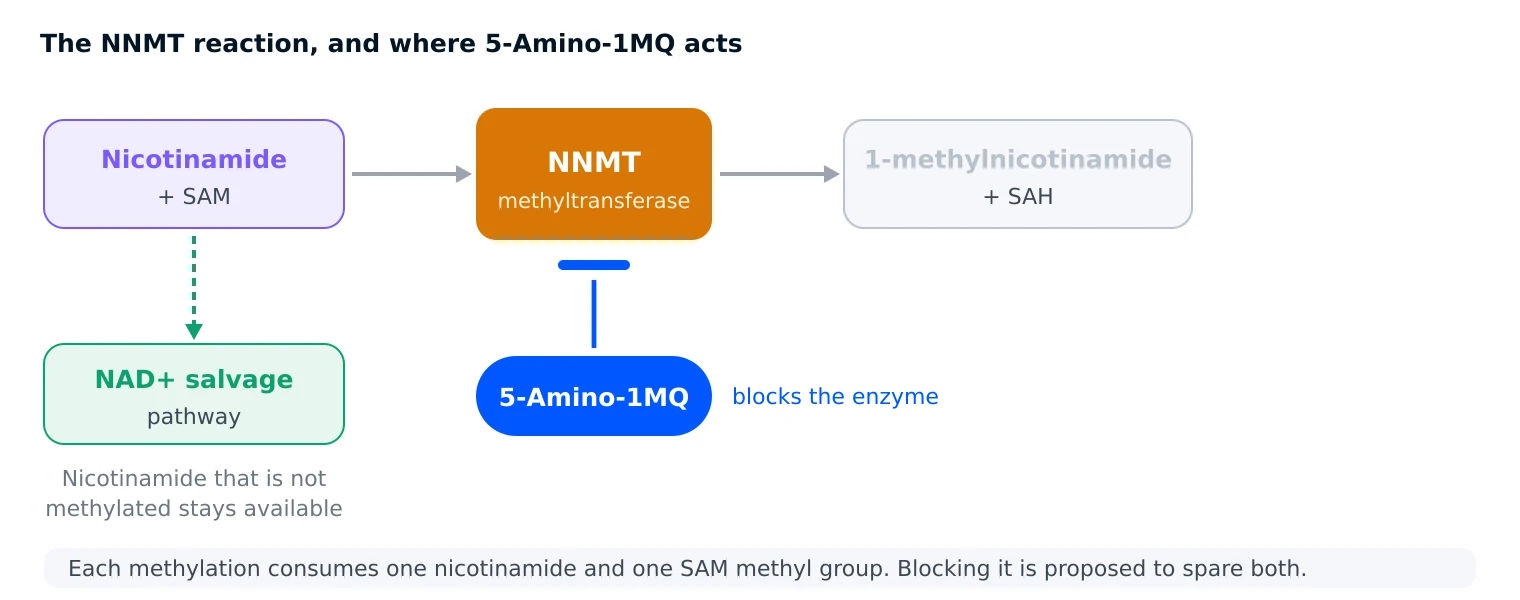
Diagram of the NNMT reaction: nicotinamide plus SAM converted by NNMT into 1-methylnicotinamide plus SAH, with nicotinamide otherwise feeding the NAD+ salvage pathway, and 5-Amino-1MQ shown blocking NNMT.

Figure 1. What NNMT does and where 5-Amino-1MQ acts. NNMT consumes both nicotinamide and a SAM methyl group. Inhibiting it is proposed to leave more nicotinamide available for NAD+ salvage. The downstream metabolic effects are the part still being tested.

What does the published evidence cover?

What the evidence does and does not show. The mouse obesity result is real and from a credentialed group, but it is one line of work in rodents (Figure 2). There are no published clinical trials of 5-Amino-1MQ, no published pharmacokinetics, and no controlled data on body weight, body composition or metabolic markers. Before-and-after claims circulating online are not supported by published research.
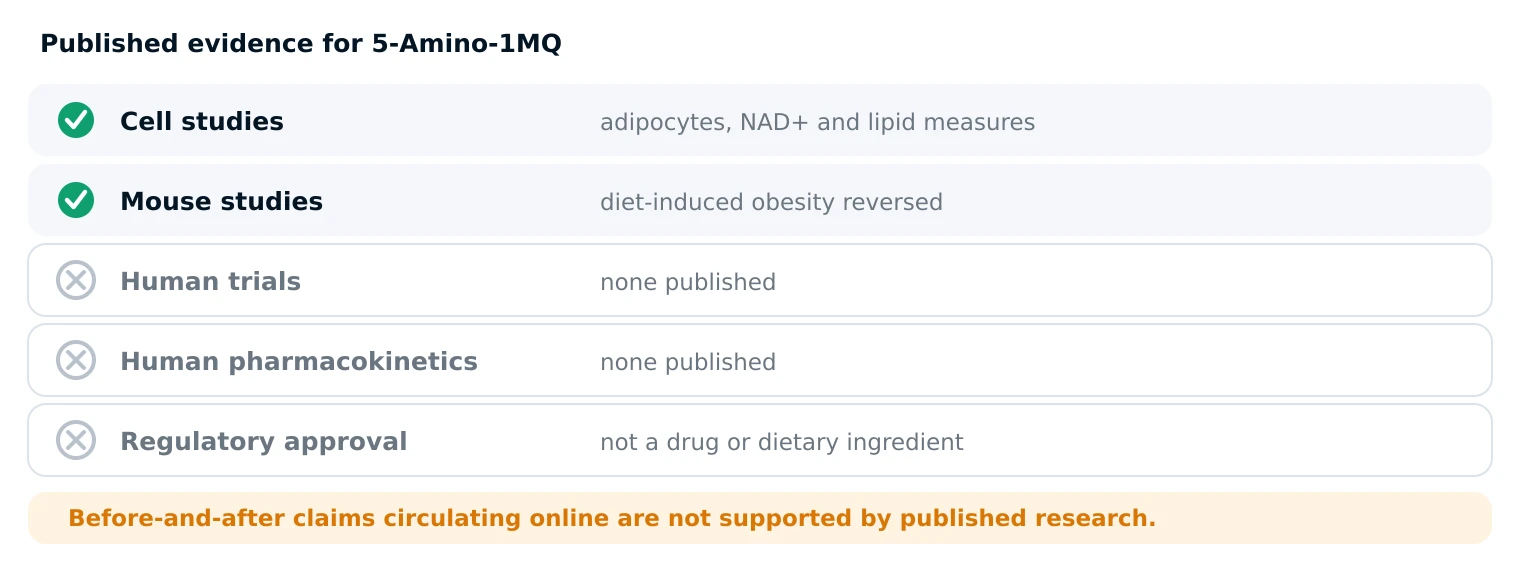
Evidence map for 5-Amino-1MQ showing published cell studies and mouse studies, and no published human trials, no human pharmacokinetics and no regulatory approval.

Figure 2. Published evidence for 5-Amino-1MQ. Cell and mouse work only. The gap between the rodent literature and the claims made for this compound online is unusually wide.

Is 5-Amino-1MQ FDA approved?

No. 5-Amino-1MQ is not an FDA-approved drug and is not an approved dietary ingredient in the United States.

It also sits outside the peptide compounding process that has been in the news through 2026. The FDA's April 2026 action and the advisory committee votes that followed concerned twelve peptides [2]. 5-Amino-1MQ is a small molecule and was not among them, so none of that applies to it in either direction.

Is 5-Amino-1MQ a peptide?

No. It is worth being clear about this, because a large share of searches use the phrase "5-Amino-1MQ peptide" and that framing is simply wrong.

Peptides are chains of amino acids joined by peptide bonds. 5-Amino-1MQ contains no amino acids. It is 5-amino-1-methylquinolinium, a quinolinium: a two-ring aromatic structure with a permanently positively charged nitrogen, an amino group at position 5 and a methyl group on the ring nitrogen. It is closer in character to a small-molecule drug than to anything in the rest of a peptide catalogue.

The practical consequences are real. It is not degraded by peptidases, it is not stored or handled like a lyophilized peptide in every respect, and it does not raise the same endotoxin questions that bacterially sourced or peptide-synthesised material can.

Which salt form is 5-Amino-1MQ supplied as?

5-Amino-1MQ carries a permanent positive charge, so it is always supplied with a counterion, most commonly as the iodide salt. That matters for anyone weighing material out, and it is the detail most pages get wrong.

  • The cation, 5-amino-1-methylquinolinium, has a formula of C₁₀H₁₁N₂⁺ and a mass of about 159.2.

  • The iodide salt, 5-amino-1-methylquinolinium iodide, is C₁₀H₁₁N₂I with a mass of about 286.1 and CAS 42464-96-0.

Because iodide accounts for roughly 44% of the salt's mass, a given weight of the salt contains substantially less of the active cation. A protocol that specifies an amount without saying which form it means is ambiguous. Check what the certificate of analysis reports for the lot in hand, and state the form explicitly when recording methods.

What is 5-Amino-1MQ used to study?

The compound exists mainly as a tool for probing NNMT, and the published work reflects that.

  • Diet-induced obesity in mice. The foundational study. Neelakantan and colleagues reported that selective, membrane-permeable NNMT inhibitors of this class reversed high-fat-diet-induced obesity in mice [1].

  • Adipocyte biology. Cell work measuring differentiation, lipid accumulation and NAD+ levels in fat cells with NNMT blocked.

  • NAD+ and methyl donor metabolism. Used to ask what happens to NAD+ pools and SAM availability when the methylation sink is removed.

  • NNMT in other tissues. NNMT is also studied in liver, muscle and in several cancers, and inhibitors are used as probes in those settings.

Buying 5-Amino-1MQ for research: what each vial includes

Every lot is tested by an independent laboratory, and the certificate of analysis is published in the NextGenPeps COA library.

  • Analytical testing. Identity and purity by UHPLC-MS, 99.48% purity (independent lab, April 20, 2026). This lot was not endotoxin tested.

  • Vial size. 10 mg per vial.

  • Fulfilment. Orders ship within 24 hours from the United States, with free US shipping on orders over $150.

  • Research use only. 5-Amino-1MQ is sold strictly for in vitro and approved animal research. It is not for human or veterinary use and is not sold as a drug, cosmetic, supplement or diagnostic.

5-Amino-1MQ handling, storage and analytical notes

Format. Supplied as a solid in a sealed vial. Quinolinium salts are typically yellow to pale brown rather than white.

Solubility. As a charged salt it dissolves readily in water and in DMSO. DMSO stocks are common in cell work.

Light sensitivity. Iodide salts and aromatic amines can both be light sensitive. Store protected from light and inspect for colour change between uses.

Stability. Unlike the peptides in this catalogue, 5-Amino-1MQ is not a peptidase substrate, so serum in culture media does not degrade it the same way. Its stability profile is that of a small molecule.

What is not yet established about 5-Amino-1MQ

  • Any clinical data. No published trials, no pharmacokinetics, no safety data.

  • Selectivity in vivo. How cleanly it hits NNMT and nothing else, in a whole animal over time, is not fully characterised.

  • Whether NAD+ actually rises meaningfully. The NAD+ step is central to the rationale but is inferred more often than directly measured.

  • Long-term consequences of blocking NNMT. NNMT has roles beyond fat tissue, and the effects of sustained inhibition are not well mapped.


Research Use Only. The statements made within this website have not been evaluated by the US Food and Drug Administration. These materials are not intended to diagnose, treat, cure or prevent any disease and are not intended for human or veterinary use. Studies described on this page are reported for scientific context and are not guidance of any kind.
Published research

Diet-induced obesity in mice

Selective, membrane-permeable NNMT inhibitors of this class reversed high-fat-diet-induced obesity in mice. This is the foundational result behind research interest in the compound.

Neelakantan et al., Biochem Pharmacol 2018 →

Compound information

Name
5-Amino-1MQ; 5-amino-1-methylquinolinium
Compound class
Quinolinium small molecule, not a peptide
Cation formula
C₁₀H₁₁N₂⁺
Cation mass
159.2 g/mol
Iodide salt formula
C₁₀H₁₁N₂I
Iodide salt mass
286.1 g/mol
CAS number (iodide salt)
42464-96-0
Molecular target
Nicotinamide N-methyltransferase (NNMT)
Vial size
10 mg
Purity
99.48% by UHPLC-MS (independent lab, Apr 20, 2026)
Endotoxin
Not tested on the current lot
Regulatory status
Not FDA-approved; research use only

Storage & stability

  • Protect from light. Iodide salts and aromatic amines can both be light sensitive.
  • Inspect for colour change between uses.
  • Not a peptidase substrate, so serum in culture media does not degrade it the way it degrades peptides.
  • Record which form, cation or salt, a stated mass refers to.
Solid
At or below −20 °C, sealed, protected from light and moisture
In solution
Cold and protected from light
Diluent
Water or DMSO, depending on the assay

Cited literature

  1. 01
    Membrane-permeable NNMT inhibitors reverse high-fat-diet-induced obesity in mice

    Neelakantan H, Vance V, Wetzel MD, et al. · Biochem Pharmacol 2018 · PubMed

  2. 02
    Bulk drug substances used in compounding under section 503A

    US Food and Drug Administration · FDA, April 2026

Frequently asked questions

How is 5-Amino-1MQ packaged?

5-Amino-1MQ is supplied as a solid in a sealed, labelled 10 mg vial, with the lot's certificate of analysis published in the NextGenPeps COA library. Please inspect the sealed package when it arrives and contact support promptly if the package or labeling appears damaged.

How is 5-Amino-1MQ shipped?

Orders ship within 24 hours from the United States via USPS for orders placed before the 5:00 PM PDT cutoff. Transit times are typically 3–7 business days, depending on destination and carrier conditions. Tracking information is provided when available.

How should 5-Amino-1MQ be stored?

Store the sealed vial at −20 °C or below, protected from light and moisture. Solutions should be held cold, protected from light, and checked for colour change before use. Avoid repeated freeze-thaw cycles.

What is the refund policy for 5-Amino-1MQ?

Due to the nature of research materials, NextGenPeps orders are final and are not eligible for refunds, returns, or exchanges. Review the shipping and reship policies before ordering.

Is 5-Amino-1MQ intended for human use?

No. NextGenPeps materials are supplied strictly for laboratory research and development use and are not intended for human or animal consumption, clinical use, diagnostic use, cosmetic use, or dietary use.

Customer reviews

4.7out of 5 · 3 reviews

Smooth Reconstitution

Reconstitution of 5 Amino 1MQ was rapid and with no complications. The powder fully dissolved with no particulates and held its stability.

Cristian S.

Helpful Staff

I forgot to add bac water to my order, I contacted support and they were able to add it on with no problem

Rachel T.

Super quick delivery

Fast shipping keeps me coming back. Never had to wait longer than 5 days for my order to get to me.

Justin D.

Common research questions

What is 5-Amino-1MQ?

5-Amino-1MQ is a small molecule inhibitor of nicotinamide N-methyltransferase (NNMT). Chemically it is 5-amino-1-methylquinolinium, a two-ring aromatic compound with a permanent positive charge, usually supplied as the iodide salt. It is studied in metabolic research, mainly in fat tissue, and it is not an approved drug or dietary ingredient.

Is 5-Amino-1MQ a peptide?

No. It contains no amino acids and no peptide bonds. It is a quinolinium small molecule, often sold alongside peptides and frequently searched for as one, but structurally unrelated. That difference is practical as well as semantic: it is not degraded by peptidases and does not behave like a lyophilized peptide in storage or in culture.

What does 5-Amino-1MQ do?

It blocks NNMT, the enzyme that methylates nicotinamide using a methyl group from SAM. Blocking that reaction is proposed to leave more nicotinamide available for NAD+ salvage and more SAM available for other methylation. In mice on a high-fat diet, inhibitors of this class reversed diet-induced obesity. Those are rodent findings and have not been reproduced in clinical trials.

What is 5-Amino-1MQ used for in research?

Mainly as a tool compound for probing NNMT. Published and reported uses include diet-induced obesity models in mice, adipocyte differentiation and lipid accumulation in cell culture, NAD+ and methyl donor metabolism, and NNMT's role in liver, muscle and several cancers.

Is 5-Amino-1MQ FDA approved?

No. It is not an approved drug and not an approved dietary ingredient. It is also outside the 2026 FDA peptide compounding process entirely, since that concerned twelve peptides and 5-Amino-1MQ is a small molecule.

Where can I buy 5-Amino-1MQ for research?

NextGenPeps supplies 5-Amino-1MQ in 10 mg vials for laboratory research, with an independent certificate of analysis for every lot (99.48% by UHPLC-MS on the current lot). Orders ship within 24 hours from the United States. It is sold for in vitro and approved animal research only.

Frequently Researched with

Next Gen Peptides BPC-157 product image

✓ 99.748% purity

BPC-157

$46.00$37.00

Next Gen Peptides GHK-Cu product image

✓ 99.73% purity

GHK-Cu

$74.00$59.00

You have an unfinished subscription checkout

Continue your saved checkout, or replace its item with . Your saved selection and existing subscriptions will stay unchanged.

Continue saved checkout
NextGenPeps

Reliable and innovative research with our top-grade research materials and novel research compounds tailored to lead the competitive research industry. Choose research quality. Choose NextGenPeps.

Customer Service: +1 (971) 300-1435

Get 10% Off Your First Order

Sign up now and receive a 10% discount code valid on your next purchase!

Nextgenpeps LLC

The statements made within this website have not been evaluated by the US Food and Drug Administration. The materials offered by this company are not intended to diagnose, treat, cure, or prevent any disease. All research materials on this site are for laboratory research and development use only, and are not intended for human use.

NextGenPeps is a chemical supplier. NextGenPeps is not a compounding pharmacy or chemical compounding facility as defined under 503A of the Federal Food, Drug, and Cosmetic act. NextGenPeps is not an outsourcing facility as defined under 503B of the Federal Food, Drug, and Cosmetic Act.

Privacy PolicyTerms & ConditionsAffiliate Program

501 W Broadway Ste A, San Diego, CA 92101

© 2026 NextGenPeps. All rights reserved.

Visa
American Express
Mastercard
PayPal
Discover
Apple Pay