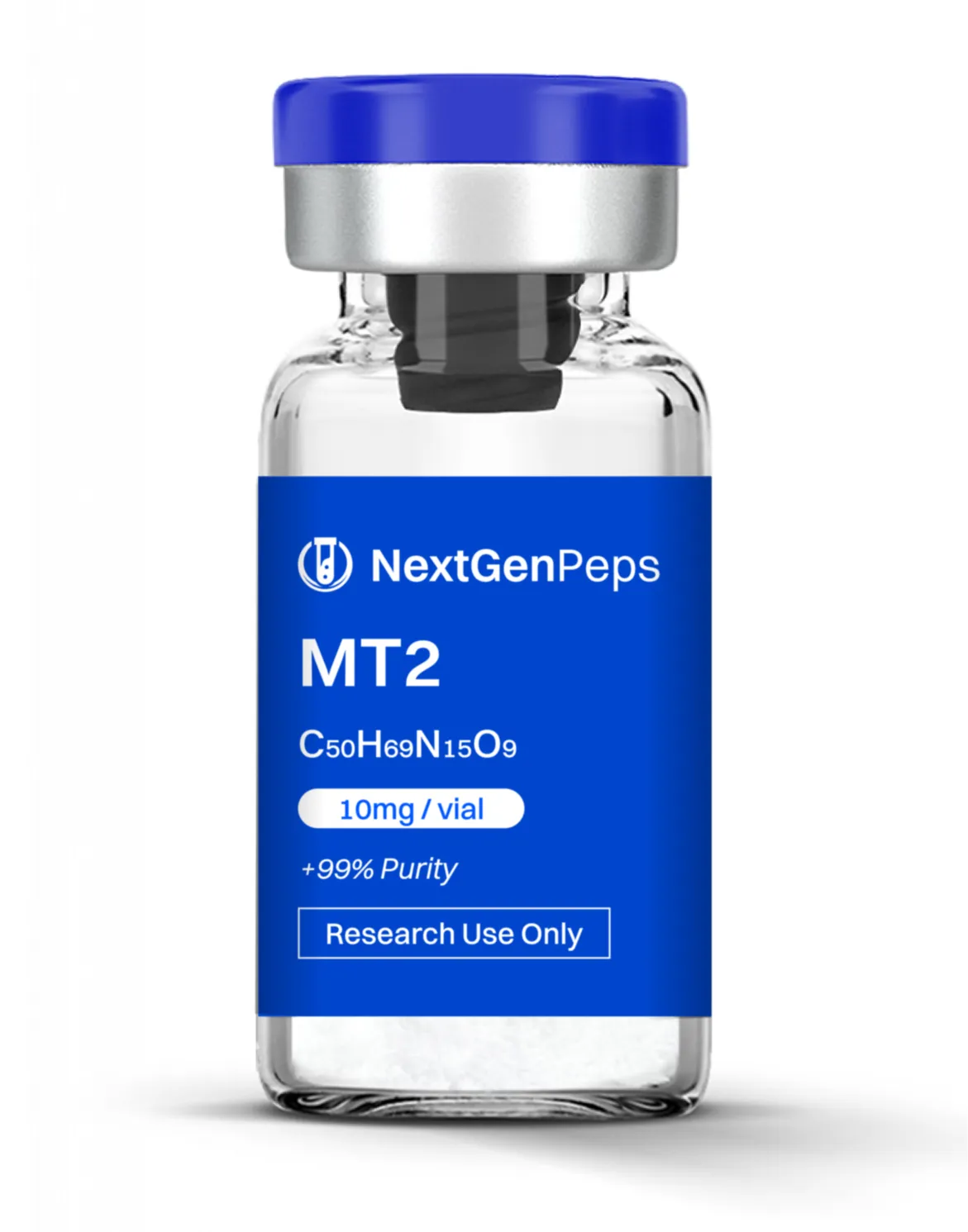
Melanotan II (MT2), in brief. Melanotan II is a small, ring-shaped lab-made analog of alpha-melanocyte-stimulating hormone (alpha-MSH), the natural hormone that signals pigment cells to darken and feeding circuits in the brain to stand down. It was designed in the late 1980s to last longer and act more potently than the natural hormone; in an isolated lizard skin assay it was about 90 times as potent as alpha-MSH [1]. It does not pick one target. It switches on four of the five melanocortin receptors, which is why one molecule darkens pigment cells, cuts food intake in rodents and triggers erectile responses in rats [3,4,8]. In obese rats it reduced body weight about four times as much as saline over two weeks [5]. Melanotan II itself is not FDA-approved. NextGenPeps supplies Melanotan II (MT2) as a 10 mg lyophilized research material for laboratory use only.
What is in each Melanotan II vial
Strength. 10 mg of lyophilized powder in a sealed vial.
Appearance. White lyophilized powder.
Identity and purity. Identity and purity by UHPLC with mass spectrometry, at 99.715% on the current lot (June 19, 2026), tested by independent labs.
Endotoxin. Under 1 EU per vial on the current lot.
Certificate of analysis. Every lot is tested by independent labs and the certificate of analysis is published in the NextGenPeps COA library.
Fulfilment. Ships within 24 hours from the United States, with free US shipping on orders over $150.
What Melanotan II is
Melanotan II is a seven-residue cyclic analog of alpha-MSH, with the sequence Ac-Nle-cyclo[Asp-His-D-Phe-Arg-Trp-Lys]-NH2 and the molecular formula C50H69N15O9, about 1024.2 g/mol (CAS 121062-08-6). It was made by trimming alpha-MSH to its active core, swapping in norleucine and D-phenylalanine, and closing the chain into a ring with a lactam bridge, changes that made it resistant to enzymes and prolonged its action in skin assays [1]. It binds MC1R most tightly, followed by MC4R and MC3R, then MC5R, and reached full cAMP output at each receptor in the same assays [3]. Because it activates several melanocortin receptors at once, it is used as a broad reference agonist for the melanocortin system rather than as a probe for a single receptor [3].
MT2 vs MT1 and PT-141
Melanotan I (MT1, afamelanotide) is a linear 13-residue analog of alpha-MSH, studied mainly for pigmentation [2]. Melanotan II is a shorter, cyclic 7-residue analog with tight binding at MC1R, MC3R, MC4R and MC5R, which is why its animal effects reach beyond pigment into feeding and erectile responses [1,3]. As afamelanotide, Melanotan I is FDA-approved as an implant for erythropoietic protoporphyria; Melanotan II is not approved [10]. A close relative, bremelanotide (PT-141), has the same ring and sequence as MT2 except for a free acid at the C-terminus in place of MT2's amide, and is an approved drug; that approval does not extend to Melanotan II [9]. The full comparison of what Melanotan I and Melanotan II did in animal studies is in Melanotan 1 vs 2: What the Animal Studies Actually Showed.
What MT2 is used to study
Melanogenesis. MC1R signalling and melanin production in melanocyte cultures and animal skin, the assay in which MT-II was first characterised [1].
Feeding and obesity models. The central melanocortin pathway downstream of leptin, including diet-induced and genetic obesity models in rodents [4,5,6].
Tachyphylaxis and receptor regulation. Why the appetite effect fades within days while fat loss continues, and how MC4R expression changes [6,7].
Erectile and spinal circuits. Brain and spinal melanocortin pathways controlling erection in rats [8].
Ligand design. MT-II is the benchmark agonist in binding and cAMP assays for new selective agonists and antagonists [3].
Handling and storage
Lyophilized: store the sealed vial at 2 to 8 °C, or −20 °C for longer holding, protected from light and moisture.
Reconstituted: hold at 2 to 8 °C, protected from light.
Reconstitute with sterile or bacteriostatic water.
Avoid repeated freeze-thaw cycles. The tryptophan residue is sensitive to light and oxidation.
Is Melanotan 2 FDA approved?
Melanotan II has never been approved as a drug in the United States. This material is supplied for research use only and is not a drug, supplement, cosmetic or diagnostic. In September 2007 the FDA called Melanotan II "an unapproved product" [11]. In April 2026 the FDA said it would remove Melanotan II from Category 2 of its list of bulk substances that raise significant safety concerns for compounding, and asked its Pharmacy Compounding Advisory Committee to review it before the end of February 2027. Removal from Category 2 does not by itself make a substance eligible for compounding, and that review does not make it an approved drug [12]. Approval of the related peptides bremelanotide (Vyleesi) and afamelanotide (Scenesse) does not extend to Melanotan II [9,10].
Research Use Only. The statements made within this website have not been evaluated by the US Food and Drug Administration. These materials are not intended to diagnose, treat, cure or prevent any disease and are not intended for human or veterinary use. Studies described on this page are reported for scientific context and are not guidance of any kind.