Melanotan 1 vs 2: What the Animal Studies Actually Showed
A plain-language comparison of Melanotan 1 and Melanotan 2 built around results: how much each darkened pigment cells, how much less treated animals ate, how much weight and fat rodents lost, and which effects only one of the two produced. Animal and cell data only, for laboratory research use.
14 min readBy NextGenPeps Research Team
On this page13 sections
- Quick results comparison
- Why the two behave differently, in one paragraph
- Result 1: skin and coat darkening
- Result 2: how long the effect lasts
- Result 3: how much the animals ate
- Result 4: body weight and body fat
- Result 5: energy burned
- Result 6: sexual behavior in rodents
- Result 7: what else showed up in the animals
- Bottom line: how they differ
- What the research has not shown
- Research product
- References
In brief: Both peptides are lab-made copies of the natural pigment hormone alpha-MSH. In animal and cell studies, Melanotan 1 shows up almost entirely as a pigment result: it darkened pigment cells roughly 26 times more strongly than the natural hormone and kept working far longer. Melanotan 2 darkened pigment cells even more strongly in the lizard-skin test (about 90 times the natural hormone), but it also produced a second set of results the pigment-focused peptide is not reported for: treated rodents ate less, lost weight and body fat, burned more oxygen, and showed changes in sexual behavior. The short version is that Melanotan 1 reads as a pigment compound and Melanotan 2 reads as a pigment-plus-brain compound.
Everything below comes from studies in frogs, lizards, mice and rats, or in cultured cells. Both compounds are supplied for laboratory research use only.
Quick results comparison
Outcome | Melanotan 1 in animal/cell studies | Melanotan 2 in animal/cell studies |
|---|---|---|
Pigment darkening | About 26x stronger than the natural hormone in a mouse pigment-cell assay; darkens frog skin; switched mouse hair pigment from light to dark at about 1/100th the concentration of the natural hormone (Sawyer 1980; Levine 1987) | About 90x stronger than the natural hormone in the lizard-skin assay, the best of seven ring sizes tested (Al-Obeidi 1989) |
How long the darkening lasts | Long-lasting compared with the natural hormone and resistant to blood enzymes, but in frogs the darkening faded within a few days (Sawyer 1980; Chang 2023) | Its 23-membered ring kept darkening pigment cells after the peptide was washed out; smaller rings did not (Al-Obeidi 1989) |
Food eaten | Fasted rats ate 44% to 55% less in the hour after it was delivered into feeding-related brain areas; also cut 24-hour intake (Kim 2000; Brown 1998) | Cut feeding in four different hungry-mouse models; in rats, about 30% less food over the first 5 days of continuous brain infusion, then the effect faded (Fan 1997; Zhang 2010) |
Body weight | No multi-day body weight dataset found in these sources | Rats were about 23 g lighter on normal chow and about 31 g lighter on a rich diet by day 14, versus about 2 g and 7 g in untreated animals (Hamilton 2002) |
Body fat | Not reported in these sources | Fat mass fell about 80% over 30 days of brain infusion; in another study fat pads were half the size of pair-fed controls (Zhang 2010; Raposinho 2003) |
Energy burned | Not reported in these sources | Oxygen use rose in treated rats, and fat-burning protein UCP1 in brown fat went up (Hamilton 2002; Li 2004) |
Sexual behavior in rodents | Not reported in these sources | Produced erections in male rats and shortened the time to the first one; increased courtship behaviors in hormone-primed female rats (Wessells 2003; Giuliano 2006; Rossler 2006) |
Other effects seen in animals | In a 4 and 12 week mouse study, no organ, blood count or weight-gain toxicity; slight rises in triglycerides and platelets in the weekly 12-week group (Dorr 1988) | Yawning alongside the erection response; appetite effect wore off within about 5 days of continuous delivery (Wessells 2003; Zhang 2010) |
"Not reported in these sources" means the comparison has not been run, not that the result is known to be absent.
Why the two behave differently, in one paragraph
Melanocortin receptors are the switches these peptides flip. MC1R sits on pigment cells and controls darkening. MC3R and MC4R sit in the brain and help control appetite, energy use and sexual behavior. Melanotan 1 is the full-length, straightened-out copy of the natural hormone; Melanotan 2 is a shorter version pinched into a ring, and that ring shape is what makes it both very hard to break down and very good at switching on the brain receptors. Both hit the pigment switch hard. Melanotan 2 is the one studied again and again for the brain-side results, which is why the eating, weight, fat and behavior data below are almost all its own.
Result 1: skin and coat darkening
The original tests for both peptides were simple: put the compound on frog or lizard skin, or on pigment cells in a dish, and measure how much darker things get and at what concentration.
Melanotan 1 was about 26 times as potent as the natural hormone at switching on the pigment-cell signal in mouse melanoma cells, and it also pushed up tyrosinase, the enzyme that actually makes the pigment (Sawyer 1980). In mice, it and two related fragments flipped hair follicles from making light pigment to making dark pigment at roughly one hundredth of the concentration the natural hormone needed, and it worked even when applied to the skin surface, darkening fur far from where it was applied (Levine 1987).
Melanotan 2 was the standout in the lizard-skin test. Of seven ring-shaped versions built and tested side by side, the 23-membered ring, which is the one we now call Melanotan 2, scored a relative darkening potency of about 90 against the natural hormone set at 1. Shrinking or growing the ring dropped potency sharply, to as low as 5 (Al-Obeidi 1989).
Figure 1. Darkening strength of each peptide compared with the natural hormone.
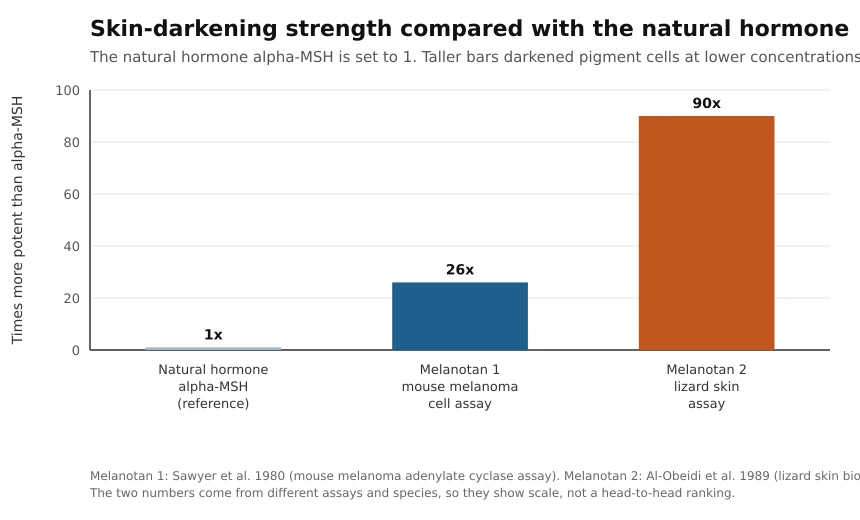
What it means: both are far stronger darkening agents than the hormone they were copied from. The one honest caveat is that nobody put them through the same test on the same day, so the 26 and the 90 are not a race result.
Result 2: how long the effect lasts
Duration was the whole point of both designs. The natural hormone is chopped up by blood enzymes within minutes. Melanotan 1 resisted that breakdown and produced what its authors called ultralong activity in the frog-skin test (Sawyer 1980). Even so, in a 2023 comparison, frogs given plain Melanotan 1 lost their darkening within a few days, while a slow-release gel form of the same peptide held it for more than four weeks (Chang 2023).
Melanotan 2 got its staying power from its ring. The 23- and 24-membered rings kept working after the peptide was rinsed away in both the frog and lizard tests; the tighter rings did not (Al-Obeidi 1989).
Result 3: how much the animals ate
This is where the two tracks separate. Melanotan 2 is the compound that put melanocortins on the map for appetite: delivered into the brain, it cut feeding in four separate hungry-mouse models, and a blocker drug switched the effect off completely, confirming it worked through the brain receptors and not by making the animals ill (Fan 1997).
Melanotan 1 does the same thing when it is placed directly into feeding-related brain regions. Fasted rats ate 52% less when it went into one region, 44% less in a second and 55% less in a third, measured one hour later (Kim 2000). Delivered into the brain ventricles, it also lowered 24-hour food intake and blunted the appetite surge caused by a known hunger signal, while leaving water drinking untouched, which suggests a specific effect on eating rather than general sedation (Brown 1998).
Over longer stretches, the appetite effect of Melanotan 2 fades. In rats on a 14-day continuous brain infusion, food intake dropped about 30% during the first 5 days and then drifted back to normal even though delivery continued; pausing and restarting brought the response back (Zhang 2010).
Figure 2. Food eaten by treated animals compared with untreated controls.
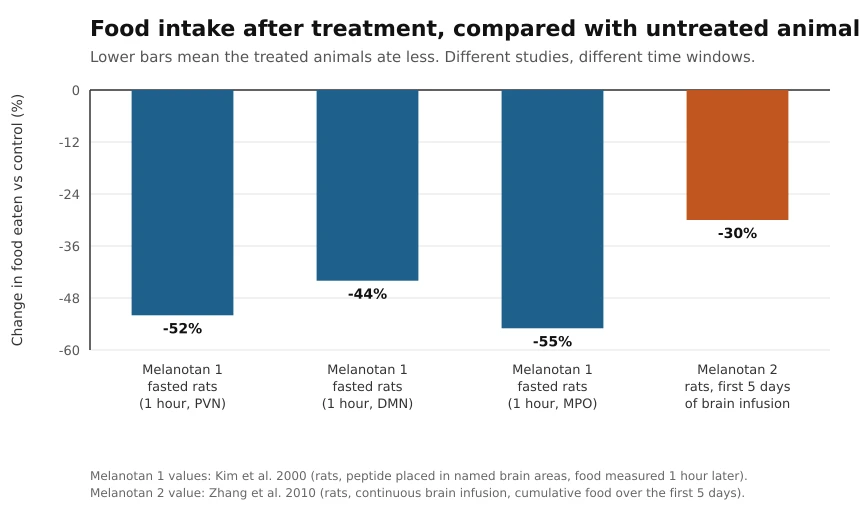
What it means: both peptides suppress eating when they reach the brain. The Melanotan 1 numbers are a sharp one-hour effect in fasted animals; the Melanotan 2 number is an average across five days of steady delivery, which is a harder test and fades with time.
Result 4: body weight and body fat
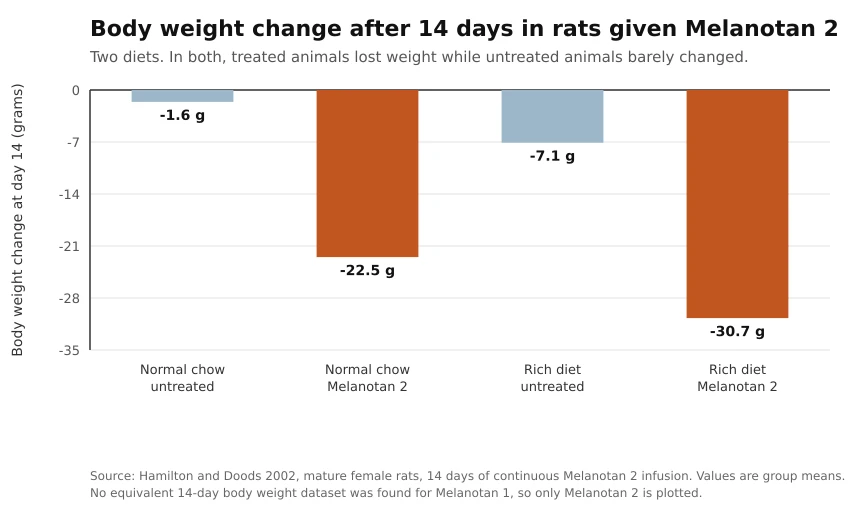
Melanotan 2 is the only one of the pair with multi-week weight data in these sources. In mature female rats, 14 days of continuous delivery left treated animals about 23 g lighter on normal chow and about 31 g lighter on a rich snack-food diet, while untreated animals on the same diets changed by about 2 g and 7 g (Hamilton 2002).
Figure 3. Body weight change at day 14 in rats given Melanotan 2.
The fat results are more striking than the weight results. After 30 days of brain infusion, rats had lost about 80% of their measured fat mass, and a fat-burning marker in abdominal fat was more than 10 times higher than in controls (Zhang 2010). In a separate 7-day study, treated rats carried fat pads about half the size of animals fed the same amount of food, meaning the fat loss was not simply the result of eating less (Raposinho 2003).
Result 5: energy burned
Two findings explain how Melanotan 2 keeps weight off after appetite recovers. Oxygen consumption, a direct measure of how fast an animal is burning energy, went up in treated rats (Hamilton 2002). And in both normal and diet-induced obese rats, treatment raised UCP1, the protein brown fat uses to turn calories into heat, with the rise in energy burn arriving faster in the obese group (Li 2004). No comparable energy-expenditure data for Melanotan 1 appeared in these sources.
Result 6: sexual behavior in rodents
This is a Melanotan 2 result with no Melanotan 1 counterpart in these sources. In awake male rats, Melanotan 2 produced erections whether it was given into the brain, into the lower spinal canal or into the bloodstream, and the response grew with the amount given; delivery to the lower spinal cord worked better than delivery to the brain. Injecting it directly into the penis did nothing, which shows the effect is driven by nerve signalling rather than local tissue (Wessells 2003). A later study confirmed it triggered erectile events and shortened the time until the first one, and traced part of the effect to the sympathetic nerve supply (Giuliano 2006).
In female rats primed with ovarian hormones, treatment increased courtship behaviors such as hops, darts and ear wiggling, without changing the receptive posture itself, and only when both priming hormones were present (Rossler 2006).
Result 7: what else showed up in the animals
For Melanotan 1, a mouse toxicology study ran 4 and 12 week schedules by injection and by skin application and found no damage to organs, no change in blood counts and no effect on weight gain or behavior, and no sign of stress-hormone activity. The only changes were slight rises in triglycerides and platelets in the group treated weekly for 12 weeks (Dorr 1988).
For Melanotan 2, the two recurring observations are yawning, which appeared alongside the erection response after brain and bloodstream delivery but not after spinal delivery (Wessells 2003), and the fading of the appetite effect within about 5 days of continuous delivery (Zhang 2010).
Bottom line: how they differ
On pigment, they are close cousins. Both darken pigment cells far more strongly and for far longer than the hormone they were copied from, and the published potency figures for both are in the same broad range once you allow for different tests and species.
Everything else is where they part. The animal record for Melanotan 2 extends into eating, body weight, fat mass, energy burn and sexual behavior, with numbers attached to each. The animal record for Melanotan 1 is concentrated on pigment, with a strong but short-window appetite effect when it is delivered straight into feeding-related brain areas and a clean mouse toxicology profile. Nobody has run the two head to head on the same animals and the same endpoints, so every comparison here is an assembly of separate studies rather than a single experiment.
What the research has not shown
No study in this set compares the two peptides side by side under identical conditions for any outcome.
The pigment potency figures come from different assays and different species and cannot be combined into one ranking.
Most of the eating, weight and fat results used delivery straight into the brain of rodents, which is a research technique, not a route that tells you anything about other species or delivery methods.
The absence of a Melanotan 1 result in a given row above means it was not measured in these sources, not that it would be zero.
None of these data establish efficacy, safety or any usage information outside controlled laboratory research.
Research product
Melanotan II (MT2) is available from NextGenPeps for laboratory research. Sequence Ac-Nle-cyclo[Asp-His-D-Phe-Arg-Trp-Lys]-NH2, molecular formula C50H69N15O9, approximately 1024.2 g/mol, CAS 121062-08-6.
References
Sawyer TK, Sanfilippo PJ, Hruby VJ, et al. 4-Norleucine, 7-D-phenylalanine-alpha-melanocyte-stimulating hormone: a highly potent alpha-melanotropin with ultralong biological activity. Proc Natl Acad Sci USA. 1980;77(10):5754-5758. PMID: 6777774.
Al-Obeidi F, Castrucci AM, Hadley ME, Hruby VJ. Potent and prolonged acting cyclic lactam analogues of alpha-melanotropin: design based on molecular dynamics. J Med Chem. 1989;32(12):2555-2561. PMID: 2555512.
Levine N, Lemus-Wilson A, Wood SH, et al. Stimulation of follicular melanogenesis in the mouse by topical and injected melanotropins. J Invest Dermatol. 1987;89(3):269-273. PMID: 3624899.
Chang CL, Cai Z, Hsu SYT. A gel-forming alpha-MSH analog promotes lasting melanogenesis. Eur J Pharmacol. 2023;958:176008. PMID: 37673364.
Fan W, Boston BA, Kesterson RA, Hruby VJ, Cone RD. Role of melanocortinergic neurons in feeding and the agouti obesity syndrome. Nature. 1997;385(6612):165-168. PMID: 8990120.
Kim MS, Rossi M, Abusnana S, et al. Hypothalamic localization of the feeding effect of agouti-related peptide and alpha-melanocyte-stimulating hormone. Diabetes. 2000;49(2):177-182. PMID: 10868932.
Brown KS, Gentry RM, Rowland NE. Central injection in rats of alpha-melanocyte-stimulating hormone analog: effects on food intake and brain Fos. Regul Pept. 1998;78(1-3):89-94. PMID: 9879751.
Zhang Y, Collazo R, Gao Y, Li G, Scarpace PJ. Intermittent MTII application evokes repeated anorexia and robust fat and weight loss. Peptides. 2010;31(4):639-643. PMID: 20034526.
Hamilton BS, Doods HN. Chronic application of MTII in a rat model of obesity results in sustained weight loss. Obes Res. 2002;10(3):182-187. PMID: 11886941.
Li G, Zhang Y, Wilsey JT, Scarpace PJ. Unabated anorexic and enhanced thermogenic responses to melanotan II in diet-induced obese rats despite reduced melanocortin 3 and 4 receptor expression. J Endocrinol. 2004;182(1):123-132. PMID: 15225137.
Raposinho PD, White RB, Aubert ML. The melanocortin agonist Melanotan-II reduces the orexigenic and adipogenic effects of neuropeptide Y. J Neuroendocrinol. 2003;15(2):173-181. PMID: 12535159.
Wessells H, Hruby VJ, Hackett J, et al. Ac-Nle-c[Asp-His-DPhe-Arg-Trp-Lys]-NH2 induces penile erection via brain and spinal melanocortin receptors. Neuroscience. 2003;118(3):755-762. PMID: 12710982.
Giuliano F, Clement P, Droupy S, Alexandre L, Bernabe J. Melanotan-II: investigation of the inducer and facilitator effects on penile erection in anaesthetized rat. Neuroscience. 2006;138(1):293-301. PMID: 16360286.
Rossler AS, Pfaus JG, Kia HK, et al. The melanocortin agonist, melanotan II, enhances proceptive sexual behaviors in the female rat. Pharmacol Biochem Behav. 2006;85(3):514-521. PMID: 17113634.
Dorr RT, Dawson BV, Al-Obeidi F, et al. Toxicologic studies of a superpotent alpha-melanotropin, [Nle4, D-Phe7]alpha-MSH. Invest New Drugs. 1988;6(4):251-258. PMID: 2852652.
For research use only. The information above summarizes published preclinical and in vitro research and is provided for scientific and educational purposes. NextGenPeps products are supplied strictly for laboratory research and development use and are not intended for human or animal consumption, clinical, diagnostic, cosmetic, or dietary use.
Mentioned in this article
Shop all compounds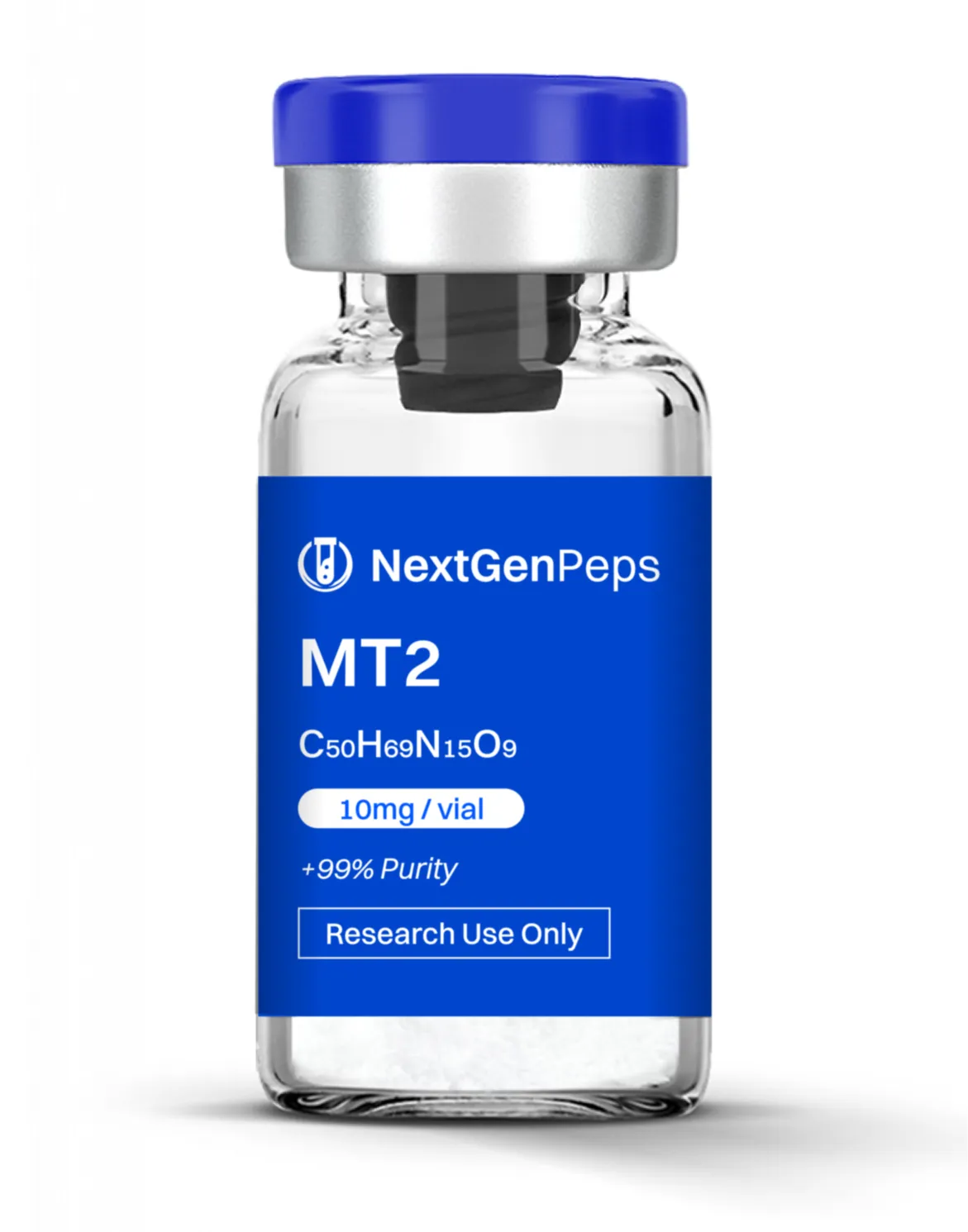
Written by NextGenPeps Research Team
The NextGenPeps Research Team summarizes published laboratory and animal research on the compounds NextGenPeps supplies for research use only.
More articles →Research Use Only: this article describes laboratory research. Nothing here is dosing guidance, and these materials are not intended for human use.