DHEA Capsules, in brief. DHEA (dehydroepiandrosterone) is a steroid made from cholesterol, mainly in the innermost layer of the adrenal cortex. It does little on its own; its main job is to be raw material. Tissues that carry the right enzymes turn it into androstenedione, testosterone and estrogens, and much of it is converted to a sulfated form, DHEA-S. That makes DHEA a precursor, or prohormone, rather than a finished signal. In primates the adrenal gland releases large amounts of it, while mice and rats make little or none, so rodent studies add DHEA from outside. In those studies DHEA reduced weight gain and body fat, prevented obesity and lowered high blood glucose in genetic mouse models, and reduced spontaneous tumors. DHEA is a steroid, not a peptide. NextGenPeps supplies DHEA Capsules as an oral-format research material for laboratory use only.
What is DHEA?
DHEA is a steroid hormone that serves mainly as a building block for other steroid hormones. The name is short for dehydroepiandrosterone, and its chemical name is 3β-hydroxyandrost-5-en-17-one. It is a C19 steroid: the same four-ring androstane skeleton as testosterone, with 19 carbon atoms.[1,2]
Most DHEA is made in the zona reticularis, the innermost zone of the adrenal cortex, and much of it is converted there into its sulfate ester, DHEA-S. DHEA and DHEA-S then act as precursors for more potent androgens, including testosterone, in peripheral tissues.[1] In the adrenal cortex the amount of tissue expressing the cofactor cytochrome b5, and DHEA output with it, has been reported to fall with age.[1]
Is DHEA a steroid or a hormone?
Both. DHEA is a steroid by structure and a hormone by origin: it is synthesized from cholesterol by the adrenal cortex and released into the blood. Because its best-documented role is as a substrate for other hormones, it is usually described as a prohormone or androgen precursor rather than as a strong hormone in its own right.[1,3]
It is not a peptide. Peptides are chains of amino acids; DHEA is a small lipid-derived molecule of 288 g/mol with no amino acids at all. Its direct actions, separate from its conversion products, are thought to involve several different receptors rather than one dedicated DHEA receptor.[3]
What does DHEA do?
It supplies the raw material for sex steroids. Most of what DHEA is known to do comes from what tissues turn it into, and from the sulfated reserve it forms in the blood.[1,2]
In practice that means three things:
Precursor to androgens. Tissues that express 3β-HSD convert DHEA to androstenedione, and 17β-HSD enzymes convert androstenedione to testosterone.[1,2]
Precursor to estrogens. Aromatase converts androgens to estrogens: androstenedione to estrone and testosterone to estradiol.[2] In mice fed DHEA, serum androgens and estrogens rose, and the conversion did not depend on the adrenals or gonads.[8]
A sulfated form. The enzyme SULT2A1 adds a sulfate group to make DHEA-S, the form most often measured in studies of adrenal androgen output.[1]
How is DHEA made?
DHEA is made from cholesterol in three enzyme steps, and one enzyme, CYP17A1, does most of the work (Figure 1).
CYP11A1 (P450scc) first cuts the side chain of cholesterol to make pregnenolone. CYP17A1 (P450c17) then performs two reactions: its 17α-hydroxylase activity converts pregnenolone to 17-hydroxypregnenolone, and its 17,20-lyase activity cleaves that product to DHEA.[2] The lyase step is enhanced by cytochrome b5, and the rise of cytochrome b5 in the zona reticularis is part of why that zone becomes the main source of DHEA.[1] This Δ5 route is the main pathway to C19 steroids in the primate adrenal, whereas rats and mice rely on a different (Δ4) route.[2,3]
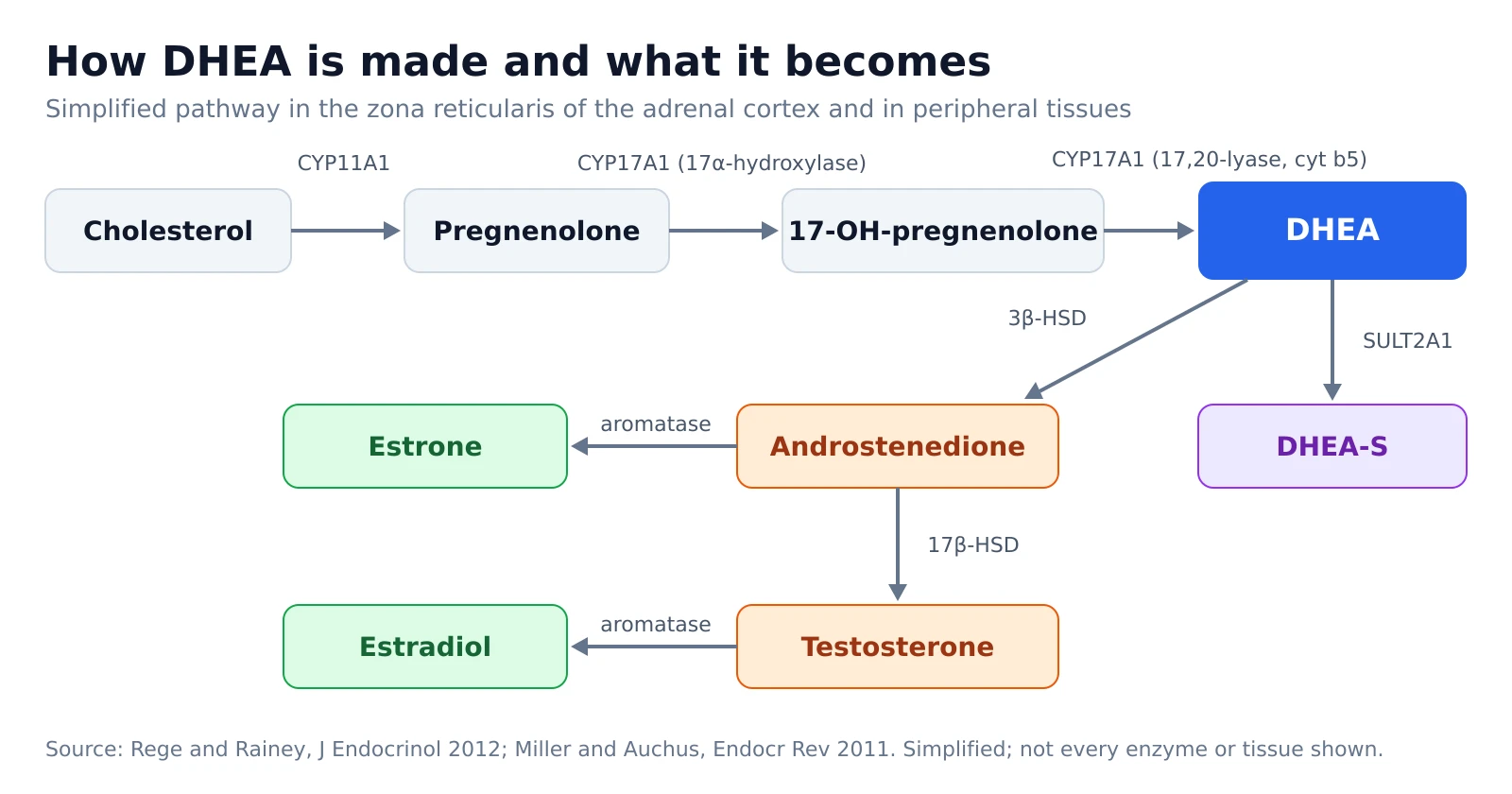
Figure 1. How DHEA is made and what it becomes. DHEA is the product of the CYP17A1 lyase step in the adrenal cortex. It is then stored as DHEA-S or converted to androgens and estrogens. A simplified scheme based on published reviews.[1,2]
What did DHEA do in animal studies?
In mice, DHEA reduced weight gain and body fat without cutting food intake, prevented obesity and lowered blood glucose in genetic models, reduced spontaneous tumors and prolonged survival in a lupus model. These results come from adding DHEA to animals that make very little of their own, which shapes how they can be read.
Less weight gain and less fat (Figure 2). Cleary and colleagues gave male C3H mice DHEA (450 mg/kg, by intubation three times a week) from 6 to 16 weeks of age. In mice housed five per cage, weight gain was 8.0 g against 15.6 g in controls, and fat pads made up 2.60% of body weight against 4.61%. In singly housed mice the gaps were smaller (10.9 g against 12.6 g; 2.91% against 3.92%). Food intake was similar between groups.[5]
Prevented obesity in yellow Avy/a mice. Yen and colleagues found that DHEA kept genetically obese Avy/a mice from becoming obese. Lower fat (triacylglycerol) storage accounted for much of the weight difference, liver fat synthesis was reduced, appetite was not suppressed, and the effect reversed when treatment stopped.[4]
Fewer spontaneous breast tumors. Long-term oral DHEA inhibited the formation of spontaneous mammary cancer in female C3H-Avy/A mice, a strain that normally develops these tumors.[6]
Lower blood glucose in diabetic mice. Coleman and colleagues reported therapeutic effects of dietary DHEA in diabetic mouse strains.[7] Follow-up work in db/db mice found that DHEA's estrogenic metabolites were the most potent at reducing hyperglycemia, suggesting that part of the effect depends on conversion.[8]
Longer survival in a lupus model. In New Zealand Black x New Zealand White F1 mice, which develop a lupus-like autoimmune disease, oral DHEA prevented the formation of antibodies to double-stranded DNA and prolonged survival.[9]
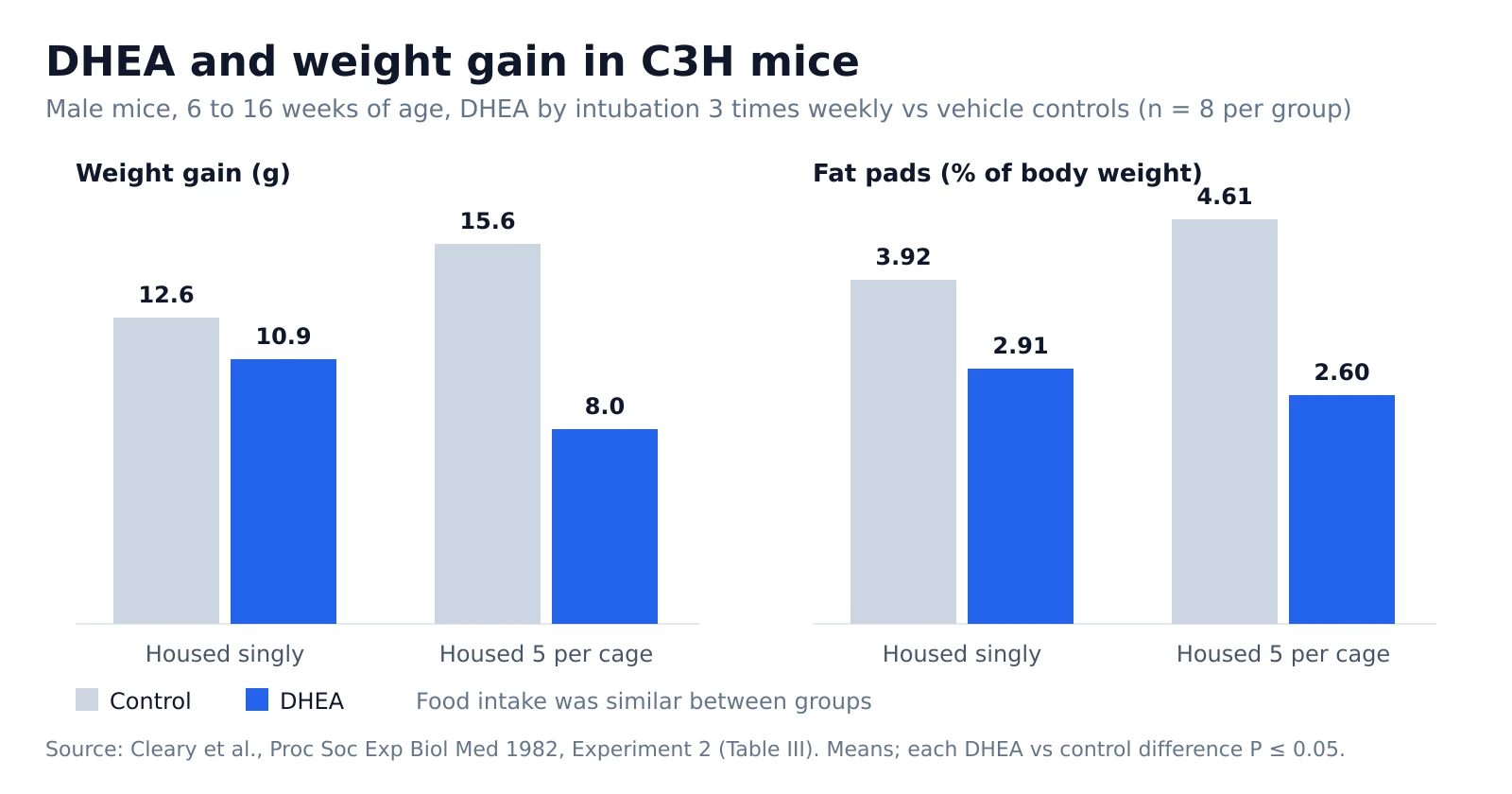
Figure 2. DHEA and weight gain in C3H mice. Mean weight gain and fat pad mass in male mice treated with DHEA or vehicle from 6 to 16 weeks of age, n = 8 per group. Every DHEA versus control difference shown was statistically significant.[5]
Why rodent results need care. Little or no DHEA is produced by the adrenal glands of nonprimate species such as mice and rats, which make their sex steroids by a different (Δ4) route.[3] Rodent studies therefore add DHEA at pharmacological levels to animals that normally have almost none, and the same review notes that DHEA is carcinogenic in rodents that show peroxisome proliferation at such doses.[3] Effects seen this way may not reflect what DHEA does at the levels primates produce naturally.
DHEA vs testosterone
DHEA is an upstream precursor; testosterone is one of its downstream products. They share the same steroid skeleton but differ in where they sit in the pathway and how they act.
Position in the pathway. DHEA is made directly from 17-hydroxypregnenolone by CYP17A1. Testosterone is two enzyme steps further on, typically via androstenedione.[1,2]
Main source. DHEA comes mainly from the zona reticularis of the adrenal cortex. Testosterone is made from androstenedione by 17β-HSD enzymes, both in the gonads and in peripheral tissues that receive adrenal precursors such as DHEA.[1]
Potency. Testosterone is a potent androgen. DHEA is described as a precursor that peripheral tissues use to produce more potent androgens.[1]
Further conversion. Both feed estrogen synthesis: aromatase converts testosterone to estradiol, and DHEA reaches estrogens through androstenedione.[2]
hCG for comparison. hCG, also listed by NextGenPeps, is a glycoprotein that acts on the LH/hCG receptor of the gonads. It is a receptor agonist, not a steroid or a steroid precursor, and the two materials are used to study different points in reproductive endocrinology.
What is DHEA made of?
DHEA is a single small molecule: a 19-carbon steroid with four fused rings, a hydroxyl group at carbon 3 and a ketone at carbon 17. The double bond between carbons 5 and 6 marks it as a Δ5 steroid, which is why it is converted to androstenedione by 3β-HSD, the enzyme that moves that double bond and oxidizes the 3-hydroxyl.[2]
The molecular formula is C19H28O2, with a molecular weight of 288.4 g/mol and CAS number 53-43-0. It is also known as prasterone and dehydroisoandrosterone.[9,11]
DHEA Capsules at a glance
Compound: Dehydroepiandrosterone (DHEA), also called prasterone
Class: C19 steroid; adrenal androgen precursor. Not a peptide
Structure: 3β-hydroxyandrost-5-en-17-one
Molecular formula: C19H28O2
Molecular weight: 288.4 g/mol
CAS number: 53-43-0
Strength: Per-capsule content and capsule count as stated on the container label
Identity and purity: Every lot is tested by independent labs and the certificate of analysis is published in the NextGenPeps COA library
Format: Oral capsules in a sealed container; no reconstitution needed
Regulatory status: Excluded from the US federal definition of an anabolic steroid by the Anabolic Steroid Control Act of 2004.[10] Listed by the World Anti-Doping Agency as a prohibited anabolic agent (S1.1)[11]
Is DHEA legal?
In the US, DHEA is not a controlled substance. The Anabolic Steroid Control Act of 2004 added dehydroepiandrosterone to the substances excluded from the federal definition of an anabolic steroid, and the Drug Enforcement Administration's implementing rule took effect on January 17, 2006.[10]
Sport is different. The World Anti-Doping Agency's 2026 Prohibited List names prasterone (dehydroepiandrosterone, DHEA, 3β-hydroxyandrost-5-en-17-one) under S1.1, anabolic androgenic steroids, prohibited when administered exogenously.[11] NextGenPeps supplies DHEA Capsules for laboratory research only.
What is DHEA used to study?
Researchers use DHEA to study the adrenal androgen pathway itself, and as an intervention in rodent models of obesity, diabetes, cancer and autoimmunity.
Adrenal steroidogenesis. CYP17A1 lyase activity, cytochrome b5 and SULT2A1 are studied through DHEA and DHEA-S output, including the rise of adrenal androgens known as adrenarche.[1]
Peripheral steroid conversion. DHEA is used as a substrate to measure how tissues make androgens and estrogens locally.[2,8]
Metabolic models. Obesity and diabetes models in mice, including Avy/a and db/db strains, test DHEA's effects on fat storage and blood glucose.[4,5,7]
Cancer models. Spontaneous and induced tumor models in rodents examine DHEA as a modifier of tumor formation.[6]
Autoimmunity. Lupus-prone NZB/NZW mice are used to study DHEA's effects on autoantibodies and survival.[9]
Buying DHEA Capsules for research: what each container includes
Every lot is tested by independent labs and the certificate of analysis is published in the NextGenPeps COA library.
Documented identity. The certificate of analysis for each lot is published in the public COA library.
Labelled strength. Per-capsule content and capsule count are printed on the container label.
US-based fulfilment. Orders ship within 24 hours from the United States, with free US shipping on orders over $150.
Research use only. DHEA Capsules are sold strictly for in vitro and approved animal research. They are not for human or veterinary use and are not sold as a drug, supplement or diagnostic.
DHEA Capsules handling, storage and analytical notes
Format. Supplied as capsules in a sealed container. No dosing instructions are supplied, and none should be taken from the studies above.
Storage. Keep the sealed container at 2 to 8 °C, dry and protected from light. Return the container to cold storage promptly after opening and keep it tightly closed to limit moisture uptake.
DHEA or DHEA-S. DHEA and its sulfate are different molecules, and assays differ in which one they measure. Studies should state which form was measured and how.[1]
Species. Because mice and rats make little adrenal DHEA, rodent results reflect added DHEA at pharmacological levels rather than a natural adrenal signal.[3]
Naming. DHEA, dehydroepiandrosterone, prasterone and dehydroisoandrosterone are the same compound. DHEA-S (DHEAS) is its 3-sulfate.
What is not established about DHEA
A dedicated receptor. DHEA's direct actions appear to involve several receptors, and how much of any effect comes from DHEA itself rather than its conversion products is often unclear.[3,8]
Transfer from rodents. Most animal results come from species whose adrenals make little or no DHEA, using pharmacological amounts.[3]
Safety at high exposure. DHEA has been reported to be carcinogenic in rodents that show peroxisome proliferation at pharmacological levels, so its tumor-reducing effects in other models are not a general property.[3,6]
Research Use Only. The statements made within this website have not been evaluated by the US Food and Drug Administration. These materials are not intended to diagnose, treat, cure or prevent any disease and are not intended for human or veterinary use. Studies described on this page are reported for scientific context and are not guidance of any kind.