BPC-157 Capsules, in brief. BPC-157 is a short chain of 15 amino acids, made in the lab and copied from part of a protein first described in gastric juice. In rat and cell studies it is studied for one job: helping injured tissue repair itself, mainly by helping blood vessels regrow and helping repair cells move into the damaged area [1,2]. What sets it apart from most peptides is that it has been tested by mouth. The research group that developed it describes it as stable in human gastric juice [3,4], and many of its rat studies gave it in drinking water as well as by injection [5,6,7,8,9]. In rats with a surgically created bladder fistula, every BPC-157 regimen, drinking water included, left the repaired bladder able to hold about five times more fluid before leaking than in controls [9]. What has never been measured is how much intact peptide reaches the blood after oral intake: the only published pharmacokinetic study found tested intravenous and intramuscular routes only [10]. NextGenPeps supplies BPC-157 Capsules in bottles of 60 capsules for laboratory use only.
What does BPC-157 do?
In animal studies it speeds up the repair of injured tissue, and in rats that effect has been reported when the peptide was simply dissolved in the drinking water. The same research group usually ran drinking-water groups side by side with injected groups, and in the studies below both routes were reported to work [5,6,7,8,9].
In practice the oral-route work covers three kinds of injury:
Gut and fistula models. In rats with a surgically made fistula from the colon to the skin, BPC-157 in drinking water or by injection healed the colon and skin defects and closed the fistula [5]; in a bladder fistula model it stopped leakage within a week of starting treatment [9].
Short bowel. After a large part of the small intestine was removed, untreated rats lost weight, while rats given BPC-157 in drinking water or by injection gained weight steadily above their pre-surgery values over four weeks [6].
Ligament and muscle-tendon injury. Oral BPC-157 improved healing of a cut knee ligament over 90 days [7] and restored function after the quadriceps muscle was detached from its tendon [8].
A 2025 systematic review of BPC-157 in muscle, tendon, ligament and bone found 36 eligible studies, 35 of them preclinical, so the evidence base is almost entirely animal and cell work [12].
NextGenPeps supplies BPC-157 Capsules for in vitro research and approved animal studies only. They are not sold as a drug, supplement or diagnostic.
How does BPC-157 work?
The short answer is that it makes blood vessel cells more responsive to growth signals and makes repair cells move. The route does not change the molecule, so this mechanism, worked out mostly in cultured cells, is the same one described on the BPC-157 vial page (Figure 1).
Blood vessels. In cultured endothelial cells, BPC-157 raised the amount of VEGFR2, the main receptor for the vessel growth factor VEGF, and switched on the VEGFR2, Akt and eNOS chain that produces nitric oxide. In rats with a blocked hind-limb artery it sped the recovery of blood flow [1].
Repair cells. In fibroblasts grown from rat Achilles tendon, BPC-157 did not make the cells divide faster. It increased how far they grew out of tendon explants, how many survived oxidative stress and how fast they migrated, through the FAK and paxillin pathway that cells use to crawl [2].
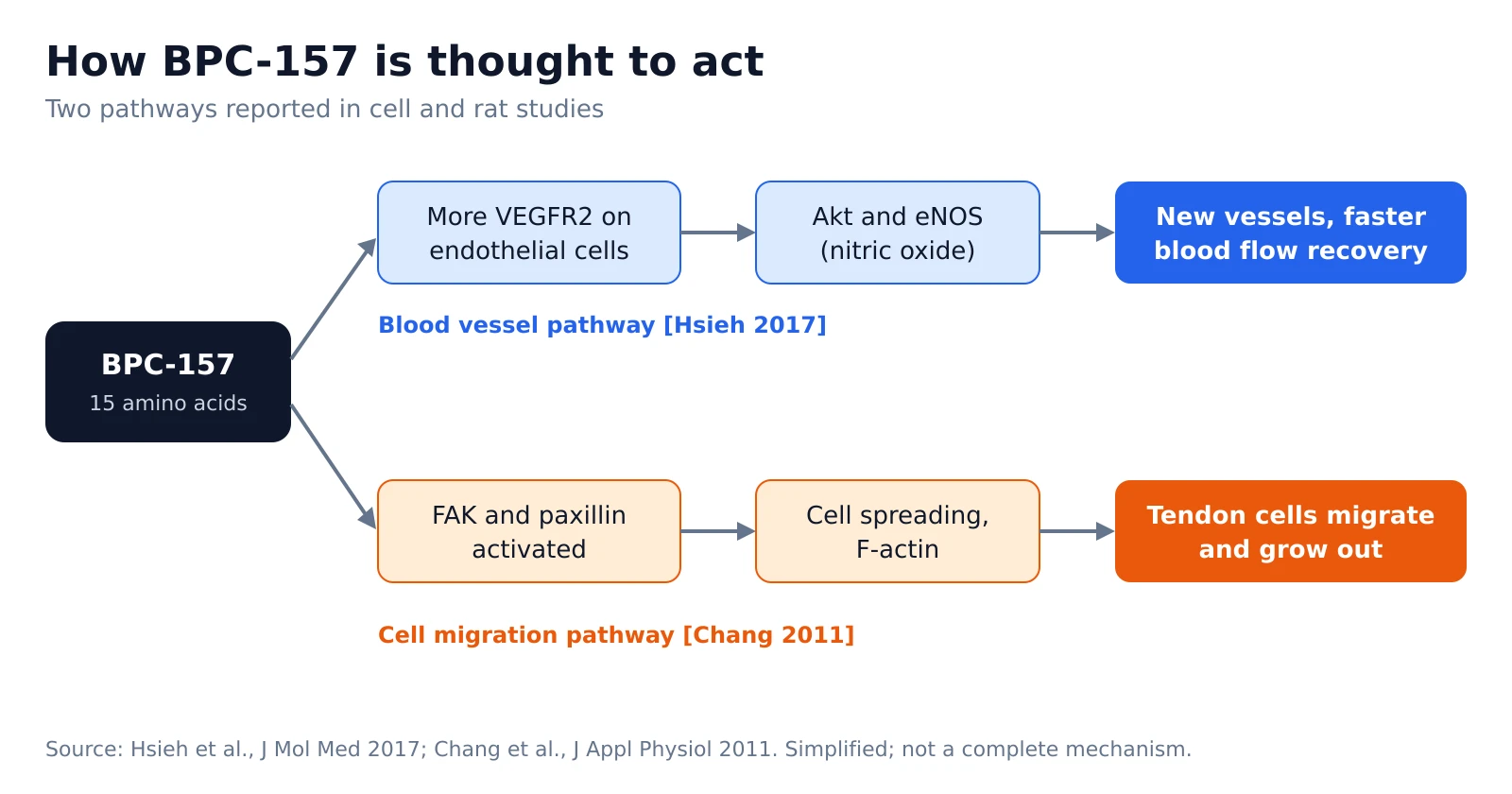
Figure 1. How BPC-157 is thought to act. A simplified map of the two best-described pathways, from rat and cell studies with the peptide given by injection or added to cells; it is not a complete mechanism.[1,2]
Is BPC-157 stable in stomach acid?
It is described that way, but the claim rests on the developing group's own statements rather than a published stability dataset.
Reviews from the Zagreb group that first described BPC-157 call it stable in human gastric juice [3,11], and a 2014 book chapter by the same group states it was found to be stable for at least 24 hours in human gastric juice [4]. None of these sources presents the underlying experiment: the assay method, the pH, the temperature or the share of intact peptide left at each time point. The 2022 pharmacokinetic study repeats that BPC-157 resists gastric juice but did not test it [10].
Stability in gastric juice is also not the same as absorption. A peptide can survive the stomach and still be broken down in the gut wall or the liver before it reaches the circulation, and in rat plasma the injected peptide was broken into smaller fragments within minutes [10]. For oral-route experiments, stability under the actual study conditions is best checked directly, for example by HPLC of peptide incubated in simulated gastric fluid.
Does oral BPC-157 work? What animal studies show
In rats, yes: in every oral-route study reviewed for this page, drinking-water groups were reported to heal better than controls. Five studies show what that looked like.
Bladder fistulas closed and stopped leaking. Rats were given a fistula between the bladder and vagina and left untreated for 14 days, so the fistula was established before treatment began. They then received BPC-157 in drinking water or by injection, with plain water or saline as controls (6 rats per group per time point). All BPC-157 regimens stopped urine leakage through the vagina within the first week. Later in the study, the repaired bladder held about five times more fluid before leaking than in controls, and the fistula closed completely. Every control rat with a long-standing fistula developed a bladder stone; no BPC-157 rat did (Figure 2) [9].
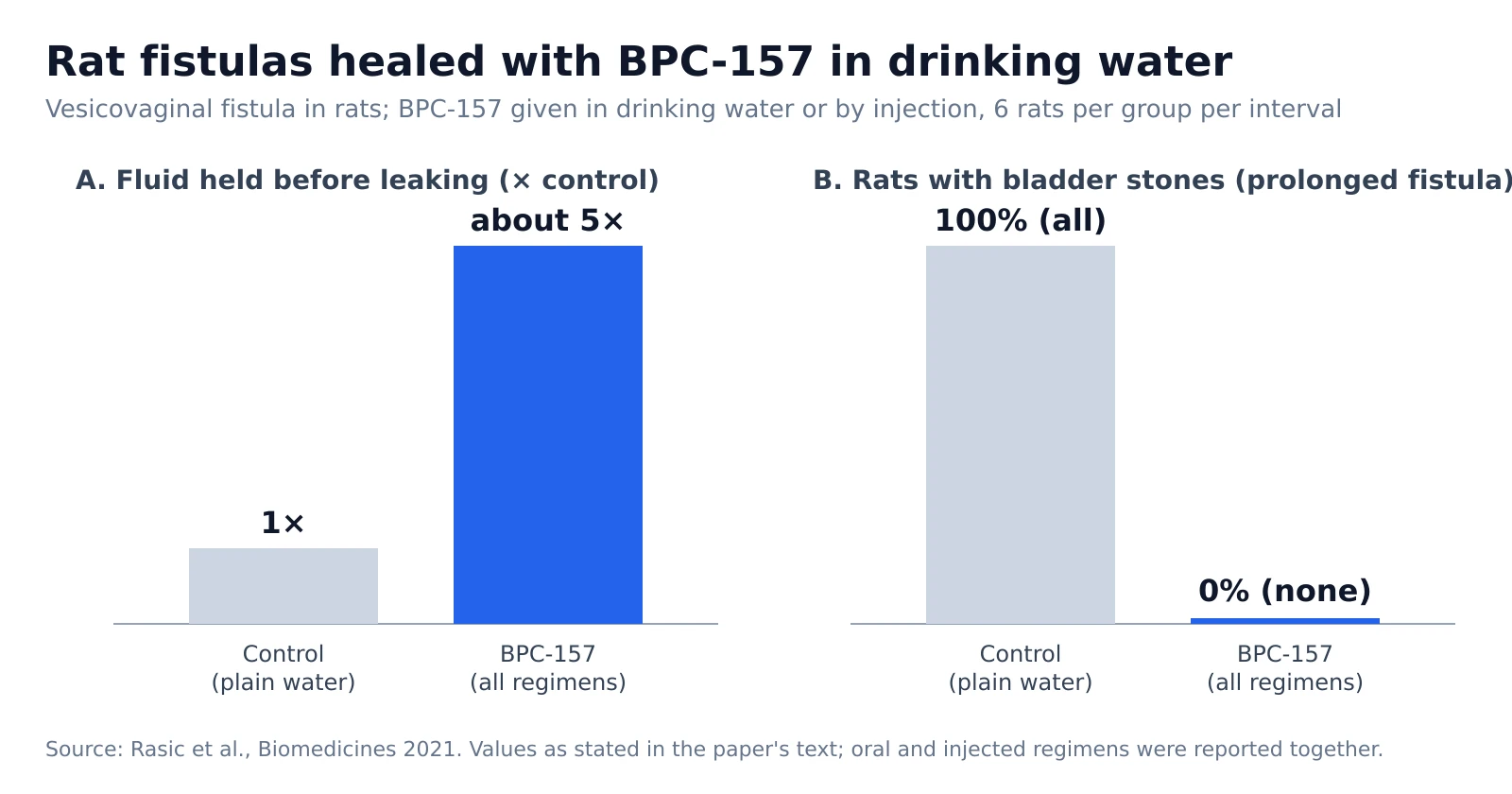
Figure 2. Oral and injected BPC-157 in a rat bladder fistula model. Ratios and stone counts as stated in the paper's text, 6 rats per group per interval; drinking-water and injected regimens were reported together, not compared head to head. Source: Rasic et al., 2021.[9]
Colon fistulas healed. In rats with a fistula from the colon to the skin, BPC-157 given in drinking water or by injection accelerated healing of both the colon and skin defects over 28 days and closed the fistula, which then held more water without leaking. The anti-inflammatory drug sulphasalazine was only moderately effective, and a corticosteroid made healing worse [5].
Weight came back after bowel removal. After a large small-bowel resection, untreated rats lost weight. Rats given BPC-157 in drinking water or by injection gained weight steadily above their pre-surgery values over four weeks, with taller villi and deeper crypts in the remaining bowel, both signs of the gut adapting [6].
Ligaments and muscle-tendon junctions healed. After the medial collateral ligament of the knee was cut, BPC-157 given by injection, in drinking water or as a cream improved functional, biomechanical and microscopic healing over 90 days, and the authors state it was effective given orally [7]. After the quadriceps muscle was detached from its tendon, BPC-157 in drinking water or by injection was reported to give full functional recovery, less muscle wasting and smaller defects by day 42 [8].
Limits of this evidence. All five studies come from one research group, most abstracts report the direction of effects rather than group values, and none was designed to compare oral and injected routes statistically. A review from the same group on anti-inflammatory drug injury also describes both oral and injected regimens as protective [11].
BPC-157 Capsules vs injection: what differs between routes
In the rat literature the two routes gave similar healing results, but only the injected routes have blood-level data (Figure 3).
How it was given. Oral-route studies dissolved the peptide in drinking water, so the rats took it in through the day; injected studies gave a single daily intraperitoneal dose [5,6,7,8,9].
Healing outcomes. Where both routes were tested in the same study, both were reported to work, without a formal comparison of which worked better [5,6,7,8,9].
Blood levels. After intramuscular injection, bioavailability was about 14 to 19% in rats and 45 to 51% in dogs, and after intravenous dosing the intact peptide had a half-life of about 15 minutes in rats and about 5 minutes in dogs [10]. Oral bioavailability has not been reported.
Format. Capsules hold a fixed amount of dry material and need no reconstitution, while vials hold lyophilised powder that is dissolved before use. Gavage of a suspension or solution is the usual way to give a defined oral amount to a single animal.
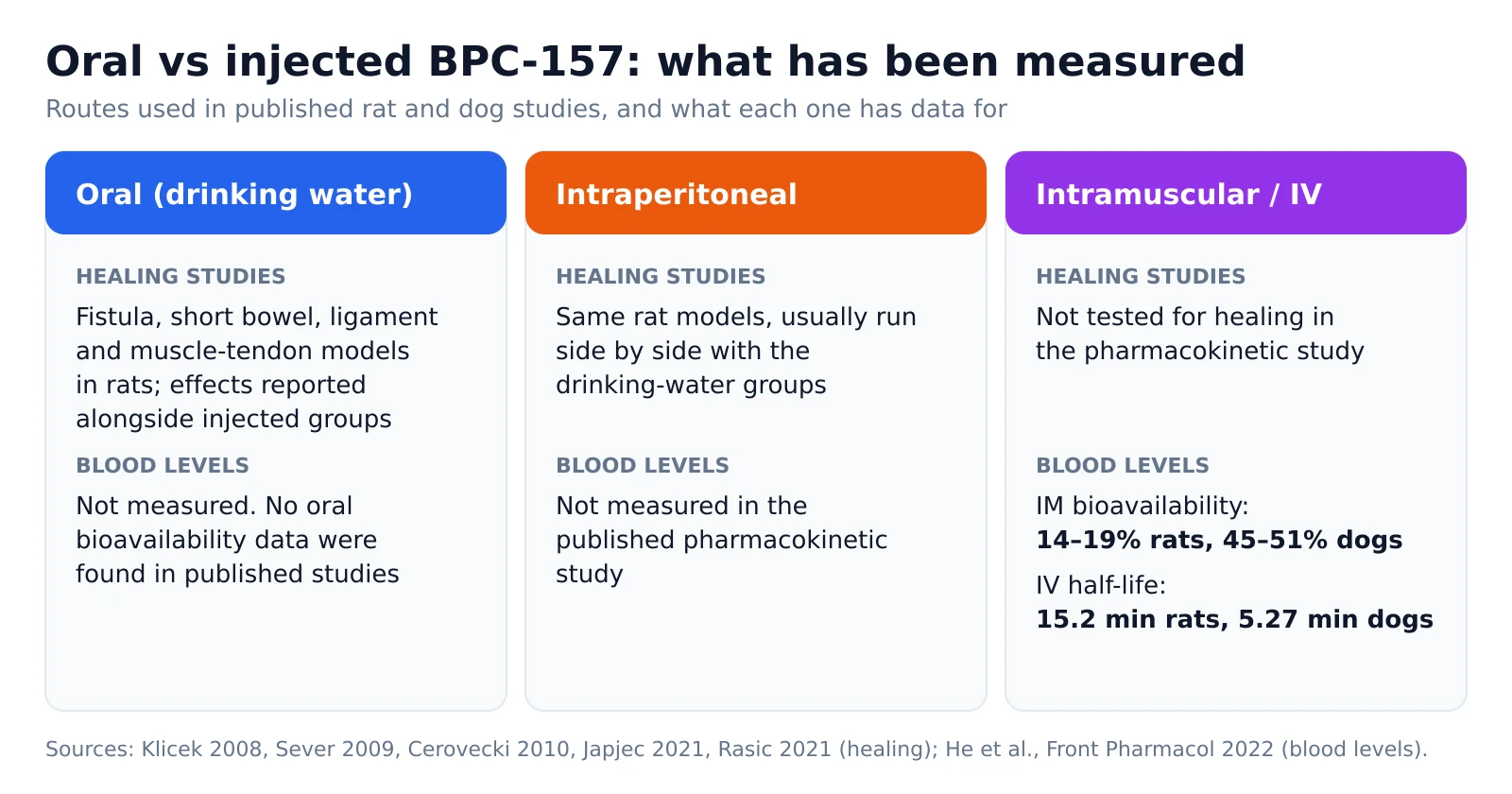
Figure 3. What is known for each route. Healing data come from rat studies that ran oral and intraperitoneal groups side by side; blood-level data come from a single rat and dog study of intravenous and intramuscular dosing. Sources: Klicek 2008, Sever 2009, Cerovecki 2010, Japjec 2021, Rasic 2021, He 2022.[5,6,7,8,9,10]
What is BPC-157 made of?
BPC-157 is a linear peptide of 15 amino acids, written GEPPPGKPADDAGLV (Gly-Glu-Pro-Pro-Pro-Gly-Lys-Pro-Ala-Asp-Asp-Ala-Gly-Leu-Val). The name stands for body protection compound 157, and the sequence is a partial sequence of a protein described in gastric juice. Its molecular formula is C62H98N16O22 and its molecular weight is 1419.5 g/mol (CAS 137525-51-0).
Four of the 15 residues are proline, three of them in a row near the start. In rats the peptide was broken down into small fragments and ultimately into single amino acids, and at one hour proline made up most of the radioactivity in plasma after a labelled dose [10]. The capsule contains the same sequence as the BPC-157 vials; only the format differs.
BPC-157 Capsules at a glance
Compound: BPC-157 (body protection compound 157), also written BPC 157
Class: Synthetic linear pentadecapeptide
Sequence: Gly-Glu-Pro-Pro-Pro-Gly-Lys-Pro-Ala-Asp-Asp-Ala-Gly-Leu-Val (GEPPPGKPADDAGLV)
Molecular weight: 1419.5 g/mol; formula C62H98N16O22; CAS 137525-51-0
Format: 60 capsules per bottle
Identity and purity: Every lot is tested by independent labs and the certificate of analysis is published in the NextGenPeps COA library
Appearance: Capsules in a sealed bottle
Reconstitution: Not required; the capsule fill can be dissolved or suspended for oral-route work
Half-life: Under 30 minutes in rats and dogs after intravenous or intramuscular dosing; not measured after oral dosing [10]
Regulatory status: Not an FDA-approved drug. Research use only
What are BPC-157 Capsules used to study?
Researchers use the oral format when the question is about the route itself, or about injuries of the gut where the peptide can act along the way.
Oral versus injected delivery. Head-to-head designs that test whether a drinking-water or gavage regimen reproduces an injected effect, ideally with plasma sampling, which the published work lacks [10].
Fistula healing. Colon-to-skin and bladder fistula models in rats, with leak volume, closure and histology as endpoints [5,9].
Intestinal adaptation. Short bowel models, with body weight, villus height and crypt depth as endpoints [6].
Ligament and muscle-tendon repair. Transected ligament and myotendinous junction models, with function and biomechanics as endpoints [7,8].
Gastric stability. Simulated gastric fluid assays that measure how much intact peptide remains over time [3,4].
Buying BPC-157 Capsules for research: what each bottle includes
Every lot is tested by independent labs and the certificate of analysis is published in the NextGenPeps COA library. For injected or in vitro work, the same peptide is available as BPC-157 in 5 mg and 10 mg vials, and BPC-157 / TB-500 Capsules pair it with a thymosin beta-4 fragment in the same oral format.
Lot documentation. The certificate of analysis for each lot is published in the COA library.
One format. 60 capsules per bottle.
US-based fulfilment. Orders ship within 24 hours from the United States, with free US shipping on orders over $150.
Research use only. BPC-157 Capsules are sold strictly for in vitro and approved animal research. They are not for human or veterinary use and are not sold as a drug, supplement or diagnostic.
BPC-157 Capsules handling, storage and analytical notes
Format. Supplied as capsules in a sealed bottle. No dosing instructions are supplied, and none should be taken from the studies above, which used peptide dissolved in drinking water or given by injection rather than capsules.
Storage. Keep the sealed bottle at 2 to 8 °C, dry and protected from light, and close it promptly after opening, since moisture degrades peptides. Material dissolved for an experiment should be held at 2 to 8 °C and used within the window the laboratory has validated.
Content. For quantitative work, confirm the peptide content of the capsule fill by HPLC against a reference standard rather than assuming a nominal amount, and report it in study records.
Short half-life. After injection the intact peptide had a half-life of 5 to 30 minutes depending on species, route and amount [10]. Any study measuring exposure after oral delivery needs early and frequent sampling and an assay that separates intact peptide from fragments.
Naming. BPC-157, BPC 157 and pentadecapeptide BPC 157 refer to the same sequence. PL 14736 is a development code used for the same peptide in some papers.
What is not established about BPC-157 Capsules
Oral bioavailability. No published study has measured how much intact BPC-157 reaches the blood after oral delivery in any species [10].
Gastric stability data. The stability claim comes from the developing group, and the underlying method and time-course data have not been published in full [3,4].
Capsule-specific data. The oral-route studies used peptide dissolved in drinking water. None tested a capsule format, and route comparisons were not powered to detect differences [5,6,7,8,9].
Independent replication. The oral-route healing studies come from a single research group, and no dedicated long-term safety study exists; a 2025 systematic review found no clinical safety data [12].
Research Use Only. The statements made within this website have not been evaluated by the US Food and Drug Administration. These materials are not intended to diagnose, treat, cure or prevent any disease and are not intended for human or veterinary use. Studies described on this page are reported for scientific context and are not guidance of any kind.