






Isolation and discovery
VIP was isolated from porcine small intestine as the factor responsible for vasodilation, and named for that activity.
Said & Mutt, Science 1970 →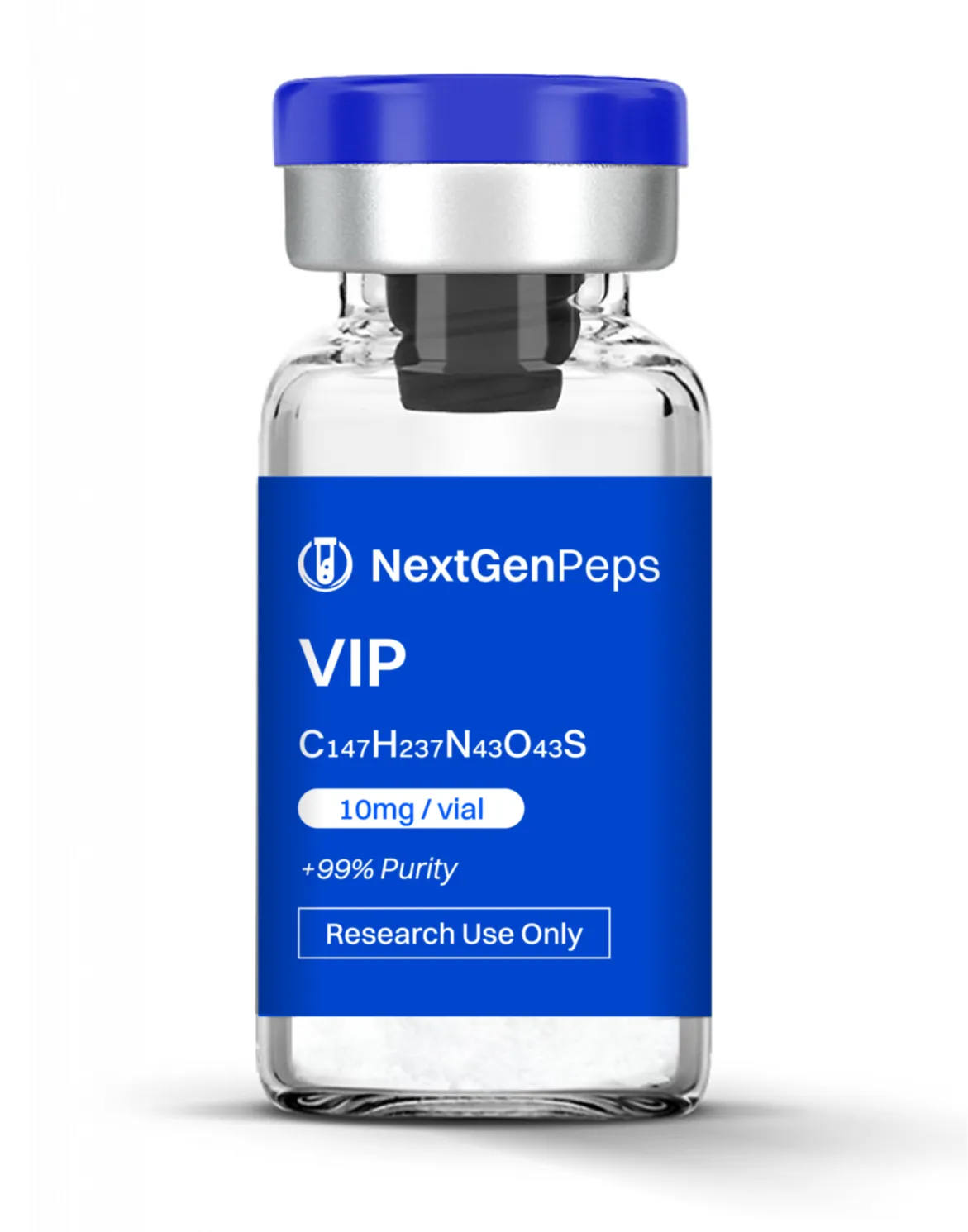
5.0· 3 reviewsout of 5In stock
Buy VIP peptide (vasoactive intestinal peptide) for research: 10 mg vials, 99.2% purity by UHPLC-MS, public COA on every lot. Ships within 24 hours.
Bundle & Save
Need more?
Secure checkout · Visa · Mastercard · American Express · Discover · PayPal · Venmo · Apple Pay
99.195%
HPLC purity · Tested by Janoshik
VIP, in brief. Vasoactive intestinal peptide is a 28-residue hormone your own body makes, isolated from pig intestine by Said and Mutt in 1970. It acts on two receptors, VPAC1 and VPAC2, raising cAMP and producing smooth muscle relaxation, vasodilation and reduced inflammatory signalling. Its synthetic form, aviptadil, has been through human trials in pulmonary hypertension and in COVID-19 respiratory failure, and is not approved for any use. The plasma half-life is about a minute, which constrains every protocol built around it. NextGenPeps supplies VIP for laboratory research only.
VIP is a 28-amino-acid peptide hormone belonging to the secretin and glucagon superfamily, which also includes PACAP, GHRH and glucagon-like peptides. Its sequence ends in a C-terminal amide, which is required for receptor binding.
Said and Mutt isolated it in 1970 while looking for the factor in intestinal extracts responsible for vasodilation, which is where the name comes from [1]. The name has not aged well: VIP turned out not to be primarily an intestinal hormone. It is produced throughout the central and peripheral nervous systems, in the gut, in the lungs and by immune cells including T lymphocytes and mast cells. In the brain it is a major transmitter in the suprachiasmatic nucleus, the master circadian clock.
So VIP is better understood as a widely distributed signalling peptide that happens to have been found in the gut first.
VIP binds two class B G-protein-coupled receptors with high affinity, VPAC1 and VPAC2, and a third, PAC1, with substantially lower affinity (PAC1 prefers the related peptide PACAP). Binding raises intracellular cAMP and activates protein kinase A (Figure 1).
From there the effects depend entirely on which cell type is expressing the receptor, which is why VIP's effects look so scattered in the literature:
Smooth muscle relaxes, producing vasodilation and bronchodilation, and relaxation in gut smooth muscle.
Immune cells shift away from pro-inflammatory signalling. Part of this is attributed to reduced NF-kappaB nuclear translocation downstream of the cAMP rise.
Secretory epithelium changes fluid and electrolyte secretion, which is the basis of the watery diarrhoea seen in VIPoma, a rare VIP-secreting tumour.
The breadth is both why VIP is interesting as a research tool and why it has been hard to turn into a drug: there is no tissue where you can act on it in isolation.

Figure 1. VIP receptor signalling. The same cAMP and PKA step produces different outcomes depending on which cell carries the receptor. VPAC1 and VPAC2 are the high-affinity targets; PAC1 binds VIP weakly and prefers PACAP.
VIP is cleared from plasma within roughly a minute. This is not an estimate: in a 1978 human study, plasma VIP fell with first-order kinetics after an infusion was stopped, with a mean disappearance half-time of about one minute [4].
This is the single most important practical fact about working with VIP, and most vendor pages omit it. It explains why clinical programmes have used continuous infusion or inhaled delivery rather than simple injection, why much of the mechanistic literature is in cell and tissue preparations rather than whole animals, and why results are sensitive to how quickly the peptide gets from preparation to assay. Record that interval in your methods.
Gastrointestinal motility and secretion. The original territory, and still a major one, in isolated tissue preparations and in whole-animal work.
Airway and vascular tone. VIP relaxes airway and vascular smooth muscle, which drove the pulmonary hypertension and asthma interest.
Neuroimmune signalling. VIP is used to probe how neuropeptides modulate T cell and macrophage behaviour, where the anti-inflammatory literature is strongest.
Circadian biology. VIP and VPAC2 are central to how suprachiasmatic nucleus neurons stay synchronised, and VIP is a standard tool in that field.
Receptor pharmacology. As the endogenous ligand, VIP is the reference compound for characterising VPAC1 and VPAC2 and for developing selective agonists and antagonists.
Yes, more than most research peptides, and the results are instructive.
Synthetic VIP is called aviptadil. The two results worth knowing are these.
Pulmonary hypertension, 2003. A study in primary pulmonary hypertension reported lower mean pulmonary artery pressure and improved cardiac output with VIP [5]. This result is cited constantly. It is worth knowing that it was an open-label series of eight patients with no control group, and that it was never replicated in a controlled trial.
COVID-19 respiratory failure. Aviptadil was developed as ZYESAMI and attracted enormous attention. The FDA declined an emergency use authorization in November 2021, and declined a second narrowed request afterwards [6]. The definitive test came later: TESICO, an NIH-funded randomised placebo-controlled trial of 461 patients, 94% of them in intensive care. It found no benefit on its primary endpoint (odds ratio 1.11, 95% CI 0.80 to 1.55, p = 0.54) and no mortality difference at 90 days. The data safety monitoring board stopped the aviptadil arm for futility [3].
Aviptadil is not approved by the FDA for any indication (Figure 2). It is available in some other countries in different contexts, including as a component of a combination product for erectile dysfunction in parts of Europe, which is unrelated to the uses discussed here.
What the evidence does and does not show. VIP's receptor biology and its effects in isolated tissue are well established, and unlike almost everything else in this catalogue it has been through an adequately powered randomised human trial. That is exactly why the result matters: being a real hormone with real receptors did not translate into clinical benefit, and the trial was stopped for futility. Mechanistic findings in cells and rodents are routinely presented online as though they were human evidence. They are not.

Figure 2. Where VIP evidence stands. Solid basic biology and completed human trials, without an approval. The short half-life and the breadth of receptor distribution are the recurring obstacles.
Every VIP lot is tested by an independent laboratory, and the certificate of analysis is published in the NextGenPeps COA library.
Analytical testing. Identity and purity by UHPLC-MS, 99.20% purity (Janoshik, April 30, 2026). This lot was not endotoxin tested.
Vial size. 10 mg of lyophilized VIP per vial.
Fulfilment. Orders ship within 24 hours from the United States, with free US shipping on orders over $150.
Research use only. VIP is sold strictly for in vitro and approved animal research. It is not for human or veterinary use and is not sold as a drug, cosmetic, supplement or diagnostic.
Format. Supplied as white lyophilized powder in a sealed vial and reconstituted with sterile or bacteriostatic water before use. No dosing instructions are supplied, and none should be inferred from the trials above.
Adsorption to surfaces. VIP is a long, basic peptide and sticks to glass and plastic. At the low concentrations used in receptor work, surface losses can be a significant fraction of what you weighed out. Carrier protein such as BSA in the buffer, and low-binding tubes, are common precautions.
Peptidase sensitivity. The same proteolysis that gives VIP its short half-life operates in tissue preparations and serum-containing media. Peptidase inhibitors are routine in isolated tissue work.
Oxidation. The sequence contains a methionine, which can oxidise. Protect from air and light and avoid prolonged storage in solution.
Clinical benefit anywhere. No indication has been approved, and the COVID-19 emergency authorization was declined.
Whether the short half-life can be engineered around. Longer-acting analogues and VPAC-selective agonists remain under investigation.
Tissue selectivity. Because VPAC receptors are so widely distributed, isolating an effect to one system is an unsolved problem.
Any of the uses it is marketed for as a research peptide. These are not supported by controlled human data.
Research Use Only. The statements made within this website have not been evaluated by the US Food and Drug Administration. These materials are not intended to diagnose, treat, cure or prevent any disease and are not intended for human or veterinary use. Studies described on this page are reported for scientific context and are not guidance of any kind.
VIP was isolated from porcine small intestine as the factor responsible for vasodilation, and named for that activity.
Said & Mutt, Science 1970 →IUPHAR review of the VPAC1, VPAC2 and PAC1 receptors, their distribution and their signalling.
Harmar et al., Br J Pharmacol 2012 →After infusion stopped, plasma VIP fell with first-order kinetics and a mean disappearance half-time of about one minute. This is the source of the half-life figure.
Domschke et al., Gut 1978 →Open-label study in eight patients with primary pulmonary hypertension reporting reduced pulmonary artery pressure and improved cardiac output. Uncontrolled and never replicated in a randomised trial.
Petkov et al., J Clin Invest 2003 →In 461 patients, intravenous aviptadil showed no benefit on the primary endpoint (OR 1.11, p=0.54) and no mortality difference at 90 days. The aviptadil arm was stopped for futility.
Brown et al., Lancet Respir Med 2023 →Said SI, Mutt V · Science 1970;169(3951):1217-8 · PubMed
Harmar AJ, Fahrenkrug J, Gozes I, et al. · Br J Pharmacol 2012;166(1):4-17 · PubMed
Brown SM, Barkauskas CE, Grund B, et al.; ACTIV-3b/TESICO Study Group · Lancet Respir Med 2023;11(9):791-803 · PubMed
Domschke S, Domschke W, Bloom SR, et al. · Gut 1978;19(11):1049-55
Petkov V, Mosgoeller W, Ziesche R, et al. · J Clin Invest 2003;111(9):1339-46 · PubMed
NRx Pharmaceuticals / Relief Therapeutics · Company announcement, November 2021
VIP is supplied as lyophilized powder in a sealed, labelled 10 mg vial, with the lot's certificate of analysis published in the NextGenPeps COA library. Please inspect the sealed package when it arrives and contact support promptly if the package or labeling appears damaged.
Orders ship within 24 hours from the United States via USPS for orders placed before the 5:00 PM PDT cutoff. Transit times are typically 3–7 business days, depending on destination and carrier conditions. Tracking information is provided when available.
Store lyophilized VIP at −20 °C or below in the sealed vial, protected from light and moisture. After reconstitution with sterile or bacteriostatic water, hold the solution at 2–8 °C, protected from light, and avoid repeated freeze-thaw cycles.
Due to the nature of research materials, NextGenPeps orders are final and are not eligible for refunds, returns, or exchanges. Review the shipping and reship policies before ordering.
No. NextGenPeps materials are supplied strictly for laboratory research and development use and are not intended for human or animal consumption, clinical use, diagnostic use, cosmetic use, or dietary use.
5.0out of 5 · 3 reviews
Easy to order and delivered fast. The CoA was easy to understand after learning what to look for and could see everything line up to the labels
Anika F.
Paid for ground shipping and it still came in 2 days. Insanely fast service, def coming back
Vincent G.
Made 3 reorders and each time reconstituted crystal clear without clouding.
Silas A.
VIP, vasoactive intestinal peptide, is a 28-amino-acid hormone in the secretin and glucagon family, isolated from pig intestine by Said and Mutt in 1970. Despite the name it is made throughout the nervous system, lungs, gut and immune cells, and is a major transmitter in the brain's circadian clock. It binds the VPAC1 and VPAC2 receptors.
Binding VPAC1 or VPAC2 raises intracellular cAMP and activates PKA. What follows depends on the cell type: smooth muscle relaxes, giving vasodilation and bronchodilation; immune cells shift away from pro-inflammatory signalling; and secretory epithelium changes fluid and electrolyte handling. That breadth is why VIP is a useful research tool and a difficult drug.
Gastrointestinal motility and secretion, airway and vascular smooth muscle tone, neuroimmune signalling in T cells and macrophages, circadian biology in the suprachiasmatic nucleus, and receptor pharmacology, where VIP is the reference ligand for characterising VPAC1 and VPAC2.
No. Synthetic VIP is called aviptadil. The FDA declined an emergency use authorization for it in critical COVID-19 in November 2021 and declined a narrowed second request afterwards. The TESICO randomised trial of 461 patients then found no benefit on its primary endpoint and no mortality difference, and the aviptadil arm was stopped for futility. Aviptadil is not FDA-approved for any indication.
About a minute. A 1978 human study measured plasma VIP falling with first-order kinetics after an infusion stopped, with a mean disappearance half-time of roughly one minute. This is the most important practical fact about working with it: clinical programmes used continuous infusion or inhaled delivery rather than simple injection, and laboratory results are sensitive to the interval between preparation and assay.
NextGenPeps supplies VIP in 10 mg vials for laboratory research, with an independent certificate of analysis for every lot (99.20% by UHPLC-MS on the current lot). Orders ship within 24 hours from the United States. VIP is sold for in vitro and approved animal research only.
✓ 99.310% purity
$88.00$70.00
✓ 99.79% purity
$52.00$42.00
✓ 99.81% purity
$98.00$78.00
✓ 98.817% purity
$78.00$62.00
✓ 99.72% purity
$89.00$71.00