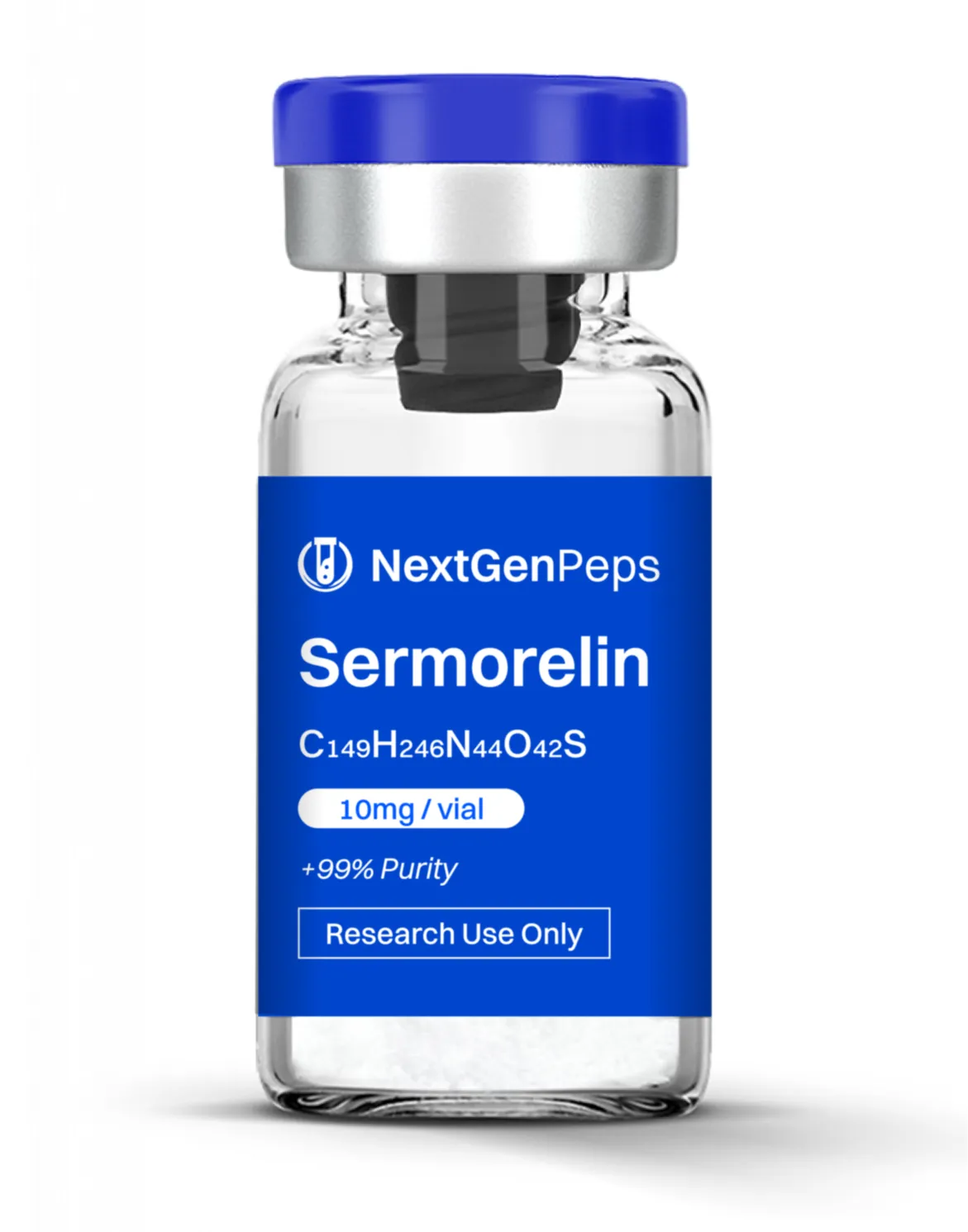




How is Sermorelin packaged?
Sermorelin is supplied in the product format and quantity shown for the selected variant. Please inspect the sealed package when it arrives and contact support promptly if the package or labeling appears damaged.
5.0· 3 reviewsout of 5In stock
10mg
Sermorelin research vials, the 1-29 amino acid fragment of growth hormone releasing hormone. Tested for purity, weight and endotoxins, COA published.
Sermorelin Research Peptide Overview
Sermorelin is a high-purity, research-grade peptide analogue of growth hormone–releasing hormone (GHRH), composed of the N‐terminal 29 amino acids of native human GHRH. It is widely used to investigate endogenous growth hormone (GH) secretion, IGF‐1 regulation, and growth hormone–linked tissue remodeling in controlled experimental systems.
Molecular Composition and Mechanistic Profile
Sermorelin (GHRH 1‐29 amide): A 29–amino acid synthetic peptide corresponding to the N‐terminal segment of human GHRH, often formulated as the acetate salt.
Mechanistically, Sermorelin:
Binds to GHRH receptors on somatotroph cells in the anterior pituitary, stimulating synthesis and pulsatile release of endogenous GH.
Increases circulating GH and downstream IGF‐1 levels while preserving physiological feedback control, which limits excessive GH exposure and related off‐target effects.
Has a short plasma half‐life (approximately 8–12 minutes) with GH-releasing effects that can persist for up to about two hours in experimental and early clinical observations.
These properties make Sermorelin a useful model for studying GH axis modulation without direct recombinant GH administration.
Integrated Research Applications
Sermorelin is employed across a range of growth hormone–related research domains. Representative experimental areas include:
Growth hormone deficiency models: Evaluation of pituitary responsiveness, GH pulsatility, IGF‐1 dynamics, and body-composition changes in pediatric and adult deficiency paradigms.
Tissue repair and remodeling: Studies on cardiac remodeling post–myocardial injury, bone density and turnover, renal function, and neurocognitive outcomes, where GH/IGF‐1 signaling plays a key role.
Sleep and circadian research: Investigation of Sermorelin’s impact on sleep architecture and nocturnal GH release, aligning dosing with endogenous GH secretion cycles.
Synergistic peptide protocols: Exploration of combined use with ghrelin mimetics (GH secretagogues like GHRP or Ipamorelin) to compare or augment GH release through dual GHRH and ghrelin receptor activation.
This breadth of applications enables integrated modeling of endocrine, metabolic, and regenerative processes mediated by the GH–IGF‐1 axis.
Analytical Validation and Product Characteristics
Research Sermorelin products from these suppliers are typically provided as lyophilized powder at defined peptide content (e.g., 5 mg per vial). Key quality and handling features include:
Purity: Commonly specified at ≥99% and verified by high-performance liquid chromatography (HPLC).
Identity: Confirmed via mass spectrometry and sequence verification to match GHRH (1‐29) amide.
Formulation: Shipped in lyophilized or powder form and intended to be reconstituted with appropriate diluent for research and testing.
Product notes emphasize that dosing instructions are not provided and that materials are intended as pharmaceutical-grade research reagents rather than clinical products.
Storage and Stability Guidelines
Proper storage is essential to maintain Sermorelin integrity and activity. Typical guidance includes:
Store vials in a cool, dry place away from light when lyophilized.
After reconstitution (“constituted”), keep refrigerated to preserve peptide stability over the short term.
For longer-term storage, freezing at approximately −20 °C is recommended to maintain structural integrity and limit degradation.
These practices align with standard handling of GHRH analogues and other research peptides.
NextGenPeps supplies Sermorelin as a high-purity research peptide intended strictly for controlled laboratory use in vitro or in established animal models. This compound is not approved as a drug, diagnostic agent, or dietary ingredient, and is not manufactured, packaged, or marketed for human consumption, self-experimentation, clinical application, or any use outside properly designed and ethically approved research protocols.
98.817%
HPLC purity · Tested by Janoshik
Sermorelin is supplied in the product format and quantity shown for the selected variant. Please inspect the sealed package when it arrives and contact support promptly if the package or labeling appears damaged.
Orders are shipped within the United States via USPS. Transit times are typically 3–7 business days, depending on destination and carrier conditions. Tracking information is provided when available.
Storage requirements are product-specific. Keep Sermorelin in its original labeled container and follow the product documentation or manufacturer instructions supplied with the order. Contact support if the applicable storage guidance is not available.
Due to the nature of research materials, NextGenPeps orders are final and are not eligible for refunds, returns, or exchanges. Review the shipping and reship policies before ordering.
No. NextGenPeps materials are supplied strictly for laboratory research and development use and are not intended for human or animal consumption, clinical use, diagnostic use, cosmetic use, or dietary use.
Sermorelin is a synthetic 29-amino acid peptide that corresponds to the N-terminal fragment of growth hormone-releasing hormone. It acts as a GHRH receptor agonist in endocrine research. Sermorelin is used to stimulate pituitary gland activity and endogenous growth hormone secretion in laboratory models. Its shorter chain makes it more stable than full-length GHRH for experimental use. Researchers study sermorelin as a tool to investigate the growth hormone axis and age-related hormonal changes.
In research, sermorelin is applied to study growth hormone release, IGF-1 production, and downstream metabolic effects in animal and cell models. It helps examine pituitary function, body composition, and tissue growth pathways. Scientists use it in experiments on sleep, recovery, and anabolic processes. Sermorelin serves as a reference compound for comparing GHRH analogs and secretagogues.
Sermorelin can indirectly support testosterone levels in some animal models by elevating growth hormone and IGF-1, which influence gonadal function. Studies show variable effects depending on the species, age, and experimental conditions. Growth hormone stimulation from sermorelin may enhance Leydig cell activity and steroidogenesis in certain setups. However, direct testosterone increases are not the primary outcome in most sermorelin research.
Sermorelin has a short half-life of approximately 10-20 minutes in research models, leading to pulsatile growth hormone release. Its effects on GH secretion are observed within minutes of administration and typically last 1-2 hours. The duration of downstream metabolic changes varies by protocol and animal model. Researchers monitor acute and chronic responses in endocrine experiments.
✓ 99.62% purity
✓ 99.748% purity
✓ 99.66% / 99.80% / 99.72% purity
✓ 99.310% purity
✓ 99.72% purity