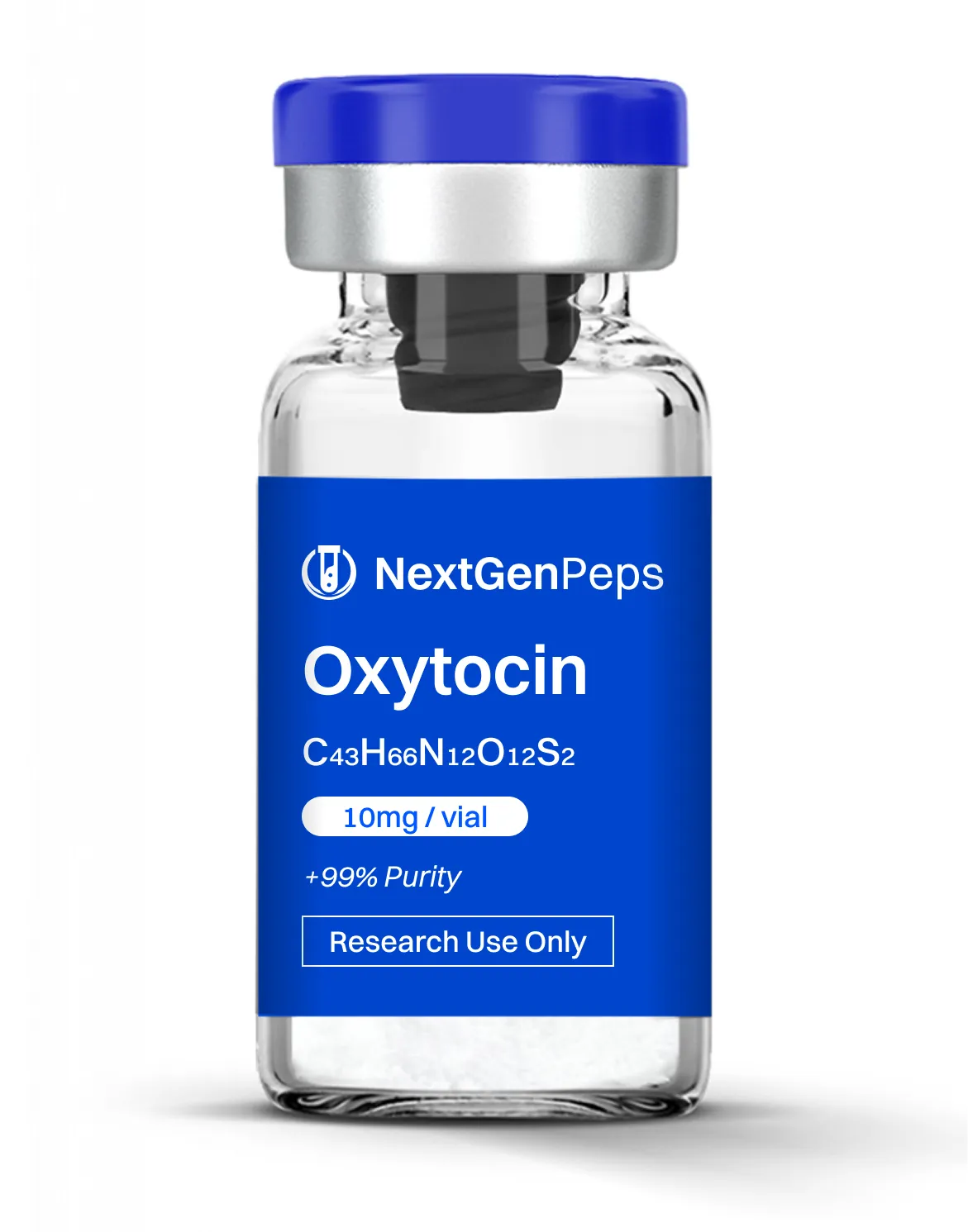
How is Oxytocin packaged?
Oxytocin is supplied in the product format and quantity shown for the selected variant. Please inspect the sealed package when it arrives and contact support promptly if the package or labeling appears damaged.
Out of stock
Oxytocin research vials, a nine-amino-acid cyclic peptide with a disulfide bridge. Tested for purity and content, and screened for endotoxins.
Oxytocin is a cyclic nonapeptide hormone investigated for its roles in social bonding, reproductive physiology, and neuromodulatory signaling pathways in preclinical models.
Molecular Composition and Mechanistic Profile
Peptide identity: Oxytocin is a nine amino acid peptide with the sequence Cys Tyr Ile Gln Asn Cys Pro Leu Gly NH2 featuring a disulfide bond between the cysteine residues at positions 1 and 6.
Origin: Endogenous neuropeptide synthesized in the hypothalamus and released from the posterior pituitary, produced synthetically for research applications.
Mechanistically, Oxytocin has been associated with:
Binding to G protein coupled oxytocin receptors that activate intracellular calcium and protein kinase pathways in experimental systems.
Modulation of neural circuits involved in social recognition pair bonding and stress responses in animal models.
Influences on reproductive behaviors and smooth muscle contractility observed in laboratory preparations.
These properties position Oxytocin as a tool for studying neuropeptide mediated social and reproductive signaling.
Integrated Research Applications
Oxytocin is examined across neural and endocrine systems. Representative domains include:
Social behavior models: Investigation of pair bonding parental care and social recognition in rodent and other animal preparations.
Reproductive physiology studies: Evaluation of effects on uterine and mammary tissue contractility in experimental systems.
Stress and anxiety related research: Assessment of neuromodulatory actions on hypothalamic pituitary adrenal axis markers in laboratory models.
Comparative neuropeptide research: Use alongside vasopressin to explore differential receptor mediated pathways in controlled settings.
Overall, Oxytocin serves as a research tool for exploring coordinated neuropeptide regulation of social reproductive and stress related networks.
Analytical Validation, Formulation, and Storage
NextGenPeps supplies Oxytocin as a high purity research peptide. Typical quality and handling features include:
Purity: ≥99% verified by HPLC.
Formulation: White lyophilized powder in sealed glass vials, intended for reconstitution with appropriate research grade solvent for experimental use only. No dosing guidance is provided for any organism.
Storage: Keep lyophilized material in a cool dark dry environment; long term storage at or below −20 °C. Store reconstituted solutions refrigerated, minimize freeze thaw cycles, and use within laboratory defined stability windows.
These conditions support structural integrity and reproducible experimental outcomes.
NextGenPeps supplies Oxytocin as a high purity research peptide intended strictly for controlled laboratory use in vitro or in established animal models, such as murine systems. This compound is not approved as a drug, diagnostic, or dietary ingredient, and is not manufactured, packaged, or marketed for human consumption, self experimentation, clinical application, or any use outside properly designed and ethically approved research protocols.
Oxytocin is supplied in the product format and quantity shown for the selected variant. Please inspect the sealed package when it arrives and contact support promptly if the package or labeling appears damaged.
Orders are shipped within the United States via USPS. Transit times are typically 3–7 business days, depending on destination and carrier conditions. Tracking information is provided when available.
Storage requirements are product-specific. Keep Oxytocin in its original labeled container and follow the product documentation or manufacturer instructions supplied with the order. Contact support if the applicable storage guidance is not available.
Due to the nature of research materials, NextGenPeps orders are final and are not eligible for refunds, returns, or exchanges. Review the shipping and reship policies before ordering.
No. NextGenPeps materials are supplied strictly for laboratory research and development use and are not intended for human or animal consumption, clinical use, diagnostic use, cosmetic use, or dietary use.
Oxytocin is a naturally occurring hormone made in the brain, specifically in a region called the hypothalamus, and released by the pituitary gland. It's a small peptide made of nine amino acids. It's often nicknamed the "love hormone" or "bonding hormone" because of its role in social and emotional connection, though its actual job in the body is broader than that nickname suggests.
In animal models beyond reproduction, it's also deeply involved in social bonding, being released during activities like physical touch, and orgasm, and playing a role in the bond that forms between parents and infants. It also has a calming effect on the nervous system, and research links it to trust, empathy, and reduced stress and anxiety in social situations.
Synthetic oxytocin is built to be structurally identical to the oxytocin that animals already make, so it works by binding to the same oxytocin receptors found on cells throughout the organism, particularly in the uterus and mammary glands. Because it's given directly into the bloodstream rather than released naturally by the brain, it acts more strongly and predictably on the body, but it doesn't necessarily cross into the brain the same way naturally produced oxytocin does.
The closest peptide is Vasopressin, since the two hormones are structurally almost identical, differing by only two amino acids out of nine, and they're even made in neighboring parts of the brain. Vasopressin's main job is regulating water balance and blood pressure, but it also plays its own separate role in social behavior and bonding, especially in males.
✓ 99.748% purity
✓ 99.62% purity
✓ 99.310% purity
✓ 99.73% purity
✓ 99.715% purity