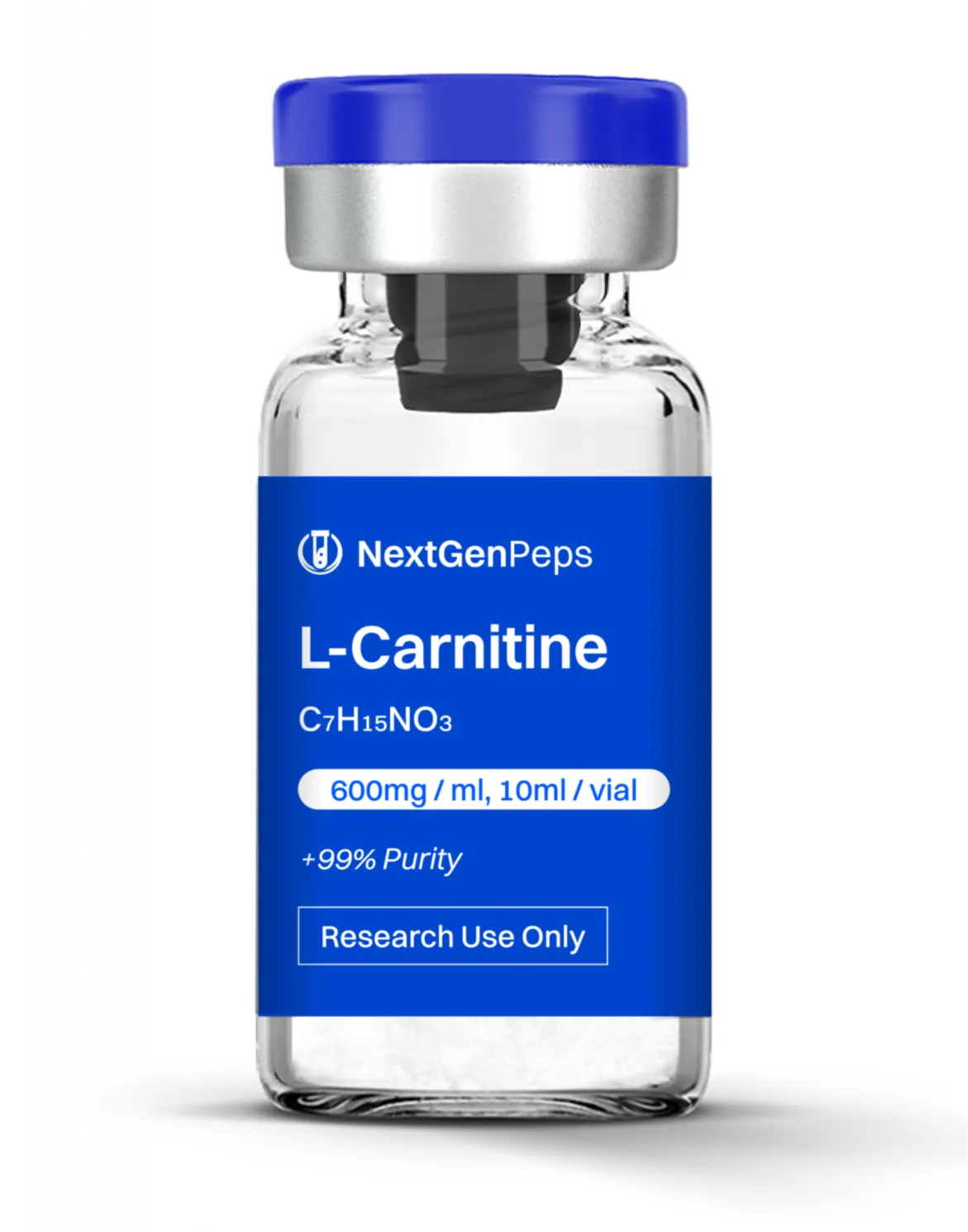




How is L-Carnitine packaged?
L-Carnitine is supplied in the product format and quantity shown for the selected variant. Please inspect the sealed package when it arrives and contact support promptly if the package or labeling appears damaged.
5.0· 3 reviewsout of 5In stock
L-Carnitine research vials, a quaternary ammonium compound supplied for laboratory use. Tested for purity and content, and screened for endotoxins.
L-Carnitine is a naturally occurring amino acid derivative that plays a central role in fat metabolism. It is widely used in research for its involvement in transporting long-chain fatty acids into mitochondria for energy production.
What makes L-Carnitine interesting is its essential function in shuttling fatty acids across the mitochondrial membrane, enabling beta oxidation and supporting cellular energy balance, particularly in muscle and heart tissue.
Its main effects center on fat metabolism and mitochondrial function:
It facilitates the transport of long-chain fatty acids into mitochondria for beta oxidation and ATP production.
It helps regulate mitochondrial fuel switching and supports overall energy metabolism.
In research models it has been studied for reducing fat accumulation and improving fat oxidation during exercise or metabolic stress.
Additional work explores its role in muscle recovery, where it may help reduce exercise induced damage and oxidative stress.
Integrated Research Applications
L-Carnitine is primarily studied for metabolic health, exercise performance, and mitochondrial function:
Most research focuses on fat metabolism and energy production. It is commonly used in studies examining fatty acid oxidation, body composition, and mitochondrial efficiency in muscle tissue.
It is applied in exercise and recovery models, where supplementation has shown potential to support performance, lower lactate levels, and reduce muscle damage markers.
Some studies investigate its benefits in metabolic conditions, including support for insulin sensitivity and fat utilization in high fat diet models.
Researchers also use it in aging and cardiovascular models due to its role in mitochondrial health and energy production.
Analytical Validation, Formulation, and Storage
Research grade L-Carnitine is supplied as a high purity solid, typically ≥98% purity verified by HPLC with a batch specific certificate of analysis.
Formulation: Solid material for reconstitution with an appropriate aqueous solvent. No dosing instructions are provided.
Storage follows standard small molecule handling:
Keep the solid form at or below -20°C in a cool, dark, dry place.
After reconstitution, store at 2-8°C, avoid repeated freeze-thaw cycles, and use within standard laboratory timeframes.
NextGenPeps supplies L-Carnitine as a high purity research compound intended strictly for controlled laboratory use in vitro or in established animal models. This compound is not approved as a drug, diagnostic, or dietary ingredient, and is not manufactured, packaged, or marketed for consumption, self-experimentation, clinical application, or any use outside properly designed and ethically approved research protocols.
99.47%
HPLC purity · Tested by Bioregen
L-Carnitine is supplied in the product format and quantity shown for the selected variant. Please inspect the sealed package when it arrives and contact support promptly if the package or labeling appears damaged.
Orders are shipped within the United States via USPS. Transit times are typically 3–7 business days, depending on destination and carrier conditions. Tracking information is provided when available.
Storage requirements are product-specific. Keep L-Carnitine in its original labeled container and follow the product documentation or manufacturer instructions supplied with the order. Contact support if the applicable storage guidance is not available.
Due to the nature of research materials, NextGenPeps orders are final and are not eligible for refunds, returns, or exchanges. Review the shipping and reship policies before ordering.
No. NextGenPeps materials are supplied strictly for laboratory research and development use and are not intended for human or animal consumption, clinical use, diagnostic use, cosmetic use, or dietary use.
L-Carnitine is a naturally occurring quaternary ammonium compound derived from the amino acids lysine and methionine. It is synthesized in the liver and kidneys and stored primarily in skeletal muscle. L-Carnitine plays a key role in fatty acid transport across mitochondrial membranes. Researchers study it as an essential cofactor in energy metabolism. The compound exists in free and acetylated forms (Acetyl-L-Carnitine) for different experimental applications.
L-Carnitine shuttles long-chain fatty acids into mitochondria for beta-oxidation and ATP production in cellular models. It helps remove toxic acyl groups and supports oxidative metabolism. In research, it modulates acyl-CoA/CoA ratios and influences carbohydrate fat metabolism balance. L-Carnitine exhibits antioxidant properties and stabilizes membranes in some studies. Its actions are central to lipid utilization and energy homeostasis investigations.
L-Carnitine is studied for its involvement in fat metabolism, exercise performance, and recovery in animal and cell models. Researchers examine its potential in mitochondrial disorders, cardiovascular function, and age-related energy decline. It is used in experiments on obesity, insulin sensitivity, and muscle fatigue. L-Carnitine supports investigations into lipid transport and metabolic flexibility. Applications focus on energy production pathways.
L-Carnitine is sometimes studied alongside GLP-1 receptor agonists in metabolic research due to complementary effects on energy balance and fat oxidation. GLP-1 agonists influence appetite and glucose control, while L-Carnitine supports mitochondrial fatty acid handling. Some protocols explore their combination for enhanced lipid metabolism in obesity models. The connection lies in shared pathways of weight regulation and insulin sensitivity. Researchers investigate potential synergistic benefits in energy expenditure studies.
✓ 99.748% purity
✓ 99.62% purity
✓ 99.310% purity
✓ 99.73% purity
✓ 99.715% purity