





Copper peptide discovery
GHK isolated from human plasma as a factor that prolonged survival of liver cells in culture; later shown to carry copper(II).
Pickart & Thaler, Nat New Biol 1973 →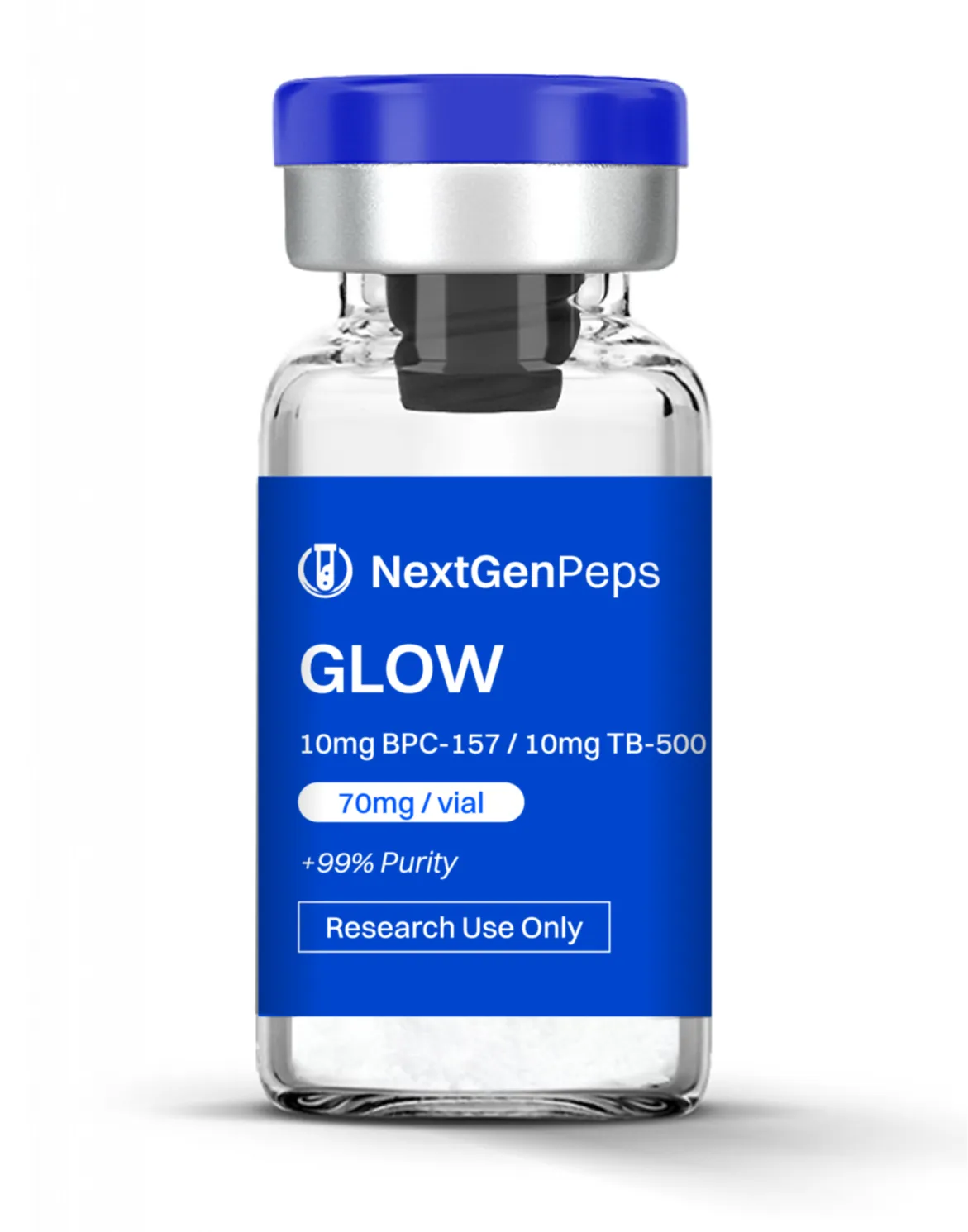
4.8· 4 reviewsout of 5Out of stock
Buy GLOW peptide, a research blend of GHK-Cu, BPC-157 and TB-500, in 70 mg and 50 mg vials. 99%+ HPLC purity, public COA on every lot. Ships within 24 hours.
Size
Enter your email and we'll let you know when this size is back.
Secure checkout · Visa · Mastercard · American Express · Discover · PayPal · Venmo · Apple Pay
99.66% / 99.80% / 99.72%
Reported purity · Tested by Bioregen
GLOW peptide, in brief. Rebuilding damaged tissue is not one job but a sequence: get blood to the injury, get cells to move in and build new vessels, then lay down the collagen scaffold that makes the repair hold. GLOW puts three peptides in one vial, and each has its own preclinical literature on a different part of that sequence. GHK-Cu, a copper-binding tripeptide found in plasma, is the one studied for the collagen stage; in fibroblast cultures it drove collagen synthesis at picomolar concentrations [2]. BPC-157, a 15-residue fragment of a gastric protein, is studied for blood supply and the earliest response to injury [5]. TB-500, synthetic full-length thymosin beta-4, is studied for getting cells to move into a wound and for new vessel growth; in a rat wound model it increased skin regrowth by up to 61% at day 7 [9]. What the three do together is unknown, because no published study has tested the combination, and that is why GLOW is a research tool rather than a characterized formulation. NextGenPeps supplies it for laboratory use only.
Each of the three is studied for making damaged tissue rebuild faster, and the vial simply holds all three at a fixed ratio. GLOW itself has not been studied as a single agent, so what follows is the record of the components, not of the blend.
Between them the three cover different stages of healing: blood supply and the early response to injury, cell movement and new blood vessel growth, and rebuilding the extracellular matrix, the scaffold of collagen and related molecules that holds tissue together.
What the mixture itself does is unknown. No peer-reviewed study has tested the three peptides in combination.
The rationale for combining the three is that tissue repair runs in overlapping stages, and each peptide has been studied in a different one (Figure 1). BPC-157 work concentrates on blood supply and the early response to injury [5]. Thymosin beta-4 work concentrates on cell movement into the wound and new vessel growth [8,9]. GHK-Cu work concentrates on rebuilding the extracellular matrix: collagen, glycosaminoglycans and the enzymes that remodel them [2,3].
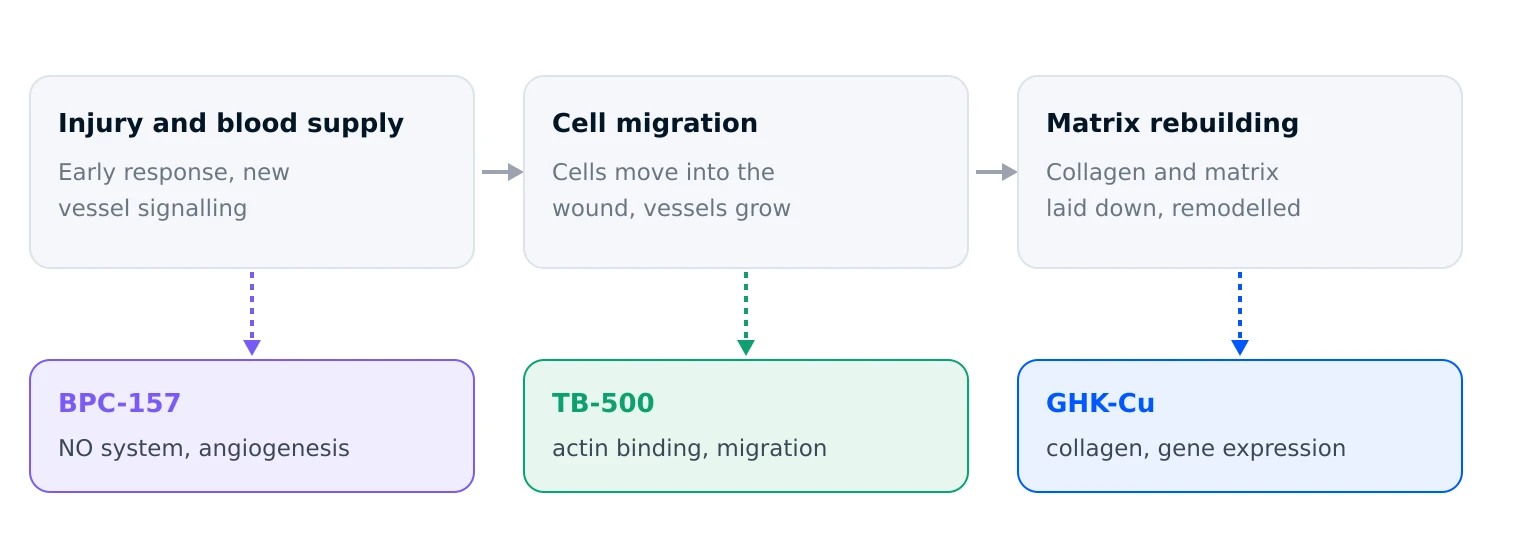
Figure 1. Where each component sits in the repair sequence. A simplification of the stages each peptide has been studied in, in cell and animal models. The arrows show the order of repair stages, not proven interactions between the peptides.
What the combination does and does not show. The case for GLOW rests on each component's separate literature. No peer-reviewed study has tested BPC-157, TB-500 and GHK-Cu together, so any additive or synergistic effect of the blend is a hypothesis to test, not a finding.
The three peptides are packed into one vial so that a protocol can deliver all three together at a fixed ratio. That suits designs meant to test the combination rather than any single component.
The three components sit at very different stages of evidence (Figure 2). GHK-Cu has the longest history, with decades of cell and animal work and use in topical cosmetics. Thymosin beta-4 has gone furthest clinically, with phase 2 trials of topical and eye-drop formulations. BPC-157 has a large rodent literature, mostly from a single research group, and almost no controlled clinical data. The blend itself has no published studies at all.
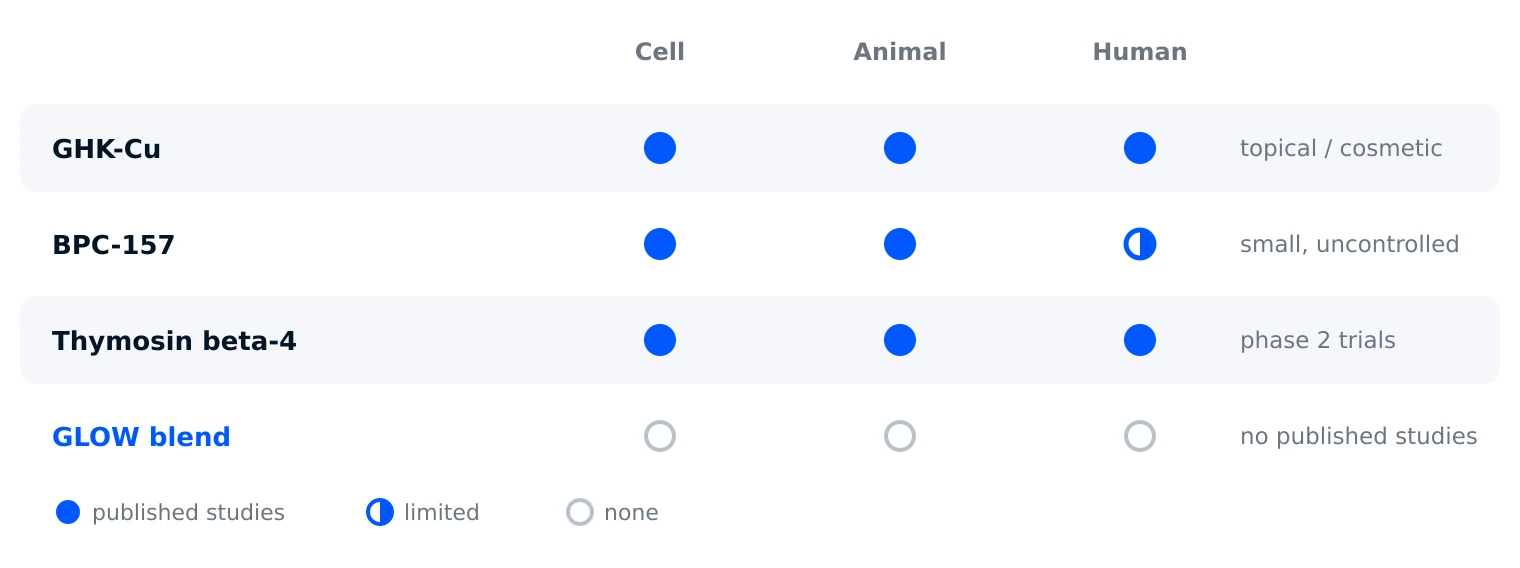
Figure 2. Published evidence by component. Filled cells mark at least one peer-reviewed study of that type. "Human" means controlled clinical data except where noted. The GLOW combination has none.
None of the three components is an FDA-approved drug. On April 15, 2026, the FDA said it would remove twelve peptides, including BPC-157, TB-500 (defined there as the LKKTETQ fragment rather than the full-length protein in GLOW) and injectable GHK-Cu, from Category 2 of its interim list of bulk substances that raise significant safety concerns for pharmacy compounding. Removal did not place them on the list of substances that may be compounded [11]. At its July 23, 2026 meeting, the FDA's Pharmacy Compounding Advisory Committee voted 8 to 6, with one abstention, to recommend adding BPC-157 and the TB-500 fragment to that list; injectable GHK-Cu is due for a separate review before the end of February 2027. The votes are not binding, and FDA must still complete rulemaking before anything changes [12].
For sport, the World Anti-Doping Agency prohibits BPC-157 as a non-approved substance and thymosin beta-4 and its derivatives, including TB-500, as peptide hormones and growth factors [13].
KLOW is the same three peptides plus a fourth, KPV, a three-residue fragment (Lys-Pro-Val) of alpha-melanocyte-stimulating hormone studied for anti-inflammatory activity. GLOW is the choice for protocols that study the repair components alone; KLOW adds an inflammation arm. Like GLOW, the four-peptide combination has no published studies of its own.
GLOW is not a single molecule. It is a fixed-ratio combination of three separate peptides, each studied for a different part of the repair process. The name is a supplier convention, not a scientific one, and different vendors use different ratios.
The NextGenPeps vial comes in two sizes. The 70 mg vial holds 50 mg of GHK-Cu, 10 mg of BPC-157 and 10 mg of TB-500. The 50 mg vial holds 30 mg of GHK-Cu, 10 mg of BPC-157 and 10 mg of TB-500 (Figure 3).
The two sizes differ only in GHK-Cu. Both carry the same amount of BPC-157 and TB-500. In both, GHK-Cu makes up most of the mass, and because it is by far the smallest of the three molecules it also makes up the large majority of the molecules in the vial.
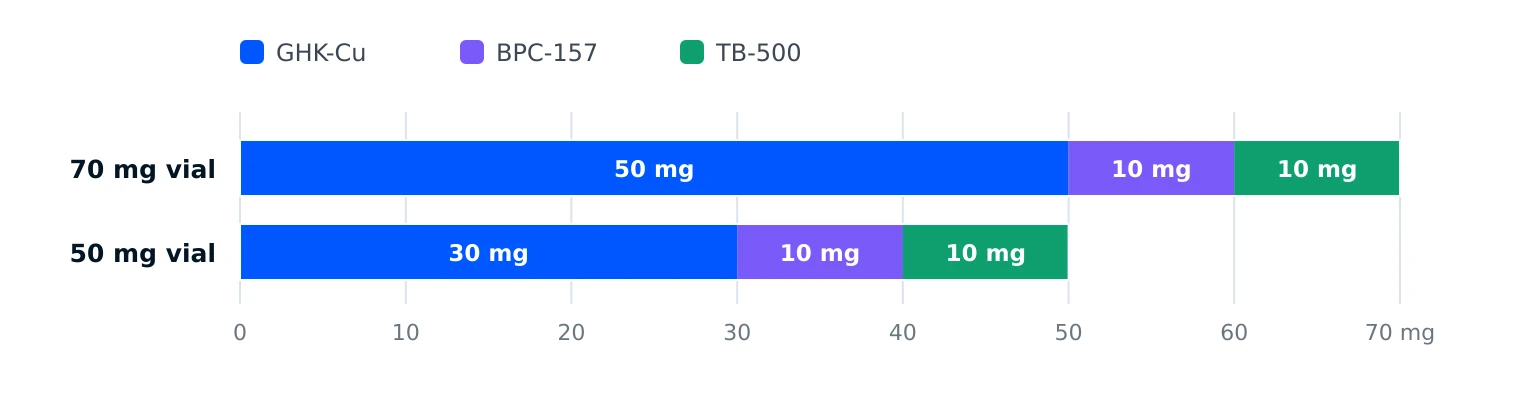
Figure 3. What is in each GLOW vial. Stated content per vial by component. GHK-Cu is 71% of the 70 mg vial and 60% of the 50 mg vial by mass. Each lot's certificate of analysis reports measured purity for the blend.
This is the component studied for the rebuilding stage, where collagen and the surrounding scaffold are laid down. GHK is the tripeptide glycyl-L-histidyl-L-lysine. Pickart first isolated it from human plasma in 1973, where it carries copper(II) with high affinity [1]. In fibroblast cultures the copper complex stimulated collagen synthesis at picomolar to nanomolar concentrations [2]. Later gene-expression analyses found that GHK shifts the activity of a large share of human genes, many of them involved in tissue remodeling, antioxidant defence and inflammation [4]. GHK-Cu is also a long-standing cosmetic ingredient in topical skin products.
This is the component studied for blood supply and the earliest response to an injury. BPC-157 is a synthetic pentadecapeptide, Gly-Glu-Pro-Pro-Pro-Gly-Lys-Pro-Ala-Asp-Asp-Ala-Gly-Leu-Val, taken from a partial sequence of a protein in human gastric juice. It is unusually stable in gastric juice for a peptide. Almost all of its literature comes from rodent and cell models, where it has been linked to blood vessel formation and the nitric oxide system [5]. In cultured tendon fibroblasts it increased outgrowth, survival under oxidative stress and cell migration [6]. Clinical data are limited to small uncontrolled reports, such as a retrospective review of intra-articular injections for knee pain [7].
This is the component studied for getting cells to move into a wound and for new blood vessels forming there. Thymosin beta-4 is a 43-residue protein present in almost every cell, where it binds and stores actin monomers, the building blocks of the cell's internal scaffolding. Outside the cell it has been linked to cell migration, new blood vessel growth and lower inflammation [8]. In a rat full-thickness wound model, thymosin beta-4 increased re-epithelialization by 42% at day 4 and by up to 61% at day 7 compared with saline [9]. Small phase 2 trials have tested topical thymosin beta-4 in chronic skin wounds without establishing efficacy [10].
The TB-500 in GLOW is synthetic full-length thymosin beta-4, all 43 residues, with its identity confirmed by mass spectrometry on each lot's certificate of analysis. The name is not used consistently: the FDA's 2026 compounding notice uses "TB-500" for the seven-residue fragment LKKTETQ, the actin-binding stretch of the protein [11]. Results reported for "TB-500" elsewhere may refer to either molecule.
Because GLOW is a blend, the useful documentation is per lot and per component. Every GLOW lot is tested by an independent laboratory, and the certificate of analysis is published in the NextGenPeps COA library.
70 mg vial. Identity by LC-MS/MS, purity by RP-HPLC (99.71%), content by HPLC quantitation, and endotoxin under 0.05 EU/mL by USP <85> (Bioviridian, September 25, 2026).
50 mg vial. Identity and purity by UHPLC-MS, reported per component at 99.66%, 99.80% and 99.72% (Bioregen, January 15, 2026).
Fulfilment. Orders ship within 24 hours from the United States, with free US shipping on orders over $150.
Research use only. GLOW is sold strictly for in vitro and approved animal research. It is not for human or veterinary use and is not sold as a drug, cosmetic, supplement or diagnostic.
Format. Supplied as lyophilized powder in a sealed vial and reconstituted with sterile or bacteriostatic water before use. No dosing instructions are supplied, and none should be inferred from the studies above.
Color. GHK-Cu is blue, so GLOW powder and solution are blue to violet. A noticeably different color is a reason to check the lot.
Ratios after reconstitution. All three components dissolve together, so every withdrawal carries the same fixed ratio. A protocol that needs to vary one component independently needs the single peptides instead.
Compatibility. Copper(II) binds strongly to GHK, but free copper can interact with other molecules. Keep GLOW solutions separate from reducing agents and chelators such as EDTA, which can strip copper from the complex.
Whether the combination does anything the parts do not. No study has compared the blend with its components alone.
Stability of the components together. Published stability work covers each peptide alone, not mixed with copper(II) in one solution.
Clinical data. Apart from topical GHK-Cu and small thymosin beta-4 trials, controlled clinical data on the components are scarce, and none exist for the blend.
Which TB-500 a study used. The name covers both full-length thymosin beta-4, which is what GLOW contains, and the LKKTETQ fragment, so published "TB-500" results are not automatically comparable.
Research Use Only. The statements made within this website have not been evaluated by the US Food and Drug Administration. These materials are not intended to diagnose, treat, cure or prevent any disease and are not intended for human or veterinary use. Studies described on this page are reported for scientific context and are not guidance of any kind.
GHK isolated from human plasma as a factor that prolonged survival of liver cells in culture; later shown to carry copper(II).
Pickart & Thaler, Nat New Biol 1973 →GHK-Cu stimulated collagen synthesis in fibroblast cultures at picomolar to nanomolar concentrations.
Maquart et al., FEBS Lett 1988 →Connectivity-map analyses suggest GHK shifts expression of a large share of human genes, including tissue-remodeling and antioxidant genes.
Pickart & Margolina, Int J Mol Sci 2018 →BPC-157 increased tendon fibroblast outgrowth, survival under oxidative stress and migration in vitro.
Chang et al., J Appl Physiol 2011 →Review of rodent work linking BPC-157 to angiogenesis and the nitric oxide system.
Seiwerth et al., Curr Pharm Des 2014 →Thymosin beta-4 increased re-epithelialization by 42% at day 4 and up to 61% at day 7 in rat full-thickness wounds, with more collagen deposition and angiogenesis.
Malinda et al., J Invest Dermatol 1999 →Topical thymosin beta-4 explored in venous stasis ulcers.
Guarnera et al., Ann N Y Acad Sci 2007 →Pickart L, Thaler MM · Nat New Biol 1973 · PubMed
Maquart FX, Pickart L, Laurent M, et al. · FEBS Lett 1988 · PubMed
Pickart L, Vasquez-Soltero JM, Margolina A · Biomed Res Int 2015 · PubMed · Free full text
Pickart L, Margolina A · Int J Mol Sci 2018 · PubMed · Free full text
Seiwerth S, Brcic L, Vuletic LB, et al. · Curr Pharm Des 2014 · PubMed
Chang CH, Tsai WC, Lin MS, Hsu YH, Pang JH · J Appl Physiol 2011 · PubMed
Lee E, Padgett B · Altern Ther Health Med 2021 · PubMed
Goldstein AL, Hannappel E, Kleinman HK · Trends Mol Med 2005 · PubMed
Malinda KM, Sidhu GS, Mani H, et al. · J Invest Dermatol 1999 · PubMed
Guarnera G, DeRosa A, Camerini R · Ann N Y Acad Sci 2007 · PubMed
US Food and Drug Administration · FDA, April 2026
AJMC staff · AJMC, July 2026
World Anti-Doping Agency · WADA, effective January 2026
GLOW is supplied as lyophilized powder in a sealed, labelled vial, 70 mg or 50 mg total peptide, with the lot's certificate of analysis published in the NextGenPeps COA library. Please inspect the sealed package when it arrives and contact support promptly if the package or labeling appears damaged.
Orders ship within 24 hours from the United States via USPS for orders placed before the 5:00 PM PDT cutoff. Transit times are typically 3–7 business days, depending on destination and carrier conditions. Tracking information is provided when available.
Store lyophilized GLOW at −20 °C or below in the sealed vial, protected from light. After reconstitution with sterile or bacteriostatic water, hold the solution at 2–8 °C, protected from light, and avoid repeated freeze-thaw cycles.
Due to the nature of research materials, NextGenPeps orders are final and are not eligible for refunds, returns, or exchanges. Review the shipping and reship policies before ordering.
No. NextGenPeps materials are supplied strictly for laboratory research and development use and are not intended for human or animal consumption, clinical use, diagnostic use, cosmetic use, or dietary use.
4.8out of 5 · 4 reviews
Very reliable and impressive, COA purity matches the label.
Liam I.
Distribution of GHK-Cu, BCP157, and TB500 is well calculated and maintains high purity for each part of the blend.
Mackenzie E.
Stayed clear and transparent during reconstitution every single time
Mateo C.
Everything arrived undamaged, with materials sealed from anything that could taint the vial
Peter Y.
GLOW is a research blend of three peptides in one lyophilized vial: GHK-Cu (a copper-binding tripeptide found in human plasma), BPC-157 (a 15-residue peptide from a gastric protein) and TB-500 (synthetic full-length thymosin beta-4). Each has its own preclinical literature on tissue repair. GLOW is not an approved drug, and no published study has tested the three together.
The NextGenPeps 70 mg vial contains 50 mg GHK-Cu, 10 mg BPC-157 and 10 mg TB-500. The 50 mg vial contains 30 mg GHK-Cu, 10 mg BPC-157 and 10 mg TB-500. GHK-Cu is the majority by mass and gives the powder its blue color. Each lot's purity and identity are on its certificate of analysis.
In research, each component is studied for a different stage of tissue repair: BPC-157 for blood supply and the early injury response, thymosin beta-4 for cell migration and new vessel growth, and GHK-Cu for collagen and extracellular matrix remodeling. These findings come from cell and animal studies of the single peptides. The blend's combined effect has not been studied.
NextGenPeps supplies GLOW in 70 mg and 50 mg vials for laboratory research, with an independent certificate of analysis for every lot and endotoxin testing on the 70 mg vial. Orders ship within 24 hours from the United States. GLOW is sold for in vitro and approved animal research only.
GLOW is reconstituted with sterile or bacteriostatic water following the laboratory's own procedure: add the diluent slowly down the inside wall of the vial and swirl gently rather than shaking. All three components dissolve together into a blue solution with a fixed ratio. Store the solution at 2 to 8 °C, protected from light.
There are no safety studies of the blend. Thymosin beta-4 has been tolerated in small phase 2 trials of topical and eye-drop formulations, and topical GHK-Cu is a common cosmetic ingredient, but BPC-157 has almost no controlled clinical safety data. None of the components is FDA-approved, and GLOW is sold for research use only.
✓ 99.72% purity
$89.00$71.00
✓ 99.81% purity
$98.00$78.00
✓ 99.715% purity
$44.00$35.00
✓ 99.79% purity
$52.00$42.00
✓ 98.848% purity
$52.00$42.00