NOVEMBER SALE - 20% OFF Everything!Shop Now
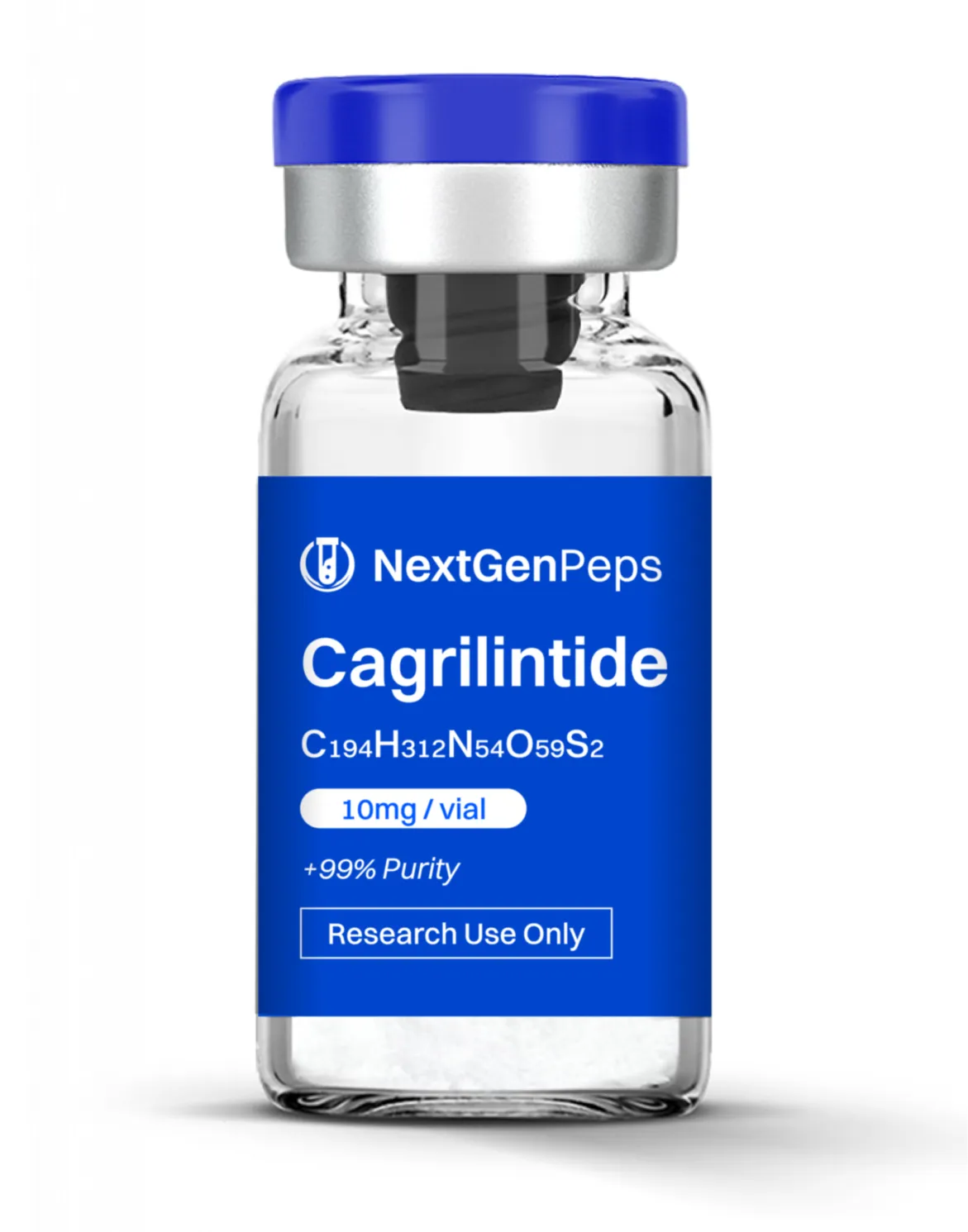
Cagrilintide Peptide - 10mg / Vial
99.74% HPLC purityLot-tested · COA below

Cagrilintide Peptide

$106.00each · 10mg / Vial

4.8· 4 reviewsout of 5In stock

Buy cagrilintide, a long-acting amylin analogue in a 10 mg research vial. 99.74% HPLC purity, endotoxin tested, public COA. Ships within 24 hours from the US.

Regular price $132.00Sale price $106.00You save $26.00 (20%)
1

Bundle & Save

Need more?

Order within 9h 39m to ship Mon, Nov 30Cutoff 5:00 PM PST · ships next business day
U.S. delivery availableFree shipping on orders over $150.00
Reship policyWrong item sent? We reship it free. Transit issues reviewed case by case.

Secure checkout · Visa · Mastercard · American Express · Discover · PayPal · Venmo · Apple Pay

Test results · tested sample

99.74%

Reported purity · Tested by Bioviridian

Tested
Sep 25, 2026
Labeled
10mg / Vial
Lab
Bioviridian
View certificate (PDF) →

Product details

Cagrilintide, in brief. After a meal, the pancreas releases a small hormone called amylin alongside insulin, and amylin tells the brain that food has arrived: eat less, and let the stomach empty more slowly. Native amylin lasts only minutes and tends to clump into fibrils, which makes it hard to work with. Cagrilintide is a rebuilt version of amylin with a fatty acid attached, which keeps it stable and active for about a week instead of minutes. It switches on the amylin receptors and the closely related calcitonin receptor, mostly in the hindbrain. In rats and mice it reduced food intake and body weight, and it is the amylin half of the investigational combination known as CagriSema. NextGenPeps supplies Cagrilintide as a 10 mg lyophilised research peptide, tested by independent labs, for laboratory use only.

What does cagrilintide do?

It makes animals eat less. Cagrilintide copies amylin, a satiety hormone released with insulin after meals, and in rodent models that signal shows up as smaller meals and, over weeks, lower body weight. Amylin signalling also slows stomach emptying, an effect documented for the related analogue pramlintide.[3,4,10]

In practice that means three things:

  • It reduces food intake. In obese mice, a single day of treatment cut food eaten by 53% compared with vehicle.[3]

  • It lowers body weight. In diet-induced obese rats, cumulative food intake fell by 39% over about three weeks, with weight loss similar to the CagriSema combination.[4]

  • It lasts long enough for weekly study designs. Its half-life in clinical pharmacology work was 159 to 195 hours, about a week, against about 48 minutes for pramlintide.[5,10]

NextGenPeps supplies Cagrilintide for in vitro research and approved animal studies only. It is not sold as a drug, supplement or diagnostic.

How does cagrilintide work?

Cagrilintide is a non-selective agonist: it activates all three amylin receptors and the calcitonin receptor itself. Amylin receptors are not separate proteins. Each one is the calcitonin receptor (CTR) paired with a receptor activity-modifying protein, RAMP1, RAMP2 or RAMP3, giving AMY1R, AMY2R and AMY3R. A 2021 pharmacology study profiled cagrilintide (code name AM833) across 25 measures of binding, activation and receptor regulation and found a profile distinct from pramlintide, which favours the amylin receptors, and from salmon calcitonin.[2]

Where it acts matters more than which receptor it hits. In obese mice lacking both RAMP1 and RAMP3, cagrilintide no longer lowered body weight or day-1 food intake, and its activation of neurons in the area postrema, a hindbrain region that senses circulating hormones, was 57% lower than in normal mice. The authors concluded that the weight effect depends on AMY1R and AMY3R.[3]
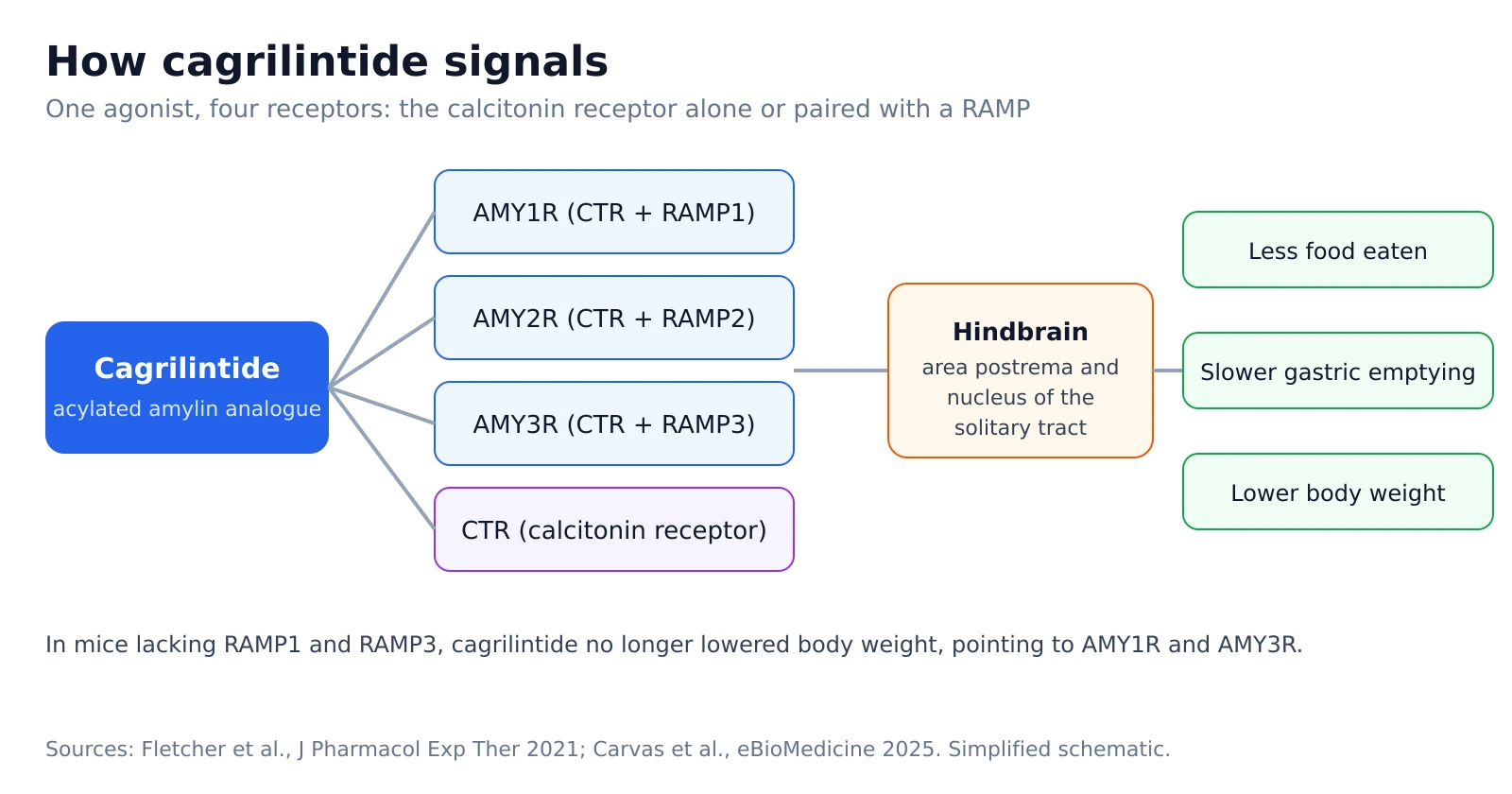
Diagram of cagrilintide activating AMY1R, AMY2R, AMY3R and the calcitonin receptor, acting in the hindbrain area postrema and nucleus of the solitary tract, leading to less food eaten, slower gastric emptying and lower body weight.

Figure 1. How cagrilintide signals. Cagrilintide activates the calcitonin receptor alone and paired with each RAMP; in mice the weight effect required RAMP1 and RAMP3. Simplified from Fletcher et al. 2021 and Carvas et al. 2025.[2,3]

What did cagrilintide do in animal studies?

Obese rats and mice given cagrilintide ate less and lost weight compared with vehicle-treated controls.

Mice. In male mice made obese on a high-fat diet, daily cagrilintide for 21 days lowered body weight by 3.4 ± 0.51 g (n=8 per group). On day 1 the treated mice ate 1.2 g of food against 2.7 g for vehicle, a 53% reduction. The appetite effect faded after the first days while the lower weight persisted, and leptin fell about two-fold. In knockout mice lacking RAMP1 and RAMP3, cagrilintide had no effect on body weight or day-1 food intake.[3]

Rats. In male diet-induced obese Sprague Dawley rats (n=8 per group), cagrilintide alone reduced cumulative food intake by 39% over the treatment period, and the treated rats lost about as much weight as rats given the cagrilintide plus semaglutide combination, which lost 8.7% of body weight while vehicle rats gained 2.6%. Unlike rats put on a matched calorie restriction, the treated rats did not show a significant drop in energy expenditure, which the authors read as blunted metabolic adaptation.[4]
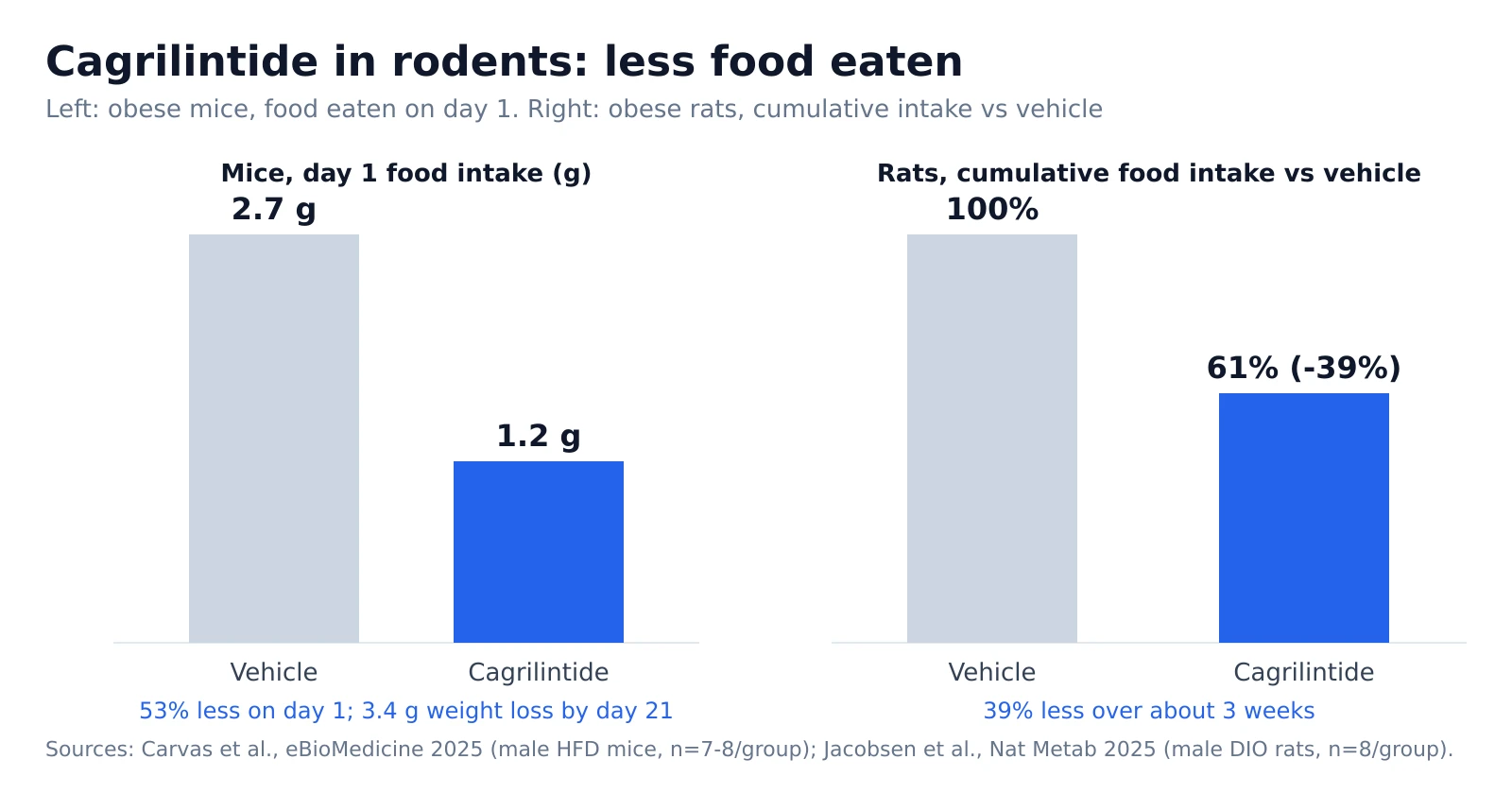
Bar chart: obese mice ate 2.7 g on vehicle versus 1.2 g on cagrilintide on day 1, a 53% reduction; obese rats on cagrilintide ate 39% less food cumulatively than vehicle over about three weeks.

Figure 2. Cagrilintide reduced food intake in obese mice and rats. Left, food eaten on day 1 by high-fat-diet mice; right, cumulative food intake in diet-induced obese rats relative to vehicle. Data from Carvas et al. 2025 and Jacobsen et al. 2025.[3,4]

What happened in clinical trials?

Cagrilintide has been tested in controlled clinical trials, alone and with semaglutide. These results are reported for scientific context only.

  • Phase 2, cagrilintide alone. A 26-week dose-finding trial randomised 706 participants. Mean body weight fell by 6.0% to 10.8% across five cagrilintide doses, against 3.0% for placebo and 9.0% for liraglutide 3.0 mg.[6]

  • Phase 1b, with semaglutide. A 20-week trial (n=96) measured the combination's pharmacokinetics; the cagrilintide half-life was 159 to 195 hours.[5]

  • REDEFINE 1. A 68-week phase 3a trial, which excluded diabetes, randomised 3,417 participants. Mean weight change was 20.4% with the combination, 14.9% with semaglutide alone, 11.5% with cagrilintide alone and 3.0% with placebo. Gastrointestinal adverse events occurred in 79.6% of the combination group and 39.9% of the placebo group.[7,9]

  • REDEFINE 2. A 68-week phase 3a type 2 diabetes trial in 1,206 participants reported a mean weight change of 13.7% with the combination against 3.4% with placebo.[8]
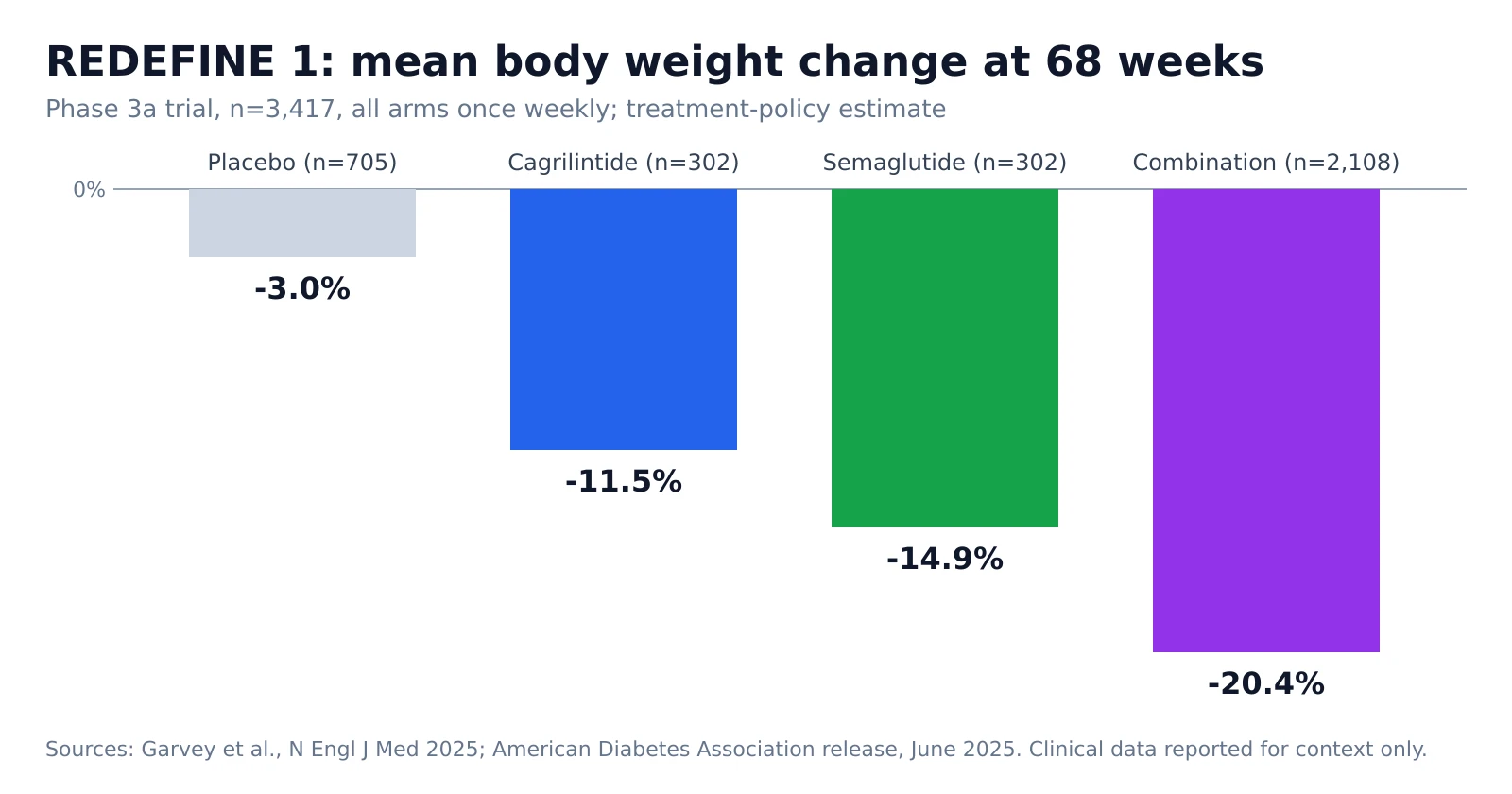
Bar chart of REDEFINE 1 mean body weight change at 68 weeks: placebo minus 3.0%, cagrilintide minus 11.5%, semaglutide minus 14.9%, combination minus 20.4%.

Figure 3. REDEFINE 1 body weight change at 68 weeks. Mean change from baseline by treatment arm, n=3,417. Reported for scientific context only.[7,9]

Cagrilintide vs pramlintide

Both are engineered versions of amylin. Pramlintide is short-acting; cagrilintide was designed to last a week.

  • Structure. Pramlintide replaces three residues of amylin with proline (positions 25, 28 and 29) to stop fibril formation. Cagrilintide carries further substitutions and an N-terminal C20 fatty diacid on a gamma-glutamate linker.[1,10]

  • Half-life. About 48 minutes for pramlintide, given before each major meal, against 159 to 195 hours for cagrilintide.[5,10]

  • Receptors. Pramlintide is amylin-receptor selective; cagrilintide activates both amylin receptors and the calcitonin receptor.[2]

  • Status. Pramlintide (Symlin) is FDA-approved for diabetes alongside mealtime insulin. Cagrilintide is not approved.[10,11]

What is cagrilintide made of?

Cagrilintide is a 37-residue amylin analogue with a lipid tail. The sequence is KCNTATCATQRLAEFLRHSSNNFGPILPPTNVGSNTP-NH2, with a disulphide bridge between the cysteines at positions 2 and 7 and an amidated C-terminus. Compared with human amylin it differs at six positions: Asn14Glu, Val17Arg, Ala25Pro, Ser28Pro, Ser29Pro and Tyr37Pro.

The N-terminus carries eicosanedioic acid (a 20-carbon fatty diacid) attached through a gamma-glutamic acid linker. The lipid and the substitutions were chosen to give a stable, long-acting molecule, avoiding the fibril formation that makes native amylin difficult to work with. The developers describe the structure-activity work behind this design in a 2021 paper.[1]

A note on numbering. Some datasheets count the gamma-glutamate linker as a residue and describe the disulphide as 3 to 8. The bridge is the same; only the numbering convention differs.

Cagrilintide at a glance

  • Compound: Cagrilintide (AM833, NNC0174-0833)

  • Class: Long-acting acylated amylin analogue; non-selective amylin and calcitonin receptor agonist[2]

  • Sequence: (Eicosanedioyl-gamma-Glu)-KCNTATCATQRLAEFLRHSSNNFGPILPPTNVGSNTP-NH2, disulphide Cys2 to Cys7

  • Molecular formula: C194H312N54O59S2

  • Molecular weight: About 4409 g/mol

  • Strength: 10 mg per vial

  • Identity and purity: Identity by LC-MS/MS and purity by RP-HPLC at 214 nm; 99.74% on the current lot (September 25, 2026), published in the COA library

  • Endotoxin: Under 0.05 EU/ml on the current lot, tested per USP <85>

  • Appearance: White to off-white lyophilised powder, sealed vial

  • Reconstitution: Sterile or bacteriostatic water

  • Half-life: 159 to 195 hours in clinical pharmacokinetic work[5]

  • Regulatory status: Not FDA-approved alone or in combination as of November 2026[11]

Is cagrilintide FDA approved?

No. As of November 2026, cagrilintide is not approved by the FDA as a single agent or in any combination.

The developer filed a new drug application for the once-weekly cagrilintide and semaglutide combination (CagriSema) with the FDA in December 2025, and an FDA decision is expected in 2026. Cagrilintide alone is in a separate phase 3 program. Until a decision is issued, there is no approved product containing cagrilintide.[11] Cagrilintide was not among the seven peptides reviewed by the FDA's Pharmacy Compounding Advisory Committee in July 2026.[12]

What is cagrilintide used to study?

Researchers use cagrilintide when they need amylin-pathway signalling that lasts days rather than minutes.

  • Appetite and satiety circuits. Hindbrain neuron activation and the receptor requirements for its effect on food intake.[3]

  • Energy balance. Whether weight loss comes with the drop in energy expenditure seen under calorie restriction.[4]

  • Receptor pharmacology. Comparing amylin-selective and dual amylin and calcitonin receptor agonists.[2]

  • Combination designs. Amylin plus GLP-1 receptor agonism in rodent obesity models.[4]

Buying cagrilintide for research: what each vial includes

Every lot is tested by independent labs and the certificate of analysis is published in the NextGenPeps COA library. The current lot was analysed on September 25, 2026: identity by LC-MS/MS, purity by RP-HPLC at 214 nm, content by HPLC quantitation, and endotoxin per USP <85>.

  • Verified identity, purity and endotoxin. 99.74% purity and under 0.05 EU/ml endotoxin on the current lot.

  • US-based fulfilment. Orders ship within 24 hours from the United States, with free US shipping on orders over $150.

  • Research use only. Cagrilintide is sold strictly for in vitro and approved animal research. It is not for human or veterinary use and is not sold as a drug, supplement or diagnostic.

Cagrilintide handling, storage and analytical notes

Format. Supplied as 10 mg of lyophilised powder in a sealed vial and reconstituted with sterile or bacteriostatic water. No dosing instructions are supplied, and none should be taken from the studies above.

Storage. Keep the sealed vial cold (2 to 8 °C, or -20 °C for longer holding) and protected from light. After reconstitution, hold the solution at 2 to 8 °C and avoid repeated freeze-thaw cycles.

Solubility. The lipid tail makes cagrilintide less freely soluble than short unmodified peptides; it is reported as sparingly soluble in PBS and only slightly soluble in DMSO. Add diluent slowly and swirl rather than shake.

Naming. Cagrilintide, AM833 and NNC0174-0833 are the same molecule. CagriSema refers to cagrilintide given together with semaglutide, not a single molecule.

What is not established about cagrilintide

  • Long-term animal data. Most published rodent studies run about three weeks; longer-term effects on body composition are less well characterised.[3,4]

  • Mechanism of the lasting weight effect. In mice the appetite reduction faded after a few days while lower weight persisted, and the reason is not settled.[3]

  • Role of the calcitonin receptor. How much of the effect comes from the calcitonin receptor versus the amylin receptors differs between models and readouts.[2,3]

  • Regulatory outcome. No product containing cagrilintide has been approved, and the FDA has not yet ruled on the combination.[11]


Research Use Only. The statements made within this website have not been evaluated by the US Food and Drug Administration. These materials are not intended to diagnose, treat, cure or prevent any disease and are not intended for human or veterinary use. Studies described on this page are reported for scientific context and are not guidance of any kind.
Compound information

Molecular class
Acylated amylin analogue; non-selective amylin and calcitonin receptor agonist
Sequence
(Eicosanedioyl-γ-Glu)-KCNTATCATQRLAEFLRHSSNNFGPILPPTNVGSNTP-NH₂, disulphide Cys2 to Cys7
Molecular formula
C₁₉₄H₃₁₂N₅₄O₅₉S₂
Molecular weight
~4409 g/mol
Strength
10 mg per vial
Physical form
White to off-white lyophilised powder, sealed vial
Purity
99.74% by RP-HPLC at 214 nm (Sep 25, 2026); identity by LC-MS/MS
Endotoxin
Under 0.05 EU/ml, per USP <85> (current lot)
Half-life
159 to 195 h in clinical pharmacokinetic work
Synonyms
AM833, NNC0174-0833
Regulatory status
Research use only. Not FDA-approved alone or in combination as of November 2026

Storage & stability

  • Lyophilised powder
  • Store cold, protected from light
  • Avoid repeated freeze-thaw
  • Lipidated peptide: swirl gently, do not shake
Lyophilised
2 to 8 °C, or -20 °C for longer holding, in the sealed vial
Reconstituted
2 to 8 °C, protected from light
Reconstitute with
Sterile or bacteriostatic water

Cited literature

  1. 01
    Development of Cagrilintide, a Long-Acting Amylin Analogue

    Kruse T, Hansen JL, Dahl K, et al. · J Med Chem 2021 · PubMed · DOI

    Developer paper describing the structure-activity work behind cagrilintide, a stable lipidated amylin analogue designed to overcome amylin fibrillation and pramlintide's short half-life. Written by the developing company.

  2. 02
    AM833 Is a Novel Agonist of Calcitonin Family G Protein-Coupled Receptors: Pharmacological Comparison with Six Selective and Nonselective Agonists

    Fletcher MM, Keov P, Truong TT, et al. · J Pharmacol Exp Ther 2021 · PubMed · DOI

    Profiled cagrilintide across 25 endpoints against pramlintide, salmon calcitonin and other agonists, finding a distinct non-selective amylin and calcitonin receptor profile. Cell-based assays only.

  3. 03
    Cagrilintide lowers bodyweight through brain amylin receptors 1 and 3

    Oliveira Carvas A, Leuthardt A, Kulka P, et al. · eBioMedicine 2025 · PubMed · DOI · Free full text

    In high-fat-diet mice, cagrilintide lowered body weight by 3.4 g over 21 days and cut day-1 food intake from 2.7 to 1.2 g; the effect was lost in RAMP1/3 knockout mice. Small groups (n=7-8), male mice only.

  4. 04
    CagriSema drives weight loss in rats by reducing energy intake and preserving energy expenditure

    Jacobsen JM, Halling JF, Blom I, et al. · Nat Metab 2025 · DOI

    In diet-induced obese rats, cagrilintide alone reduced cumulative food intake by 39% and produced weight loss similar to the combination, without the fall in energy expenditure seen with matched calorie restriction. Male rats only, about three weeks; exact single-agent weight percentages not reported.

  5. 05
    Safety, tolerability, pharmacokinetics, and pharmacodynamics of concomitant administration of multiple doses of cagrilintide with semaglutide 2.4 mg for weight management: a randomised, controlled, phase 1b trial

    Enebo LB, Berthelsen KK, Kankam M, et al. · Lancet 2021 · PubMed · DOI

    Phase 1b trial (n=96, 20 weeks) reporting a cagrilintide half-life of 159 to 195 hours. Small, single-site and designed for safety and pharmacokinetics rather than efficacy.

  6. 06
    Once-weekly cagrilintide for weight management in people with overweight and obesity: a multicentre, randomised, double-blind, placebo-controlled and active-controlled, dose-finding phase 2 trial

    Lau DCW, Erichsen L, Francisco AM, et al. · Lancet 2021 · PubMed · DOI

    Phase 2 dose-finding trial (n=706, 26 weeks): weight change of 6.0% to 10.8% across cagrilintide doses against 3.0% for placebo. Short duration relative to phase 3 trials.

  7. 07
    Coadministered Cagrilintide and Semaglutide in Adults with Overweight or Obesity

    Garvey WT, Blüher M, et al.; REDEFINE 1 Study Group · N Engl J Med 2025 · PubMed · DOI

    Phase 3a trial (n=3,417, 68 weeks): 20.4% mean weight loss with the combination against 3.0% with placebo. Cagrilintide and semaglutide monotherapy arms were small (n=302 each).

  8. 08
    Cagrilintide-Semaglutide in Adults with Overweight or Obesity and Type 2 Diabetes

    Davies MJ, Bajaj HS, Broholm C, et al.; REDEFINE 2 Study Group · N Engl J Med 2025 · PubMed · DOI

    Phase 3a type 2 diabetes trial (n=1,206, 68 weeks): 13.7% mean weight loss with the combination against 3.4% with placebo. No cagrilintide-alone arm.

  9. 09
    CagriSema demonstrates significant weight loss in adults with obesity

    American Diabetes Association · ADA press release, June 2025

    Summary of REDEFINE 1 and 2 including the cagrilintide-alone (11.5%) and semaglutide-alone (14.9%) arms. A press release, not a peer-reviewed source.

  10. 10
    Symlin (pramlintide acetate) injection: US prescribing information

    Amylin Pharmaceuticals · FDA label, 2008 · Free full text

    Pramlintide label: proline substitutions at positions 25, 28 and 29, half-life about 48 minutes, mealtime dosing with insulin. Archived 2008 version.

  11. 11
    CagriSema (cagrilintide and semaglutide) FDA approval history

    Drugs.com · Drugs.com, 2026

    Records that the combination is not FDA-approved, with the new drug application submitted in December 2025 and review expected in 2026. Secondary regulatory tracker, not an FDA document.

  12. 12
    FDA Panel Backs 6 Peptides for Compounding

    Steinzor P · AJMC, July 2026

    Reports the July 23-24, 2026 Pharmacy Compounding Advisory Committee meeting, which reviewed seven peptides (BPC-157, KPV, TB-500, MOTS-c, Semax, Epitalon, emideltide); cagrilintide was not among them. News report, not an FDA document.

Published research

Frequently asked questions

How is Cagrilintide packaged?

Cagrilintide is supplied in the product format and quantity shown for the selected variant. Please inspect the sealed package when it arrives and contact support promptly if the package or labeling appears damaged.

How is Cagrilintide shipped?

Orders are shipped within the United States via USPS. Transit times are typically 3–7 business days, depending on destination and carrier conditions. Tracking information is provided when available.

How should Cagrilintide be stored?

Storage requirements are product-specific. Keep Cagrilintide in its original labeled container and follow the product documentation or manufacturer instructions supplied with the order. Contact support if the applicable storage guidance is not available.

What is the refund policy for Cagrilintide?

Due to the nature of research materials, NextGenPeps orders are final and are not eligible for refunds, returns, or exchanges. Review the shipping and reship policies before ordering.

Is Cagrilintide intended for human use?

No. NextGenPeps materials are supplied strictly for laboratory research and development use and are not intended for human or animal consumption, clinical use, diagnostic use, cosmetic use, or dietary use.

Customer reviews

4.8out of 5 · 4 reviews

Highly Recommended

A clean product for research use, the behavior of the Cagrilintide was mirrored between the two different batches and had no inconsistencies

Austin N.

Worth reordering

Vial presentation looked amazing with all information on the bottle matching data from the certificate of analysis

Jonathan F.

Arrived safely

My order was sealed and protected from any moisture, no issues with vials being compromised during transit.

George I.

Useful info

The molecular weight verification provided in the COA helps with reconstitution to be more accurate.

Allen J.

Common research questions

What is cagrilintide?

Cagrilintide is a long-acting synthetic analogue of amylin, a satiety hormone released with insulin after meals. It is 37 residues long, carries six substitutions relative to amylin and has a 20-carbon fatty diacid attached at the N-terminus, which extends its half-life to about a week. It activates amylin receptors and the calcitonin receptor. It is an investigational compound and is not FDA-approved.

What does cagrilintide do in research models?

In obese rodents it reduces food intake and body weight. Obese mice ate 53% less food on the first day of treatment and weighed 3.4 g less after 21 days, and obese rats reduced cumulative food intake by 39% over about three weeks. In mice the weight effect depended on amylin receptors 1 and 3 in the hindbrain.

How does cagrilintide work?

Cagrilintide binds the calcitonin receptor alone and the three amylin receptors, which are the calcitonin receptor paired with RAMP1, RAMP2 or RAMP3. Its main site of action in rodent studies is the area postrema and nearby hindbrain nuclei, which regulate meal size and stomach emptying. Mice lacking RAMP1 and RAMP3 did not lose weight on cagrilintide.

What is the difference between cagrilintide and semaglutide?

They act on different hormone systems. Cagrilintide mimics amylin and activates amylin and calcitonin receptors; semaglutide mimics GLP-1 and activates the GLP-1 receptor. In the 68-week REDEFINE 1 trial (n=3,417), mean weight change was 11.5% with cagrilintide alone, 14.9% with semaglutide alone and 20.4% with the two together, against 3.0% with placebo. The combination is known as CagriSema.

Is cagrilintide FDA approved?

No. As of November 2026, cagrilintide is not FDA-approved alone or in combination. A new drug application for the cagrilintide and semaglutide combination was submitted in December 2025, and an FDA decision is expected in 2026. Cagrilintide alone remains in phase 3 development.

How is cagrilintide different from pramlintide?

Both are amylin analogues. Pramlintide has a half-life of about 48 minutes, is amylin-receptor selective and is FDA-approved for diabetes as a mealtime injection with insulin. Cagrilintide carries a fatty acid that extends its half-life to 159 to 195 hours and it activates both amylin and calcitonin receptors. Cagrilintide is not approved.

Frequently Researched with

GLP-RT

✓ 99.72% purity

GLP-RT

$89.00$71.00

Epithalon

✓ 99.66% purity

Epithalon

$42.00$34.00

GLOW

✓ 99.71% purity

GLOW

$134.00$107.00

NAD+

✓ 99.81% purity

NAD+

$98.00$78.00

MOTS-C

✓ 99.79% purity

MOTS-C

$52.00$42.00

You have an unfinished subscription checkout

Continue your saved checkout, or replace its item with . Your saved selection and existing subscriptions will stay unchanged.

Continue saved checkout
NextGenPeps

Reliable and innovative research with our top-grade research materials and novel research compounds tailored to lead the competitive research industry. Choose research quality. Choose NextGenPeps.

Customer Service: +1 (971) 300-1435

Get 10% Off Your First Order

Sign up now and receive a 10% discount code valid on your next purchase!

Nextgenpeps LLC

The statements made within this website have not been evaluated by the US Food and Drug Administration. The materials offered by this company are not intended to diagnose, treat, cure, or prevent any disease. All research materials on this site are for laboratory research and development use only, and are not intended for human use.

NextGenPeps is a chemical supplier. NextGenPeps is not a compounding pharmacy or chemical compounding facility as defined under 503A of the Federal Food, Drug, and Cosmetic act. NextGenPeps is not an outsourcing facility as defined under 503B of the Federal Food, Drug, and Cosmetic Act.

Privacy PolicyTerms & ConditionsAffiliate Program

501 W Broadway Ste A, San Diego, CA 92101

© 2026 NextGenPeps. All rights reserved.

Visa
American Express
Mastercard
PayPal
Discover
Apple Pay