What Is KLOW Peptide? The 4-Peptide Blend and What It Did in Animal Studies
KLOW is a four-peptide research blend: GHK-Cu, BPC-157, TB-500 and KPV in one vial. Here is what is in it, what each peptide actually did in rats and mice, and how it differs from GLOW.
7 min readBy NextGenPeps Research Team
On this page14 sections
- What is KLOW peptide?
- What is in KLOW peptide?
- What is KLOW peptide used for in research?
- KLOW peptide benefits in animal studies
- GHK-Cu: wounds closed faster in rats
- TB-500: skin grew back faster in rats
- BPC-157: stronger tendon repair in rats
- KPV: less colon inflammation in mice
- KLOW vs GLOW: what is the difference?
- Why is KLOW blue?
- Is KLOW peptide FDA approved?
- Buying KLOW for research
- What is not established about KLOW
- References
What is KLOW peptide, in brief. KLOW is not one peptide. It is a research blend of four: GHK-Cu, BPC-157, TB-500 and KPV, packed into one vial at a fixed ratio. Each one has been studied for a different stage of tissue repair. In animal studies, GHK-Cu helped wounds close faster in rats, TB-500 sped up skin regrowth in rats, BPC-157 led to stronger healed tendons in rats, and KPV reduced colon inflammation in mice. KLOW is the GLOW blend plus KPV. The blend itself has not been studied as a whole. NextGenPeps supplies KLOW for laboratory research use only.
What is KLOW peptide?
KLOW is a four-peptide blend. Three of the peptides (GHK-Cu, BPC-157 and TB-500) are the GLOW blend, and KPV is the fourth one that KLOW adds. The idea is to cover the main stages of repair in one vial: blood supply, cell movement, rebuilding and calming inflammation.
Figure 1. What is in one KLOW vial.
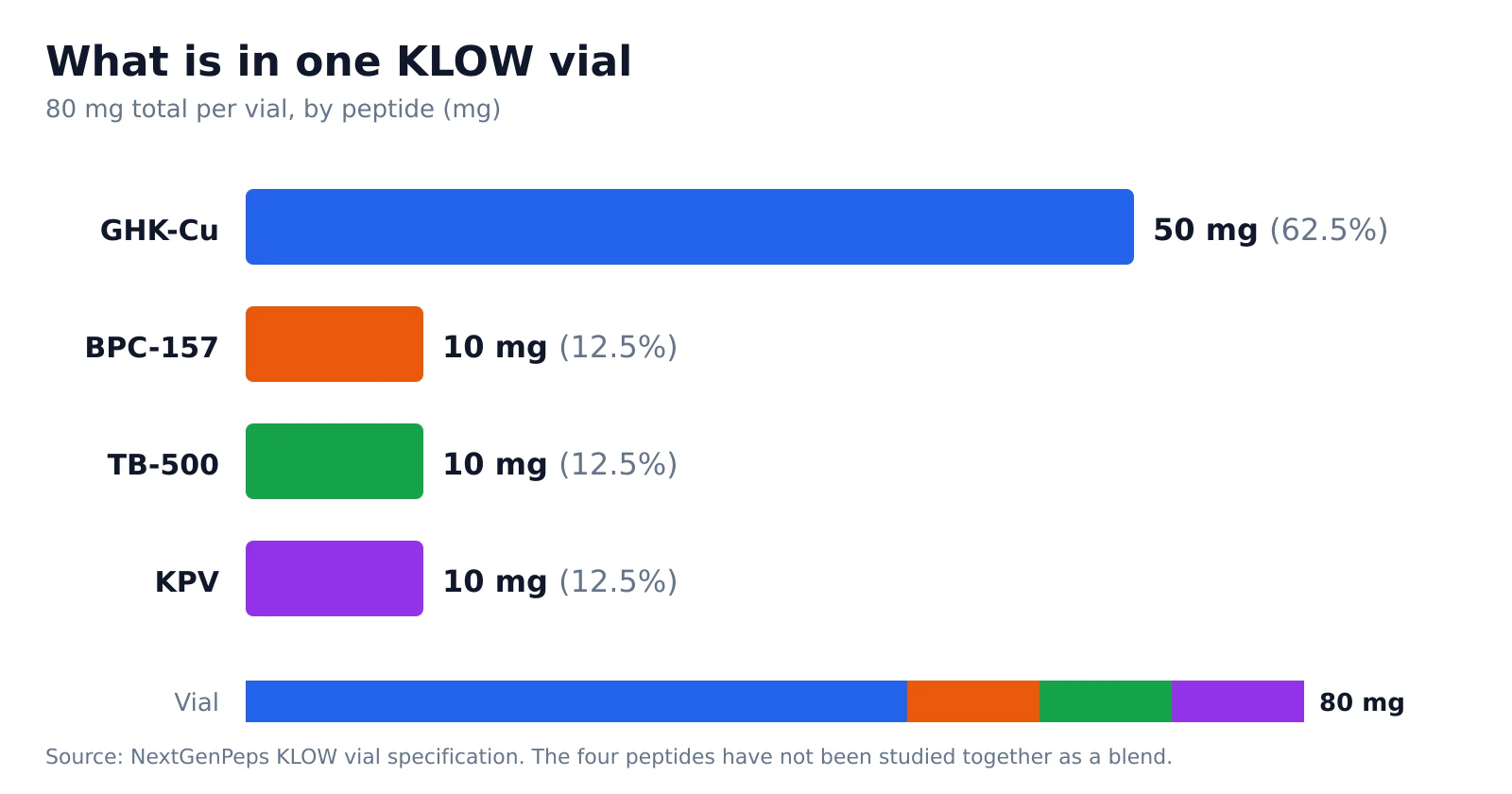
The NextGenPeps vial holds 80 mg: 50 mg GHK-Cu and 10 mg each of BPC-157, TB-500 and KPV.
What is in KLOW peptide?
Peptide | Amount per vial | What it is | Studied for |
|---|---|---|---|
GHK-Cu | 50 mg | A copper-binding 3-amino-acid peptide found in plasma | Rebuilding collagen and closing wounds |
BPC-157 | 10 mg | A 15-amino-acid fragment of a stomach protein | Blood supply and early injury response |
TB-500 | 10 mg | Synthetic thymosin beta-4 (43 amino acids) | Moving cells into wounds and growing new vessels |
KPV | 10 mg | The last 3 amino acids of alpha-MSH | Turning inflammation down |
What is KLOW peptide used for in research?
KLOW is used in tissue repair and inflammation research, where a study needs all four signals delivered together at the same ratio. What each peptide has done on its own in animals:
Figure 2. What each KLOW peptide did in animal studies.
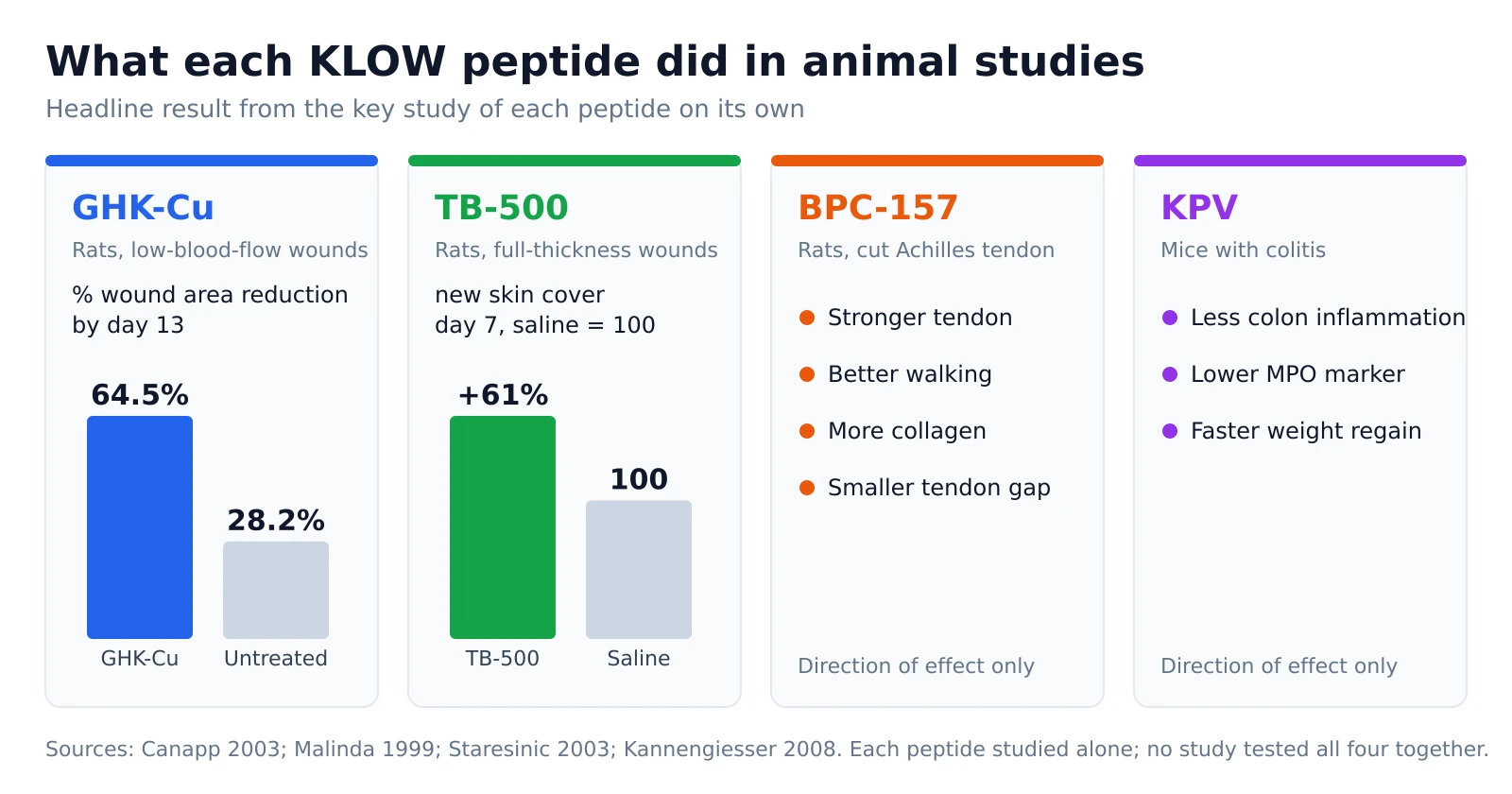
Each result comes from a study of that single peptide. No study has tested the four together.
KLOW is in stock for laboratory research, with a batch COA from independent labs.
KLOW peptide benefits in animal studies
Here is what actually happened to the animals in the key study for each component.
GHK-Cu: wounds closed faster in rats
Rat skin wounds with poor blood flow shrank more than twice as much with GHK-Cu as with no treatment.
Figure 3. GHK-Cu in rats.
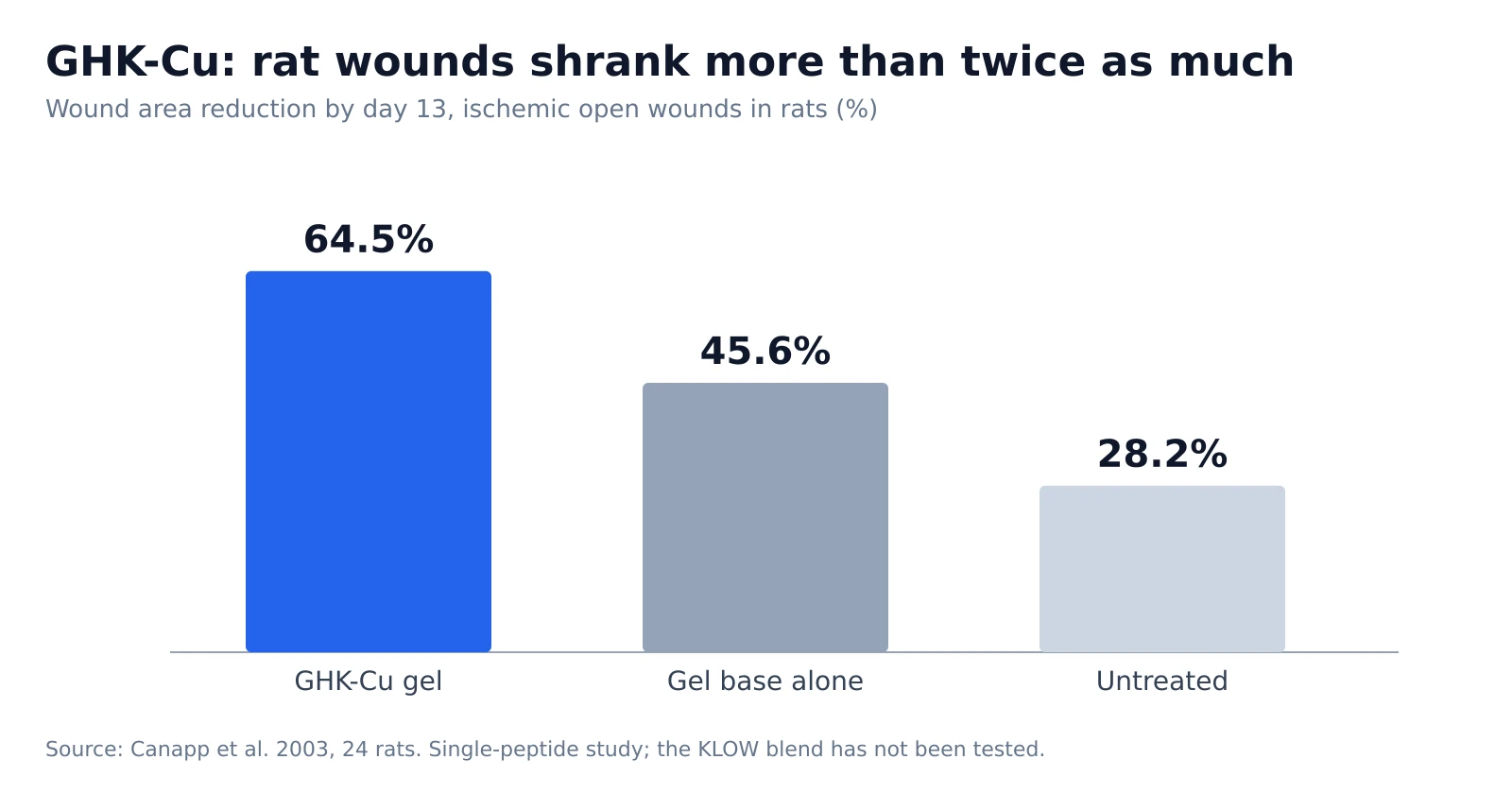
Wound area reduction by day 13: 64.5% with GHK-Cu gel, 45.6% with the gel base alone and 28.2% untreated. GHK-Cu wounds also had lower levels of the inflammatory and tissue-breakdown markers TNF-alpha, MMP-2 and MMP-9 (Canapp 2003, 24 rats).
TB-500: skin grew back faster in rats
Rats given thymosin beta-4 had 61% more new skin covering their wounds by day 7 than saline-treated rats.
Figure 4. TB-500 (thymosin beta-4) in rats.
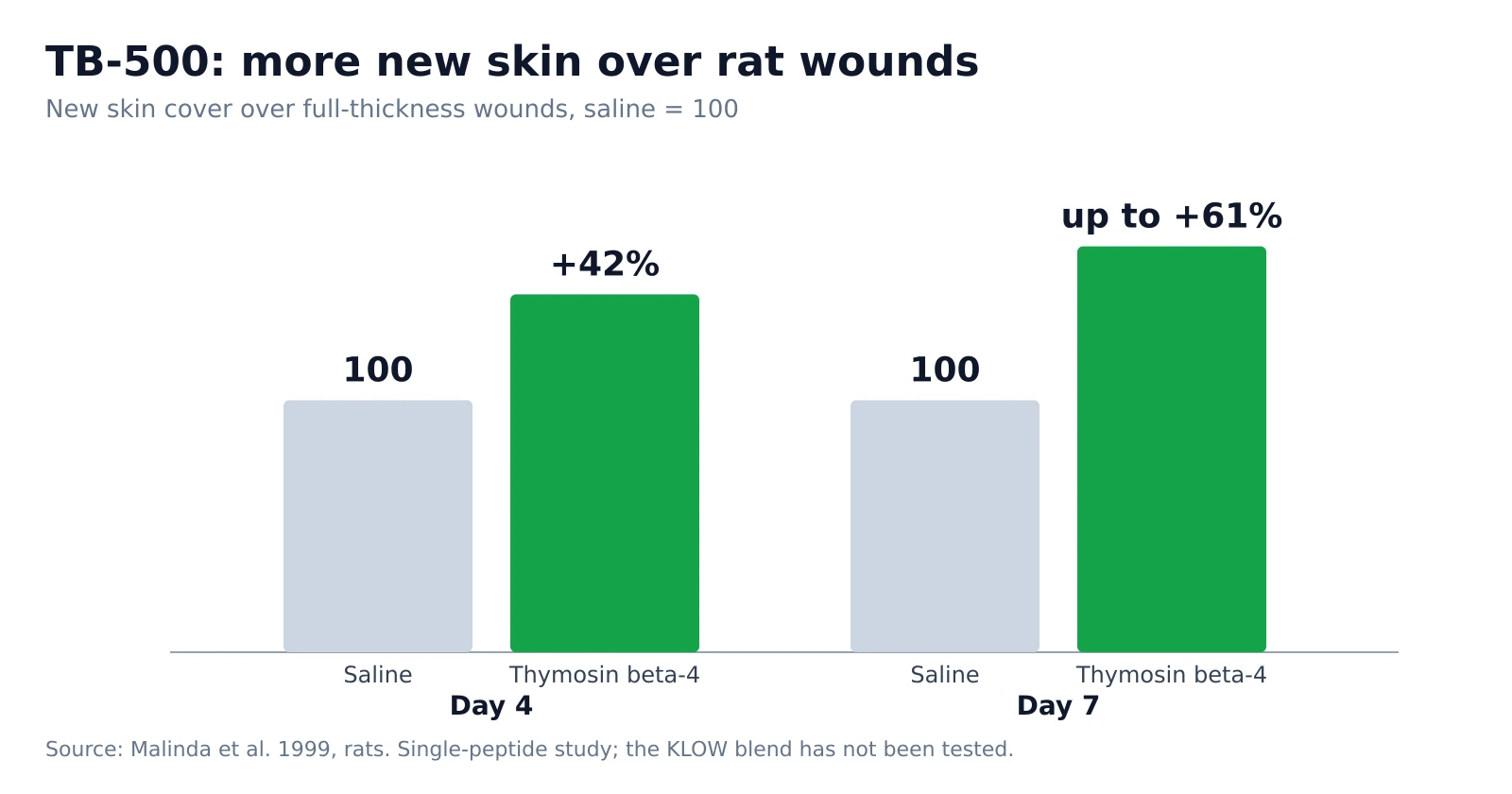
New skin cover was up 42% at day 4 and up to 61% at day 7 vs saline. Wounds also contracted at least 11% more, with more collagen and more new blood vessels (Malinda 1999).
BPC-157: stronger tendon repair in rats
Rats with a cut Achilles tendon healed with stronger tendons and walked better when given BPC-157.
What was measured (days 1 to 14) | Result vs saline |
|---|---|
Tendon strength (load to failure) | Higher |
Walking function (Achilles functional index) | Better |
Collagen and repair cells in the tendon | More |
Size of the tendon gap | Smaller |
Daily BPC-157 after the tendon was cut (Staresinic 2003). The abstract reports direction of effect, not exact values.
KPV: less colon inflammation in mice
Mice with colitis given KPV had less inflammation in the colon and regained weight sooner.
Figure 5. KPV in mice with colitis.
What was measured (mice with colitis) | Result vs untreated colitis |
|---|---|
Inflammation in the colon wall | Less |
MPO (inflammation marker) | Lower |
Weight regain | Faster |
Survival in mice lacking the MC1 receptor | Every KPV-treated mouse survived |
Less inflammation in the colon wall, lower MPO (an inflammation marker), faster weight regain, and every KPV-treated mouse lacking the MC1 receptor survived (Dalmasso 2008; Kannengiesser 2008).
Want the single peptides instead of the blend?
KLOW vs GLOW: what is the difference?
KLOW is GLOW plus KPV. Everything else is the same set of repair peptides.
Component | GLOW | KLOW |
|---|---|---|
GHK-Cu | Yes | Yes |
BPC-157 | Yes | Yes |
TB-500 | Yes | Yes |
KPV (anti-inflammatory) | No | Yes |
Best fit | Repair-only studies | Repair plus inflammation studies |
Why is KLOW blue?
The copper in GHK-Cu is blue, so KLOW powder and solution are blue to violet. A clearly different color is a reason to check the lot.
Is KLOW peptide FDA approved?
No. None of the four peptides is an FDA-approved drug. In July 2026 an FDA advisory panel voted to recommend allowing BPC-157, KPV and a TB-500 fragment in pharmacy compounding, but that vote is not binding and nothing has changed yet. KLOW is sold for research use only.
Buying KLOW for research
Independent lab testing. Every lot has a published COA covering identity and purity from independent labs.
One vial, four peptides. A fixed ratio in every withdrawal, so results are consistent across a study.
Research use only. Supplied strictly for in vitro and approved animal research.
Shop the KLOW blend or its components.
What is not established about KLOW
The blend itself. No published study has tested the four peptides together, or compared KLOW with GLOW.
Added effect of KPV. Whether KPV adds anything when combined with the other three is untested.
Stability together. Stability data exist for each peptide alone, not for all four mixed with copper.
Which TB-500. Studies use the name for both full-length thymosin beta-4 (what KLOW contains) and a short fragment.
References
Study | Model | Finding | Source |
|---|---|---|---|
Canapp 2003 | Rats, low-blood-flow wounds | GHK-Cu: 64.5% wound reduction by day 13 vs 28.2% untreated | |
Malinda 1999 | Rats, full-thickness wounds | Thymosin beta-4: +42% skin regrowth day 4, up to +61% day 7 | |
Staresinic 2003 | Rats, cut Achilles tendon | BPC-157: stronger tendon, better walking, more collagen | |
Dalmasso 2008 | Mice, colitis | KPV in drinking water reduced colitis | |
Kannengiesser 2008 | Mice, colitis | KPV: faster weight regain, less inflammation, lower MPO | |
Maquart 1988 | Fibroblast cells | GHK-Cu stimulated collagen synthesis | |
Pickart 2018 | Review | GHK-Cu regenerative and protective actions |
Research Use Only. All compounds discussed are supplied by NextGenPeps strictly for laboratory research use and are not intended for human or veterinary use. Studies described here are reported for scientific context and are not guidance of any kind.
Mentioned in this article
- BPC-157View product
- GHK-CuView product
- GLOWView product
- TB-500View product
- KLOWView product
 KPVView product
Written by NextGenPeps Research Team
The NextGenPeps Research Team summarizes published laboratory and animal research on the compounds NextGenPeps supplies for research use only.
More articles →Research Use Only: this article describes laboratory research. Nothing here is dosing guidance, and these materials are not intended for human use.