What Is HCG Peptide? The Hormone, Its Receptor and Research Findings
HCG is a two-subunit glycoprotein hormone that acts on the LH/hCG receptor. Here is what it does in cell and mouse studies, how it differs from LH, and what the research has not shown.
9 min readBy NextGenPeps Research Team
On this page10 sections
What is HCG peptide, in brief. HCG (human chorionic gonadotropin) is a glycoprotein hormone made of two subunits, alpha and beta, joined without a covalent bond. Strictly it is a protein hormone rather than a short peptide, but it is searched and listed as an HCG peptide. It acts on one receptor, the LH/hCG receptor, which it shares with luteinizing hormone (LH). In cells carrying that receptor, hCG was about 5-fold more potent than LH for cAMP (half-maximal at 107.1 pM against 530.0 pM), while LH reached its peak effect sooner. In mouse Leydig cells, hCG and LH produced equal testosterone synthesis. Mice lacking the receptor are infertile with sharply reduced testosterone, and hCG is used alongside equine gonadotropin in mouse superovulation protocols. NextGenPeps supplies HCG as a 5,000 IU lyophilised research material for laboratory research use only.
What is HCG peptide?
HCG is a hormone made of two protein chains, an alpha subunit and a beta subunit, that associate without a covalent bond (Cole 2009; Stenman 2006). That makes it a glycoprotein hormone rather than a short peptide, although “HCG peptide” is the common shorthand. It resembles LH in structure, but unlike LH it exists in several forms: regular hCG, hyperglycosylated hCG and a free beta subunit (Cole 2009).
What does HCG do?
It switches on the LH/hCG receptor, which drives steroid hormone production in the gonads.
In early pregnancy, hCG stimulates progesterone production in the corpus luteum (Stenman 2006). In primary mouse Leydig cells, which carry the mouse LH receptor that binds human LH and hCG, treatment with either hormone led to testosterone synthesis (Riccetti 2017). Both findings point to the same receptor as the place where hCG acts.
How does HCG activate its receptor?
It binds the large extracellular domain of the receptor, and the receptor then couples to the stimulatory G protein, Gs.
Cryo-electron microscopy structures reported in 2021 captured the receptor bound to chorionic gonadotropin and Gs. They revealed a “push-and-pull” mechanism: the extracellular domain is pushed by the bound hormone and pulled by an extended hinge loop next to the transmembrane domain. A highly conserved 10-residue fragment of that hinge loop, called P10, acts as a tethered agonist that triggers the conformational change in the transmembrane domain and G-protein coupling (Duan 2021).
HCG vs LH: same receptor, different signal
At the same receptor, hCG is the more potent hormone for cAMP, but LH acts faster and the two are not interchangeable.
In COS-7 cells engineered to express the human receptor, hCG was about 5-fold more potent than LH at raising cAMP, with half-maximal responses at 107.1 ± 14.3 pM for hCG and 530.0 ± 51.2 pM for LH. LH, however, reached its maximal effect significantly faster: 10 minutes for LH against 1 hour for hCG (Casarini 2012).
Figure 1. Concentration needed for a half-maximal cAMP response.
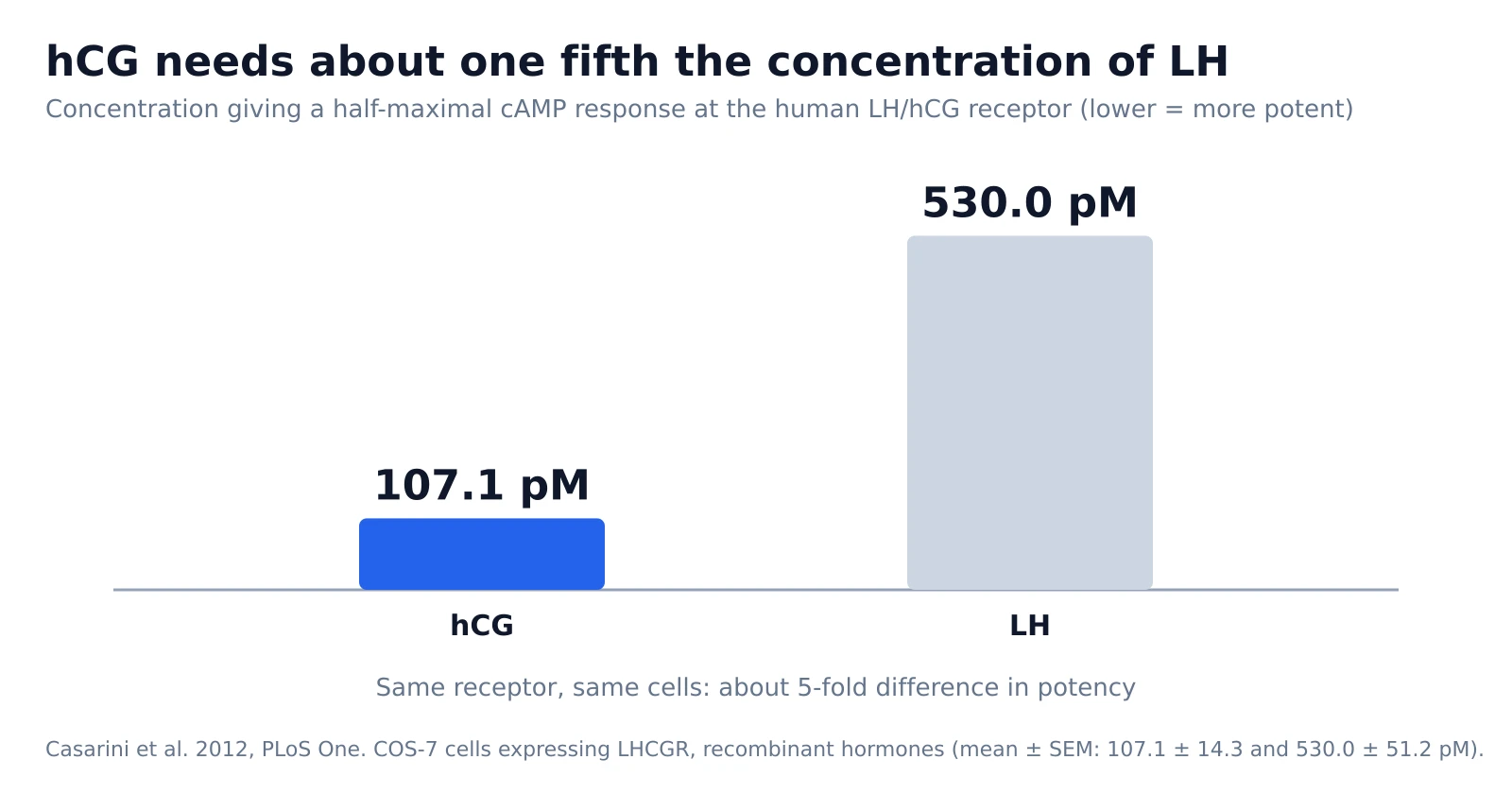
hCG reached its half-maximal cAMP response at about one fifth the concentration of LH in the same cells.
Figure 2. Time to maximal cAMP effect.
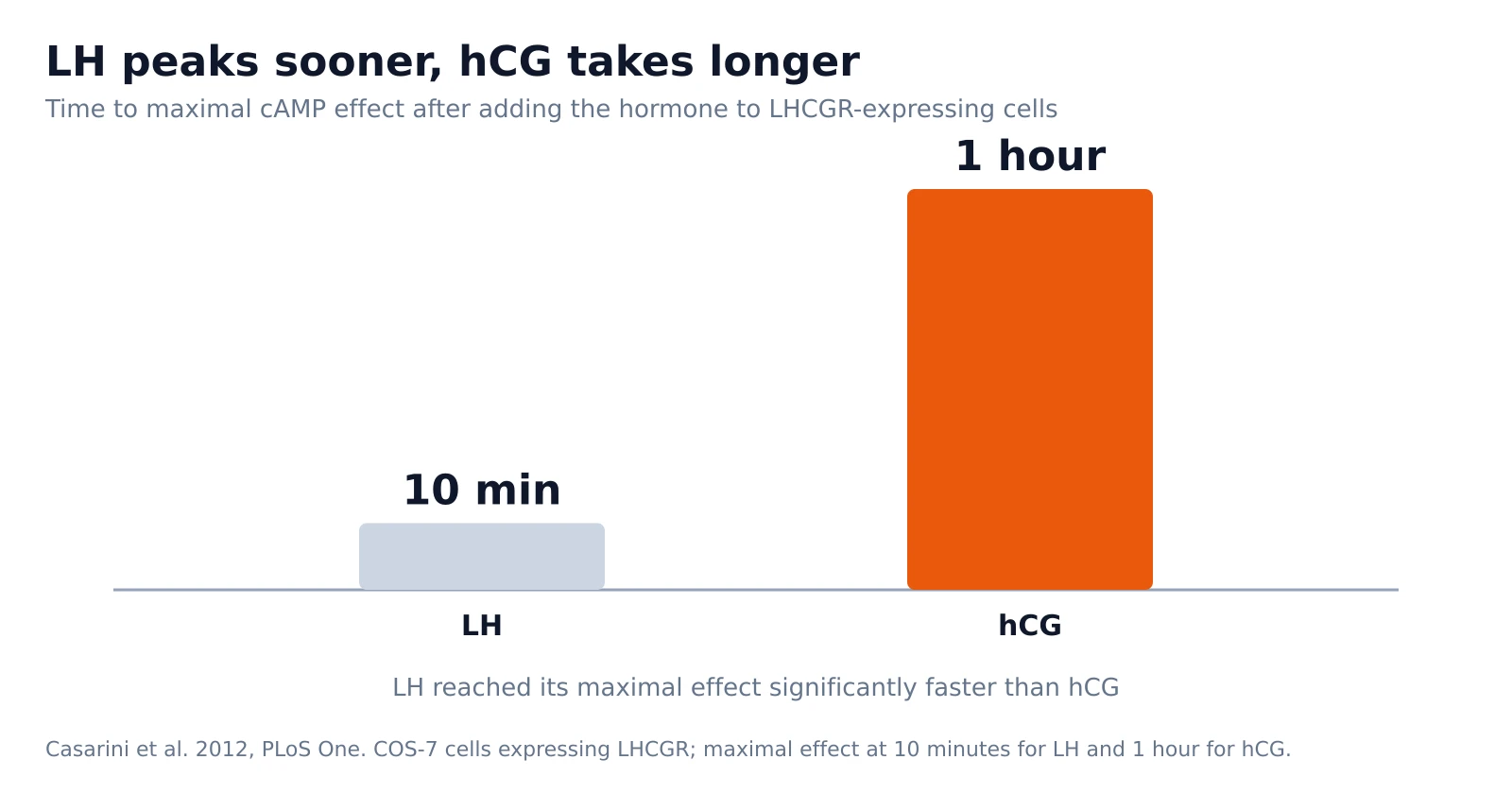
LH reached its maximal effect in 10 minutes; hCG took about 1 hour.
The pattern differs between signalling branches. In primary granulosa cells exposed to equipotent amounts for up to 36 hours, cAMP output was higher with hCG, while ERK1/2 and AKT activation was more potent and sustained with LH. The authors concluded that the receptor can tell the two hormones apart (Casarini 2012).
The picture changes by cell type. In primary mouse Leydig cells, hCG was about 10-fold more potent than LH for cAMP and slightly more potent for ERK1/2 phosphorylation, yet there were no significant differences between the hormones for Creb phosphorylation, Stard1 gene expression or testosterone synthesis (Riccetti 2017).
Figure 3. hCG compared with LH for cAMP potency.
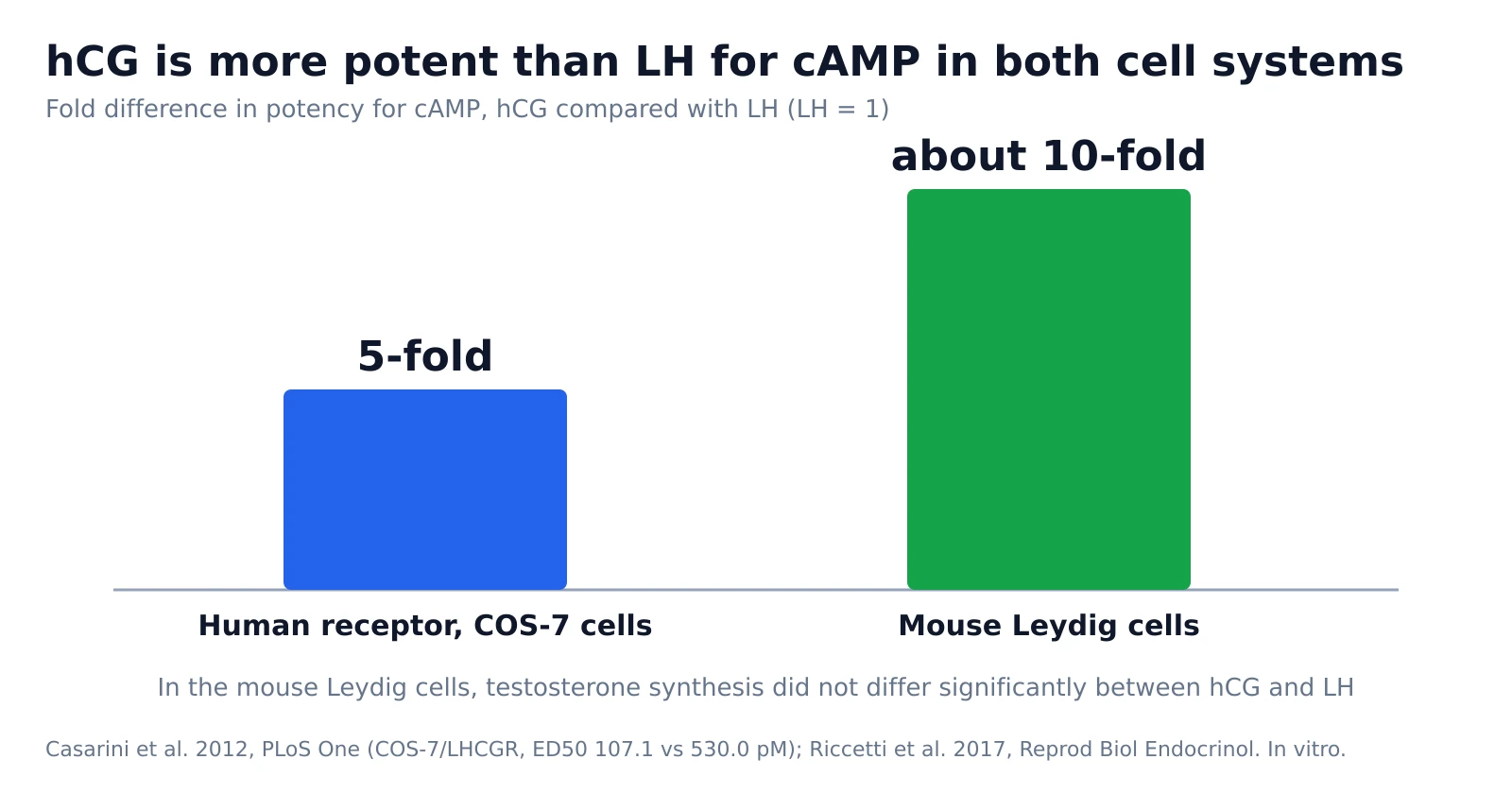
hCG was more potent than LH for cAMP in both systems, but in mouse Leydig cells testosterone synthesis did not differ between them.
HCG is in stock for laboratory research, with a batch COA from independent labs.
What is HCG made of?
Two chains that fold the same way and are held together by a protein “seat belt”.
The 1994 crystal structure showed that each subunit has a similar topology, with three disulphide bonds forming a cystine knot, a fold also found in some protein growth factors. The heterodimer is stabilised by a segment of the beta subunit that wraps around the alpha subunit and is covalently linked, like a seat belt, by the Cys 26 to Cys 110 disulphide. The authors reported that this feature appears essential both for association of the two subunits and for receptor binding (Lapthorn 1994).
Intact hCG, its free subunits and degraded forms all occur in biological fluids, and measuring them has been hampered by a lack of appropriate standards and by concentrations expressed in units that are not comparable. A uniform nomenclature and new standards were established to address this (Stenman 2006).
What is HCG used to study in animal models?
It is used to trigger ovulation in mouse protocols and, through its receptor, to study how gonadotropin signalling shapes the gonads and other tissues.
The clearest animal data come from mice with the LH/hCG receptor removed or hCG overproduced. Removing the receptor produced infertility in both sexes, and chronic hCG exposure changed bone in females.
Mouse model | What changed | Source |
|---|---|---|
LH/hCG receptor knockout (both sexes) | Infertile; gonads had no receptor mRNA or protein; serum LH greatly elevated; genitalia and gonads grossly underdeveloped | |
Receptor knockout, males | Testosterone dramatically decreased; fewer and smaller Leydig cells; spermatogenic arrest beyond the round spermatid stage | |
Receptor knockout, bone | Males had lower bone mineral density after 5 months; 9- to 10-week-old females had lower bone histomorphometry values | |
Transgenic hCG-overexpressing | Significant increases in bone mineral density and histomorphometric indices in females, not males |
What happened to the animals, from the two knockout and transgenic studies cited above.
Mouse superovulation is the other major use. In a comparison of six commonly used strains, the response to the equine gonadotropin and hCG combination depended on strain, mouse weight and hormone timing. The weight range that produced the maximal number of oocytes ran from 6.0 to 9.9 g for B6D2F1/Hsd mice to 23.5 g or more for Crl:CD1(ICR) mice (Luo 2011). A 2026 review describes the receptor knockout mouse as an instrument that has since been used alone or combined with other genetically modified models to refine understanding of LH and hCG function (Huhtaniemi 2026).
HCG at a glance
Compound: Human chorionic gonadotropin (hCG), a glycoprotein hormone
Receptor: LH/hCG receptor (LHCGR), shared with LH
Structure: Alpha and beta subunits joined non-covalently; each subunit has a cystine knot fold
Strength at NextGenPeps: 5,000 IU per vial, lyophilised powder
Measured in: International Units (biological activity), not by mass
Buying HCG for research
Documented identity and purity. Every lot has a published COA covering identity and purity from independent labs.
US-based fulfilment. Orders ship within 24 hours from the United States, with free US shipping on orders over $150.
Research use only. Supplied strictly for in vitro and approved animal research.
Shop HCG for laboratory research.
What is not established about HCG
Transfer between cell types. The Leydig cell result differed from the granulosa cell result, so findings in one cell system should not be assumed in another (Casarini 2012; Riccetti 2017).
Equivalence with LH. The two hormones share a receptor but differ in speed, potency and signalling branch, so results with one do not automatically apply to the other.
What the knockout and transgenic studies isolate. They reflect loss of the receptor or lifelong hCG overexpression, not a single exposure. The authors of the bone study concluded that gonadotropin effects on the skeleton appear indirect (Yarram 2003).
Unit comparability. hCG forms and units are not always directly comparable across assays and reference standards (Stenman 2006), so quantitative work should state its assay and reference.
References
Study | Model | Finding | Source |
|---|---|---|---|
Lapthorn 1994 | Crystal structure | Cystine knot in both subunits; beta-subunit seat belt (Cys 26 to Cys 110) | |
Stenman 2006 | Review | hCG forms, standards and units; stimulates luteal progesterone | |
Cole 2009 | Review | Regular hCG, hyperglycosylated hCG and free beta subunit | |
Casarini 2012 | COS-7 and granulosa cells | hCG 5-fold more potent for cAMP (107.1 vs 530.0 pM); LH peaks faster | |
Riccetti 2017 | Primary mouse Leydig cells | hCG about 10-fold more potent for cAMP; equal testosterone synthesis | |
Duan 2021 | Cryo-EM structures | Push-and-pull activation; P10 tethered agonist | |
Luo 2011 | Six mouse strains | Superovulation response depends on strain, weight and timing | |
Lei 2001 | LH/hCG receptor knockout mice | Infertility in both sexes; testosterone dramatically decreased in males | |
Yarram 2003 | Knockout and hCG-overexpressing mice | Bone density and histomorphometry changes | |
Huhtaniemi 2026 | Review | Lessons from the LH receptor knockout mouse |
Research Use Only. All compounds discussed are supplied by NextGenPeps strictly for laboratory research use and are not intended for human or veterinary use. Studies described here are reported for scientific context and are not guidance of any kind.
Mentioned in this article
Shop all compoundsWritten by NextGenPeps Research Team
The NextGenPeps Research Team summarizes published laboratory and animal research on the compounds NextGenPeps supplies for research use only.
More articles →Research Use Only: this article describes laboratory research. Nothing here is dosing guidance, and these materials are not intended for human use.