Tesamorelin vs Sermorelin: Structure, Animal Data and Trial Evidence Compared
Tesamorelin and sermorelin are both GHRH-based peptides, but they differ in length, structure and evidence base. This comparison reviews published animal, pharmacokinetic and clinical trial data for laboratory research context.
8 min readBy NextGenPeps Research Team
On this page8 sections
Tesamorelin vs sermorelin, in brief. Tesamorelin and sermorelin are both synthetic analogs of growth hormone-releasing hormone, but they are not interchangeable research tools. Tesamorelin is a 44-amino-acid peptide with a trans-3-hexenoyl group on tyrosine 1, while sermorelin is the 29-amino-acid fragment GHRH(1-29)-NH2. In animal work, GRF(1-29) raised GH release in rats and increased milk yield in dairy cows over 10 days. Tesamorelin has two 26-week phase 3 trials (n=412 and n=404) reporting visceral fat changes of -15.2% and -10.9%, against +5.0% and -0.6% for placebo. One small pharmacokinetic study reported a 4.3 minute disappearance half-time for GHRH(1-29)-NH2, while tesamorelin showed a 21 to 45 minute elimination half-life in dogs, so the two figures come from different species and methods. The better fit depends on whether a study needs a stabilized long-chain analog or the shorter native fragment. NextGenPeps supplies tesamorelin and sermorelin for laboratory research use only.
Tesamorelin vs sermorelin at a glance
Tesamorelin is the longer, chemically modified analog with a large phase 3 trial record, while sermorelin is the shorter 29-residue fragment with a mostly animal and pharmacokinetic literature.
Feature | Tesamorelin | Sermorelin |
|---|---|---|
Sequence | hGRF(1-44)NH2 with a trans-3-hexenoyl group on Tyr1 | GHRH(1-29)-NH2 |
Length | 44 amino acids | 29 amino acids |
Enzyme stability | Reported as resistant to DPP-IV | Short disappearance half-time in the pharmacokinetic study reviewed |
Reported half-life | 21 to 45 min elimination, dogs | 4.3 min disappearance, small IV study (different species and method) |
Evidence reviewed here | Pigs, rats, dogs; two 26-week phase 3 trials (n=412, n=404) | Rats, dairy cows, one small pharmacokinetic study |
What the animal studies show
The animal literature shows that GRF(1-29), the sermorelin sequence, drives a clear GH response in rats and measurable production changes in dairy cows, and that tesamorelin raises GH and IGF-1 across several species.
Figure 2. GH response to GRF(1-29) in euthyroid and hypothyroid rats.
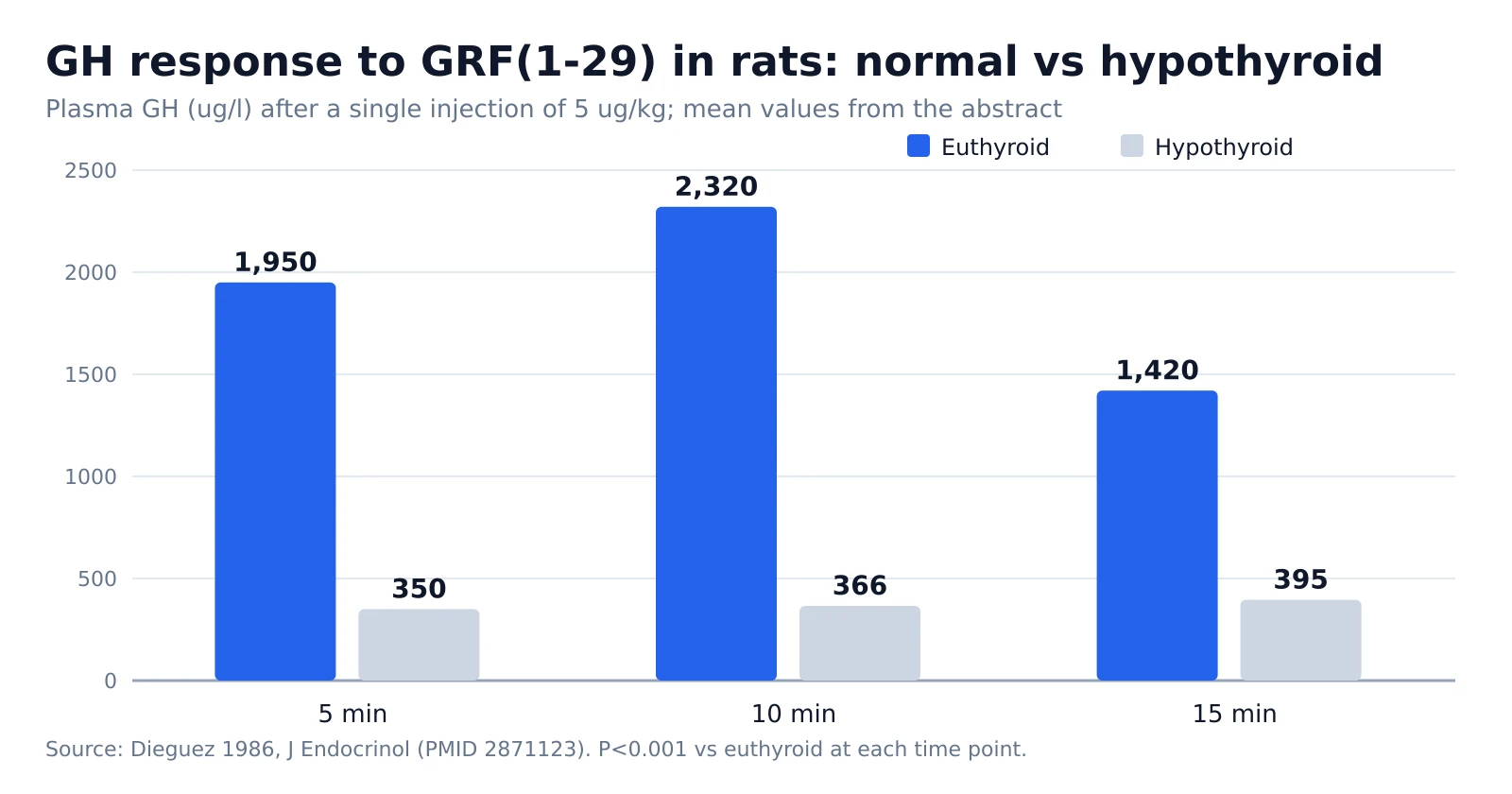
Euthyroid rats reached 1,950, 2,320 and 1,420 µg/l at 5, 10 and 15 minutes, against 350, 366 and 395 µg/l in hypothyroid rats.
Diéguez and colleagues gave GRF(1-29) to rats and found the GH response depended strongly on thyroid status. Clark and Robinson reported earlier that pulsatile intravenous GHRF(1-29)NH2 accelerated growth and raised pituitary GH content in normal female rats and in GHRF-deficient rats, while a continuous infusion at the same daily dose was ineffective. That pulsatile-versus-continuous result is one of the most cited design points in the GHRH literature.
Figure 3. Milk, fat and protein yield in dairy cows after 10 days of GRF(1-29).
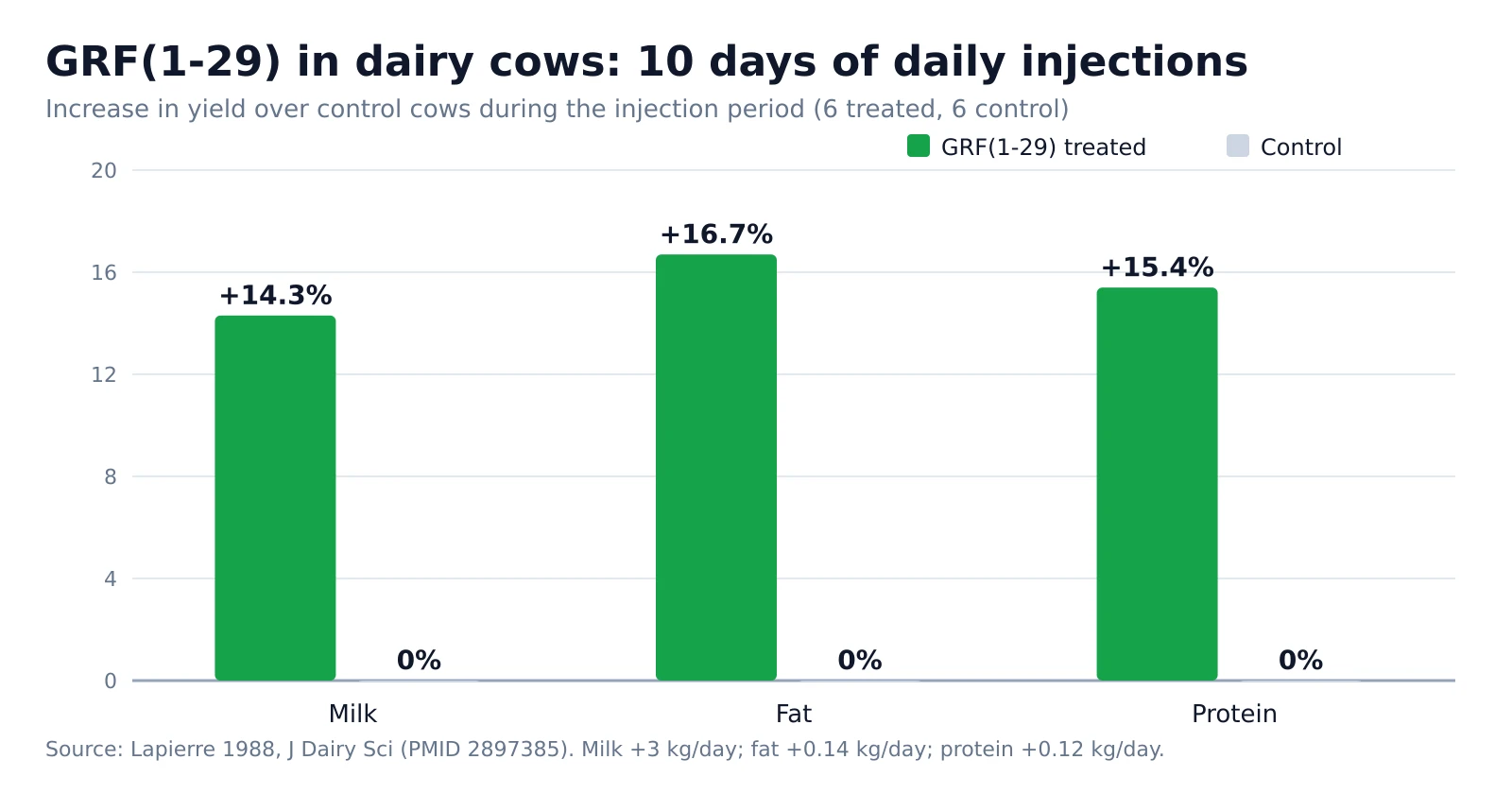
Over 10 days, treated cows (6 treated, 6 control) produced about 3 kg/day more milk, 0.14 kg/day more fat and 0.12 kg/day more protein.
In the dairy cow study, yields stayed higher into the post-treatment period, GH release persisted with no sign of refractoriness, and blood GH did not differ from controls on day 40. For tesamorelin, Ferdinandi and colleagues reported that GH and IGF-1 rose markedly in pigs, rats and dogs, and that dosing for up to 4 months produced a significant increase in weight gain. Dogs showed a more pronounced anabolic effect, along with reversible liver, kidney and anaemia findings that the authors attributed to prolonged GH and IGF-1 exposure.
Comparing GHRH analogs in the lab? Shop Tesamorelin → Shop Sermorelin →
Structure and mechanism
Both peptides are built on the growth hormone-releasing hormone sequence, and the main structural difference is length plus one chemical cap.
Figure 1. Sequence length and modification, tesamorelin vs sermorelin.
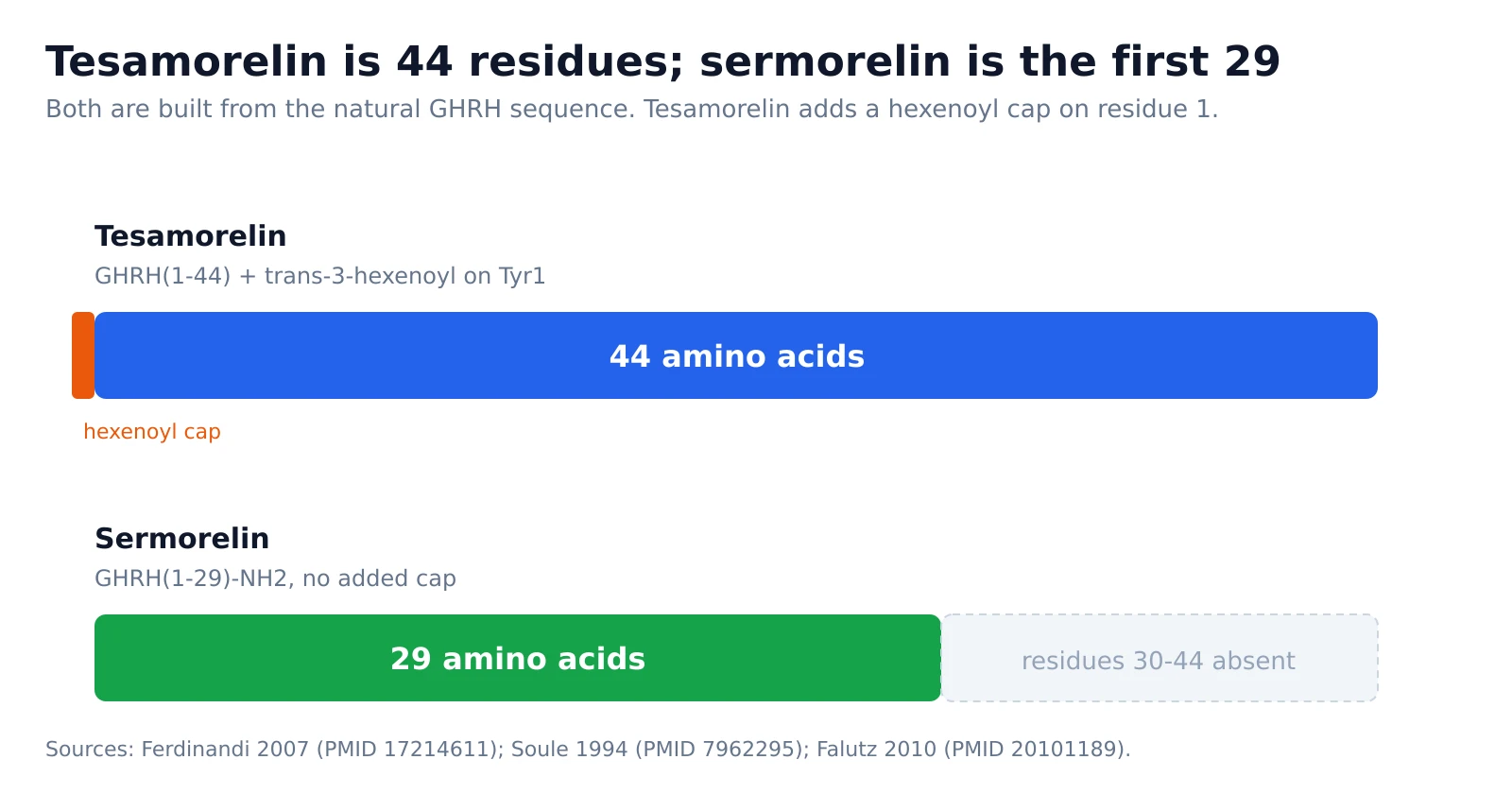
Tesamorelin carries all 44 residues plus a hexenoyl cap, while sermorelin is the first 29 residues with an amidated C-terminus.
Ferdinandi et al. describe tesamorelin as hGRF1-44NH2 with a trans-3-hexenoyl group on Tyr1 that confers resistance to DPP-IV. Sermorelin is GHRH(1-29)-NH2, the shortest fragment that retains full activity in the older literature. In a small intravenous study, Soule and colleagues measured a disappearance half-time of 4.3 ± 1.4 minutes and a metabolic clearance rate of 39.7 mL/kg/min for GHRH(1-29)-NH2, while a D-Ala2 analog showed 6.7 minutes and a clearance of 21. These values describe a different species and method from the dog data on tesamorelin (21 to 45 minutes), so they should not be read as a head-to-head comparison.
The tesamorelin clinical trial record
Tesamorelin has the larger controlled-trial record, with visceral fat as the main endpoint in adults with HIV-associated abdominal fat accumulation.
Figure 4. Visceral adipose tissue change in two 26-week phase 3 trials.
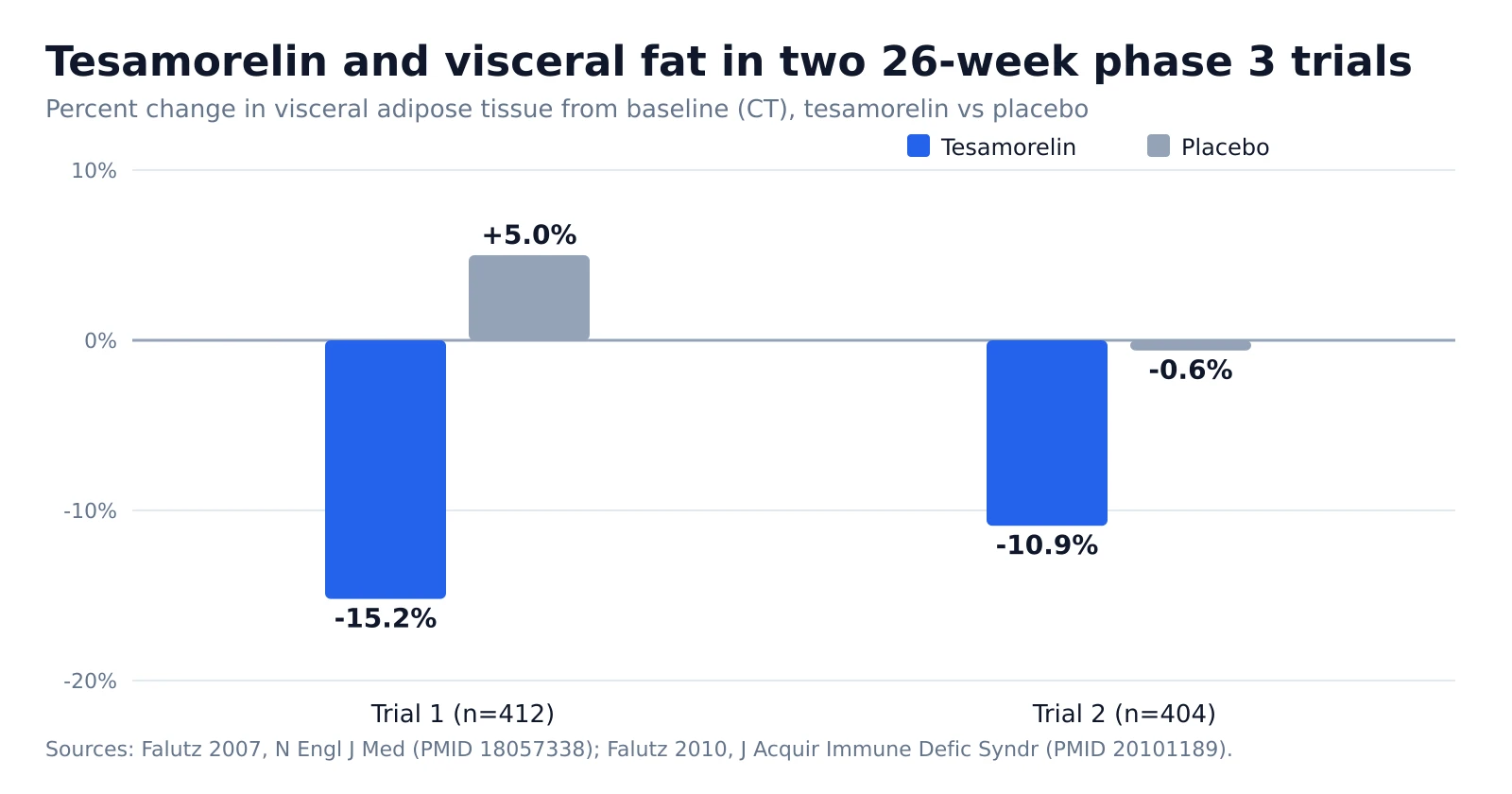
Visceral fat fell 15.2% against a 5.0% rise in the first trial and 10.9% against 0.6% in the second.
In the first 26-week trial (n=412), triglycerides changed by -50 mg/dL versus +9 mg/dL and IGF-1 rose 81.0% versus a 5.0% fall, with no glycemic difference and more withdrawals for adverse events in the tesamorelin arm. The second trial (n=404) found no change in limb or abdominal subcutaneous fat, a reduction of about 18% at 12 months with continued treatment, and a rapid loss of the gains after a switch to placebo. A 12-month trial (n=61) reported hepatic fat fraction down 4.1 percentage points (a 37% relative reduction), with 35% versus 4% reaching a fraction below 5%. A 2011 review noted tesamorelin as the first and only treatment indicated for reducing excess abdominal fat in HIV-associated lipodystrophy at that time. This record is specific to tesamorelin; the sources reviewed here do not report comparable controlled trials for sermorelin.
Which is better for a given study goal?
Neither is better in general; the choice follows the study design.
Replicating published trial endpoints such as visceral fat: tesamorelin, since the controlled data above were generated with it.
Pituitary GH release and pulsatile-versus-continuous designs in rodents: sermorelin (GRF(1-29)), which underlies the Clark and Diéguez work.
Enzyme stability studies: tesamorelin, because of its reported DPP-IV resistance from the hexenoyl cap.
Short-fragment structure-activity work: sermorelin, the minimal 29-residue sequence.
For a three-way view that includes another GHRH analog, see the CJC-1295 vs tesamorelin comparison.
Buying tesamorelin and sermorelin for research
Both are sold for laboratory research use only.
Product pages list identity and purity from independent labs.
Orders ship within 24 hours from the United States, with free US shipping on orders over $150.
Match the compound to the study design above before ordering, since the two peptides differ in length, modification and evidence base.
Ready to compare? Shop Tesamorelin → Shop Sermorelin →
What is not established
No head-to-head study of tesamorelin and sermorelin was found in the sources reviewed here.
Half-life figures come from different species and methods and cannot be compared directly.
The cow and rat results do not establish what the same compounds would do in other species.
Long-term safety is not settled: the dog studies reported reversible findings tied to prolonged GH and IGF-1 exposure, and the trials reported more adverse-event withdrawals on tesamorelin.
Trial gains in visceral fat were lost after treatment stopped, so durability is unresolved.
References
Study | Model | Finding | Source |
|---|---|---|---|
Ferdinandi 2007 | Pigs, rats, dogs | Tesamorelin structure, DPP-IV resistance, GH and IGF-1 rise, dog half-life 21 to 45 min | |
Falutz 2007 | 26-week trial, n=412 | Visceral fat -15.2% vs +5.0%; IGF-1 +81.0% vs -5.0% | |
Falutz 2010 | 26-week trial, n=404 | Visceral fat -10.9% vs -0.6%; about -18% at 12 months; gains lost after switch to placebo | |
Stanley 2019 | 12-month trial, n=61 | Hepatic fat fraction -4.1 points (-37% relative); 35% vs 4% below 5% | |
Dhillon 2011 | Drug review | Reduction maintained to week 52 on continuation; reaccumulation after discontinuation | |
Diéguez 1986 | Rats | GRF(1-29) GH response 1,950 vs 350 µg/l at 5 min, euthyroid vs hypothyroid | |
Clark 1985 | Normal and GHRF-deficient rats | Pulsatile GHRF(1-29)NH2 accelerated growth; continuous infusion at the same daily dose was ineffective | |
Lapierre 1988 | Dairy cows, 6 treated and 6 control | Milk +14.3%, fat +16.7%, protein +15.4% over 10 days | |
Soule 1994 | Small IV pharmacokinetic study, n=10 | GHRH-(1-29)-NH2 half-time 4.3 min; D-Ala2 analog 6.7 min |
Research Use Only. All compounds discussed are supplied by NextGenPeps strictly for laboratory research use and are not intended for human or veterinary use. Studies described here are reported for scientific context and are not guidance of any kind.
Mentioned in this article
Shop all compoundsWritten by NextGenPeps Research Team
The NextGenPeps Research Team summarizes published laboratory and animal research on the compounds NextGenPeps supplies for research use only.
More articles →Research Use Only: this article describes laboratory research. Nothing here is dosing guidance, and these materials are not intended for human use.
Keep reading
- Research
CJC-1295 vs Tesamorelin: Which Is Better, and What Actually Differs
CJC-1295 and tesamorelin switch on the same receptor, but tesamorelin lasts about 30 minutes and has phase 3 data, while CJC-1295 with DAC lasts about a week and was studied mainly in animals. Charts, side-by-side tables and the most-asked questions answered.
9 min read · Nov 2026