CJC-1295 vs Tesamorelin: Which Is Better, and What Actually Differs
CJC-1295 and tesamorelin switch on the same receptor, but tesamorelin lasts about 30 minutes and has phase 3 data, while CJC-1295 with DAC lasts about a week and was studied mainly in animals. Charts, side-by-side tables and the most-asked questions answered.
9 min readBy NextGenPeps Research Team
On this page12 sections
- Is tesamorelin the same as CJC-1295?
- Which one is long-acting?
- What does CJC-1295 do in animal studies?
- What does tesamorelin do in animal studies?
- Does CJC-1295 or tesamorelin reduce visceral fat?
- Which is better, CJC-1295 or tesamorelin?
- Can CJC-1295 and tesamorelin be used together?
- CJC-1295 with DAC vs No DAC: which one is being compared?
- What are CJC-1295 and tesamorelin made of?
- Buying CJC-1295 and tesamorelin for research
- What is not established
- References
CJC-1295 vs tesamorelin, in brief. Both are lab-made versions of growth hormone releasing hormone (GHRH), the signal that tells the pituitary to release growth hormone (GH). They switch on the same receptor, so the end result is the same: more GH, then more IGF-1. What differs is how long the signal lasts and how much research is behind each one. Tesamorelin is active for about 30 minutes and has phase 3 trial data. CJC-1295 with DAC grabs onto a blood protein called albumin and stays active for about a week, but its research stops at animal studies and early pharmacology trials. NextGenPeps supplies tesamorelin and both CJC-1295 forms for laboratory research use only.
Is tesamorelin the same as CJC-1295?
No. They hit the same target, but they are different molecules with different clocks. Tesamorelin is the full 44 amino acid GHRH chain. CJC-1295 is the shorter 29 amino acid piece that does the actual work, tweaked to resist breakdown.
At a glance | Tesamorelin | CJC-1295 with DAC | CJC-1295 No DAC |
|---|---|---|---|
Length | 44 amino acids | 29 amino acids + albumin anchor | 29 amino acids |
Active for | ~30 minutes | ~1 week | Minutes |
GH pattern | Short pulse | Steady rise for days | Short pulse |
IGF-1 effect | +81% at 26 weeks | 1.5-3x for 9-11 days | Little published data |
Animal data | Pigs, rats, dogs: big GH and IGF-1 rise | Dwarf mice grew to normal size | Very little |
Furthest stage | Phase 3, FDA approved | Phase 2, discontinued | No published trials |
Which one is long-acting?
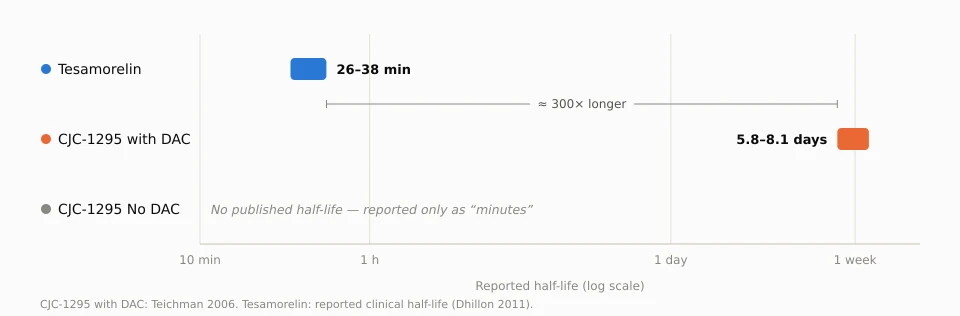
CJC-1295 with DAC, by a wide margin. Its DAC anchor binds albumin, which keeps it in circulation for about a week. Tesamorelin and CJC-1295 No DAC are both cleared within minutes to an hour.
Figure 1. How long each one stays active.
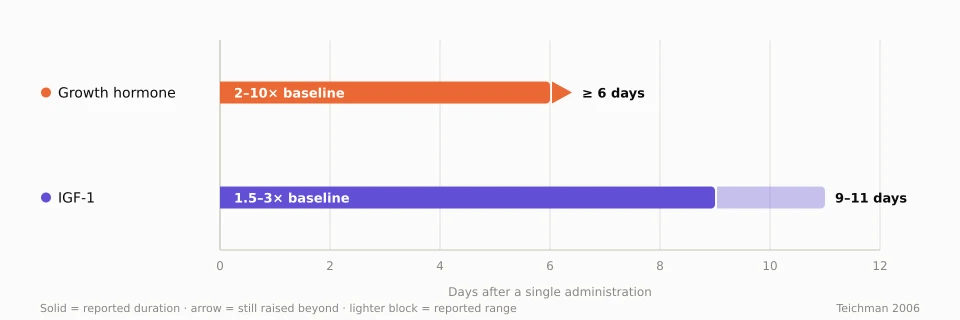
That longer clock shows up directly in GH and IGF-1 levels:
Figure 2. How long GH and IGF-1 stay raised after one administration of CJC-1295 with DAC.
What does CJC-1295 do in animal studies?
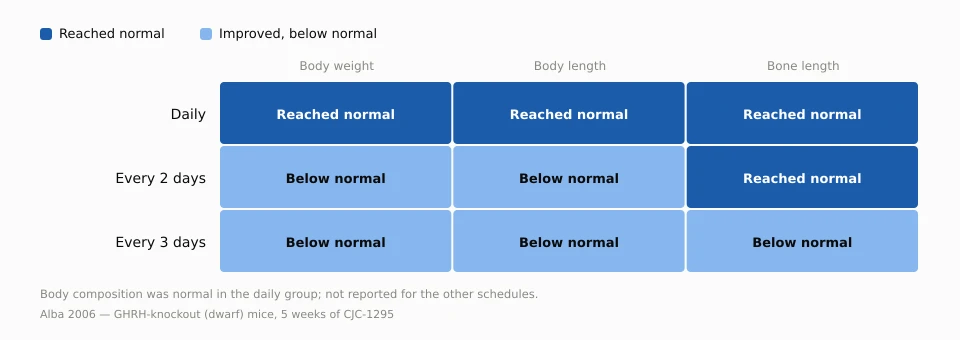
It makes growth-deficient animals grow normally. Mice born without their own GHRH grow up as dwarfs. After 5 weeks of daily CJC-1295, they reached normal body weight, normal body length, normal bone length and normal body composition, the same as healthy littermates.
Animal | What was done | What happened to the animal |
|---|---|---|
Rats | One administration | About 4x more GH released over 2 hours than the unmodified fragment, and the compound was still in the blood 3 days later |
Dwarf mice (no GHRH) | Every day for 5 weeks | Grew to normal weight, length and bone length, with normal body composition |
Dwarf mice (no GHRH) | Every 2 days for 5 weeks | Grew more than untreated mice; bone length reached normal, weight and length did not |
Dwarf mice (no GHRH) | Every 3 days for 5 weeks | Grew more than untreated mice, but stayed below normal |
Figure 3. CJC-1295 in rats.
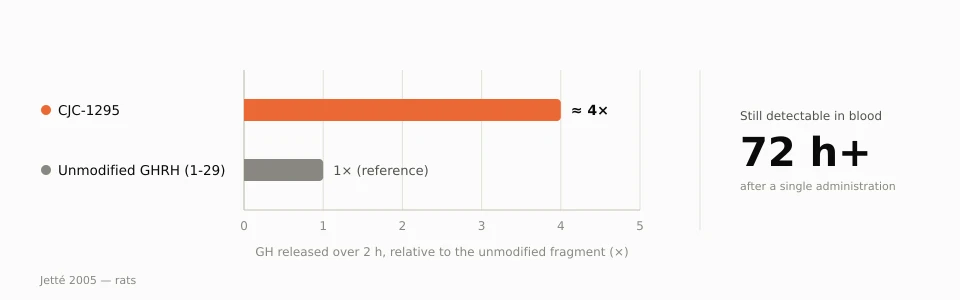
Figure 4. Dwarf mice after 5 weeks of CJC-1295.
What does tesamorelin do in animal studies?
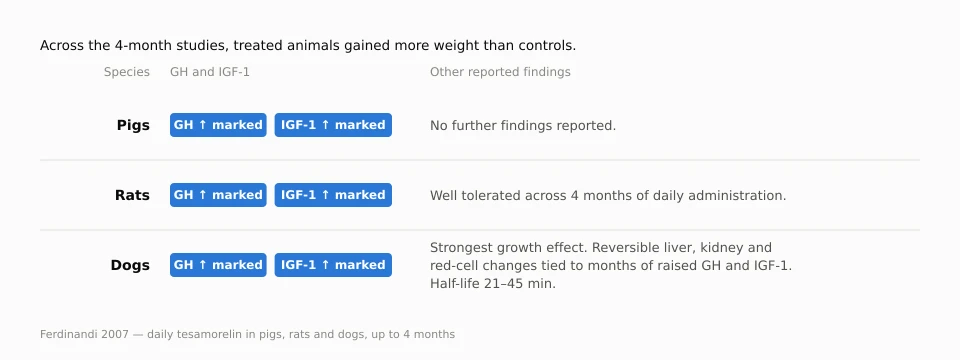
It drives GH and IGF-1 up strongly, and over months that shows up as extra growth and weight gain. Daily tesamorelin was tested in pigs, rats and dogs for up to 4 months.
Animal | What happened to the animal |
|---|---|
Pigs | GH and IGF-1 rose markedly |
Rats | GH and IGF-1 rose markedly; well tolerated over 4 months |
Dogs | Strongest growth effect; reversible liver, kidney and red blood cell changes, which the authors tied to GH and IGF-1 staying high for months |
Figure 5. Tesamorelin in pigs, rats and dogs.
Does CJC-1295 or tesamorelin reduce visceral fat?
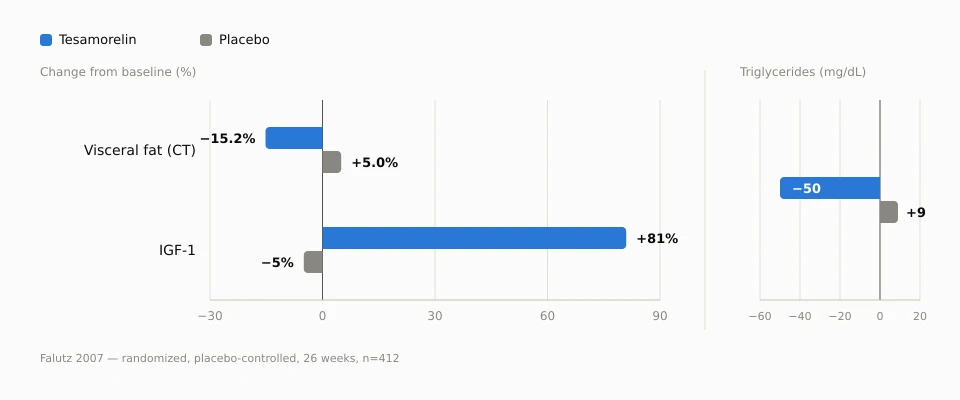
Only tesamorelin has data on it. In its 26-week phase 3 trial, visceral fat fell 15.2% while it rose 5.0% on placebo. No published study has measured fat outcomes for CJC-1295.
Figure 6. Tesamorelin vs placebo after 26 weeks.
All three are in stock for laboratory research, each with a batch COA from independent labs.
Which is better, CJC-1295 or tesamorelin?
Neither is better across the board. The right one depends on what the study needs:
Study goal | Better fit |
|---|---|
Short, pulse-like GH signaling | Tesamorelin or CJC-1295 No DAC |
Continuous GH stimulation over days | CJC-1295 with DAC |
Comparing against published outcome data | Tesamorelin |
Least frequent administration | CJC-1295 with DAC |
Can CJC-1295 and tesamorelin be used together?
No published study has tested them together. Because both act on the same GHRH receptor, combining them does not add a second mechanism. The pairing that does appear in GH research is a GHRH analog with a ghrelin-receptor agonist such as ipamorelin, which works through a different receptor.
CJC-1295 with DAC vs No DAC: which one is being compared?
The name CJC-1295 covers two compounds. With DAC is the albumin-binding form that lasts about a week. No DAC (also called Modified GRF 1-29) is the same peptide without the anchor and lasts minutes. Results for one do not apply to the other, so always check which form a study used.
What are CJC-1295 and tesamorelin made of?
Both are built from the natural GHRH sequence, shown below as it sits bound to its receptor.
Feature | Tesamorelin | CJC-1295 |
|---|---|---|
Based on | Full GHRH (1-44) | GHRH (1-29) |
Key change | Hexenoyl group at the start of the chain, which resists DPP-4 breakdown | 4 amino acid swaps (positions 2, 8, 15, 27); the DAC form adds an albumin-binding lysine |
Molecular weight | ~5,136 g/mol | ~3,648 g/mol (with DAC) |
Molecular figure
Native GHRH (1-44): the template for tesamorelin
Interactive 3D structure loads when in view.
Interactive structure of native human GHRH, all 44 residues, as resolved bound to its receptor (cryo-EM, PDB 7CZ5). Tesamorelin uses this full sequence with an added trans-3-hexenoyl group at the N-terminus. This is the native hormone, not tesamorelin itself; no experimental structure of tesamorelin is published.
Molecular figure
GHRH (1-29): the fragment CJC-1295 is built on
Interactive 3D structure loads when in view.
The first 29 residues of native GHRH, shown from the same receptor-bound structure (cryo-EM, PDB 7CZ5). This fragment carries full receptor activity and is the backbone CJC-1295 modifies with four amino acid substitutions and, in the DAC form, an albumin-binding group. This is the native fragment, not CJC-1295 itself.
Buying CJC-1295 and tesamorelin for research
Independent lab testing. Every batch ships with a COA covering identity and purity from independent labs.
Both CJC-1295 forms. With DAC and No DAC are listed separately, so studies get the exact compound they specify.
Research use only. Supplied strictly for in vitro and approved animal research.
Shop the compounds in this comparison.
What is not established
Head-to-head data. No study has compared CJC-1295 and tesamorelin directly.
CJC-1295 outcomes. There is no published fat or body composition data for CJC-1295.
Combination. No published data exists on using the two together.
CJC-1295 No DAC. Very little published research exists on this form specifically.
Long-term CJC-1295 data. Development stopped at phase 2 after a trial death that the attending physician reportedly linked to pre-existing heart disease, not the compound.
References
Study | Model | Finding | Source |
|---|---|---|---|
Falutz 2007 | Phase 3, 26 weeks, n=412 | Tesamorelin: visceral fat -15.2% vs +5.0% placebo; IGF-1 +81% | |
Falutz 2010 | Pooled phase 3 analysis | Two phase 3 trials pooled; results held up | |
Ferdinandi 2007 | Pigs, rats, dogs | Tesamorelin markedly raised GH and IGF-1; extra weight gain over 4 months | |
Jetté 2005 | Rats | About 4x GH exposure vs unmodified fragment; in blood 72+ hours | |
Alba 2006 | GHRH knockout (dwarf) mice | Daily CJC-1295 restored normal weight, length, bone length and body composition | |
Teichman 2006 | Pharmacokinetics | GH 2-10x for 6+ days; IGF-1 1.5-3x for 9-11 days; half-life 5.8-8.1 days | |
Ionescu 2006 | Pharmacodynamics | GH pulses preserved during continuous stimulation | |
Dhillon 2011 | Review | Overview of the tesamorelin clinical program |
Research Use Only. All compounds discussed are supplied by NextGenPeps strictly for laboratory research use and are not intended for human or veterinary use. Studies described here are reported for scientific context and are not guidance of any kind.
Mentioned in this article
Shop all compoundsWritten by NextGenPeps Research Team
The NextGenPeps Research Team summarizes published laboratory and animal research on the compounds NextGenPeps supplies for research use only.
More articles →Research Use Only: this article describes laboratory research. Nothing here is dosing guidance, and these materials are not intended for human use.